
Can a $100 kit fix your foundation crack? Sometimes — and we’ll tell you exactly when, and when it makes things worse.
DIY crack injection kits can work on narrow, dry, non-structural cracks in accessible poured-concrete walls — if surface prep is done meticulously. They routinely fail on leaking, wet, wide, or structural cracks, where low-pressure kits achieve only partial-depth fills. The failed kit then makes professional re-injection harder, because cured DIY resin blocks the crack.
A typical retail kit at GTA big-box stores contains surface ports, epoxy paste for the crack face, and low-pressure cartridges of epoxy or polyurethane. The method mirrors professional injection in miniature — and the differences that matter are pressure, resin volume, resin grade, and the experience to know when conditions are wrong.
That describes a real subset of cracks. If it describes yours, a carefully applied kit is a defensible weekend job — and we’d rather tell you that than pretend otherwise.
The asymmetry to understand: professional injection after a failed kit costs more than professional injection first.
| Situation | What happens with a kit | What it adds to the eventual fix |
|---|---|---|
| Leaking/wet crack | Resin can’t set against flow; partial seal weeps within months | Cured residue must be drilled out → re-injection costs more than injection would have |
| Wide or moving crack | Face-fill bridges the surface; depth stays hollow | Repair looks done, isn’t — often discovered during a storm or a home sale |
| Block/brick wall | Kits can’t address hollow cores | Wrong method entirely; water re-routes |
| Structural crack | No kit restores bond strength | Deferred structural assessment, risk compounds |
| Hidden top or bottom of crack | Unsealed ends leak around the repair | Full-length professional redo |
Full-depth fill under controlled pressure until refusal; commercial-grade resin matched to the crack’s moisture and movement; diagnosis first — including the calls where we say “this isn’t a crack problem” or “this one you could kit yourself”; both happen — and a transferable warranty in writing. One visit, typically one to two hours. See what it costs.
Tape paper over the crack after rain — any moisture within 48 h? Kit’s out.
Width over ~3 mm at the widest point? Assessment first.
Horizontal, stair-stepped, or paired with bowing? Stop — structural assessment, not any injection.
Can’t see the crack floor to top? Neither you nor the kit can seal what’s hidden.
A kit, applied patiently, is a fair bet — bookmark us for the cracks that aren’t.
Send a photo or book a free assessment — we’ll tell you honestly if it’s a DIY case.
The one decision that makes or breaks a crack repair — explained plainly, with a decision table.
Use polyurethane injection when the crack leaks or is wet — it’s a flexible, water-activated foam that permanently seals water paths. Use epoxy injection when the crack is dry and structural — it rigidly bonds the concrete back to full strength. The most common injection failure is epoxy pumped into a wet crack, where it cannot bond.
Epoxy is a structural adhesive. Injected into a crack, it cures rigid and bonds both faces back together — cured injection epoxy is typically stronger than the surrounding concrete. Think of it as welding the wall.
Polyurethane is a reactive foam. It meets water in the crack, expands up to ~20 times its volume, and fills the full depth plus every hairline branch. It cures flexible, so seasonal wall movement doesn’t break the seal. Think of it as permanent, expanding caulking that water itself activates.
| Your crack | Right material | Why |
|---|---|---|
| Actively leaking or damp | Polyurethane | Water activates the cure; epoxy cannot bond to wet concrete |
| Dry, hairline, non-structural | Either — usually polyurethane | Cheaper, faster, seals the future water path |
| Dry, wide (3 mm+), stable | Epoxy | Restores monolithic strength |
| Engineer-specified structural repair | Epoxy | Only epoxy rebonds the wall |
| Crack still moving seasonally | Polyurethane (after assessing cause) | Rigid epoxy re-cracks beside the repair |
| Horizontal crack / bowing wall | Neither alone | That’s a structural failure — assessment first |
Epoxy fails when it’s injected into wet cracks (no bond), into moving cracks (re-cracks alongside), or fed too fast (face-fill that leaves the depth hollow). Most “injection didn’t work” calls we take trace back to one of these three.
Polyurethane fails when it’s asked to do a structural job (it seals, it doesn’t bond), when a cheap single-component product shrinks in a crack that later fully dries, or when the real problem was never the crack — cove-joint or window-well water that injection was never going to stop. Those cases start at basement leak repair.
Almost every page comparing these two materials is written from opinion. There is a published document, and it is worth quoting.
ACI RAP Bulletin 1, Structural Crack Repair by Epoxy Injection, is the American Concrete Institute’s field guide to the method. It is short, it is free, and it sets three limits that decide most of these arguments:
RAP-1 also states plainly that the cause of the damage must be assessed and corrected before injection, and describes the procedure itself — surface ports at roughly 200 mm (8 in.) on centre, injecting from the widest point on a horizontal crack or from the bottom upward on a vertical one, continuing until the crack refuses to take more resin.
For epoxy injection specifically, ICRI also publishes Guide Specification 110.2. Neither ACI nor ICRI publishes an equivalent endorsement of polyurethane injection for foundation leak sealing — polyurethane is standard field practice with a sound engineering rationale, not a cited standard, and anyone telling you otherwise is overselling.
In practice the choice is rarely close. It comes down to these, in this order.
If water is moving through the crack, polyurethane. It cures because water is present. Standard epoxy needs a dry, clean substrate, and injecting it into a running crack is the single most common reason a repair fails within a year.
If the crack is structural — the wall needs the two faces bonded back together — that is epoxy’s job and polyurethane cannot do it. Cured epoxy is stronger than the concrete either side of it. Flexible foam is not a structural adhesive and should never be sold as one.
Seasonal movement rules out a rigid bond. A crack that opens in winter and closes in summer will break an epoxy repair. Polyurethane flexes with it.
Answer those three honestly and the material picks itself. The uncomfortable case is a crack that is both wet and structural — that is a staged repair: polyurethane first to stop the water, structural work once conditions allow. It is uncommon in houses, and it is not a reason to inject the wrong thing once and hope.
Polyurethane is typically the more economical repair for the same crack; epoxy carries a material and labour premium. Current per-crack ranges are published on our crack injection cost page.
If your crack leaks, the debate is over — polyurethane. If your crack is dry and an inspection says the wall’s strength matters, epoxy. If anyone quotes you epoxy for a crack that’s visibly wet, ask them one question: how will it bond? — and then call someone who checks moisture before choosing a material. Ours is checked at a free assessment.
Moisture checked, method matched, quote in writing — free.
From the Concrete Crack Repair Pros blog — plain answers from the crews who fix this every day.
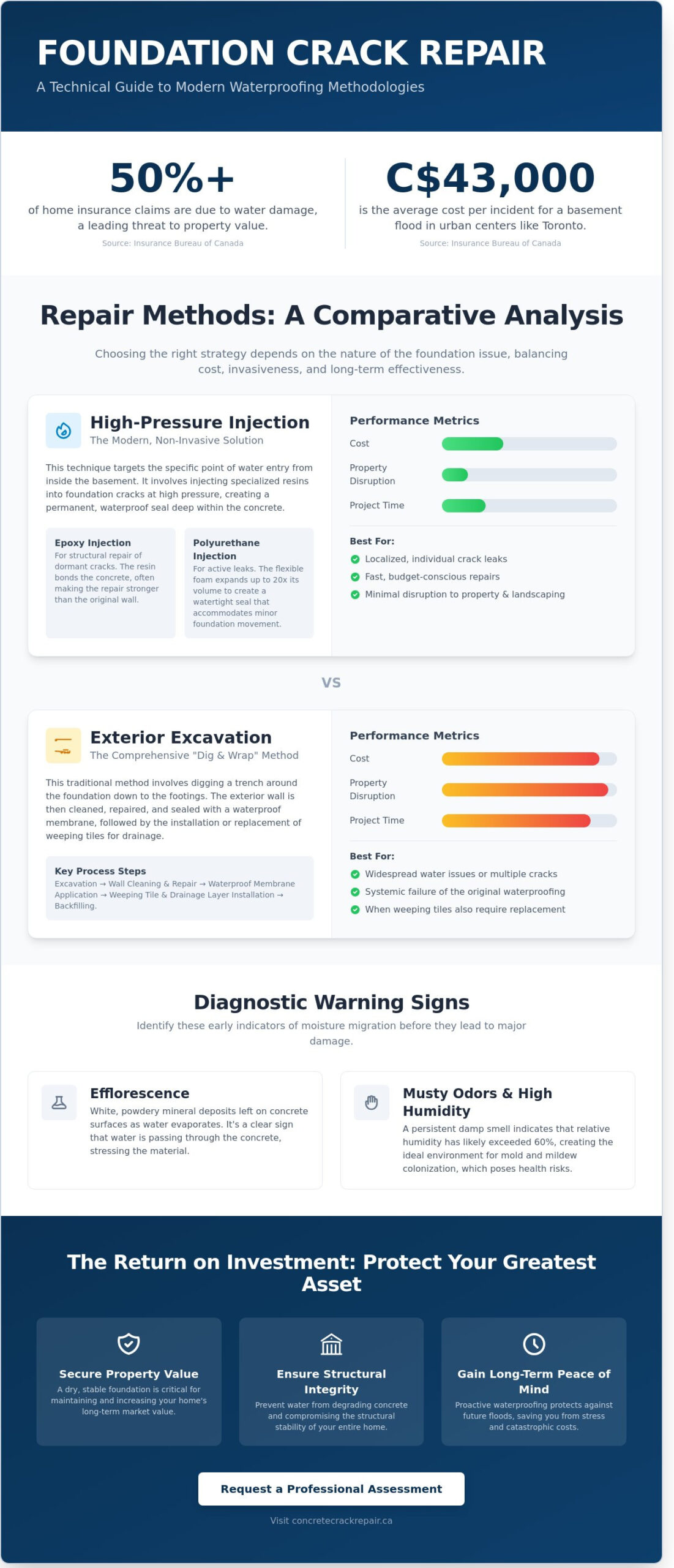
According to the Insurance Bureau of Canada, water damage accounts for over 50% of home insurance claims, with average basement flood costs in urban centers like Toronto reaching C$43,000 per incident. A home represents the biggest investment a person makes in their life, yet it remains vulnerable to the acute pressures of the Ontario water table. Maintaining the structural integrity of a foundation requires a conscious approach to basement waterproofing to prevent mold growth and foundation degradation. Most homeowners recognize that a damp basement doesn’t just cause a mess; it’s a precursor to significant financial loss and potential health risks.
This 2026 guide delivers a comprehensive technical analysis of modern methodologies to secure long-term property value and provide peace of mind during the spring thaw. Readers will gain an unparalleled understanding of advanced exterior drainage, interior hydrostatic pressure management, and the latest membrane technologies used across the GTA. It explores the transition from simple repairs to durable foundation renovations that ensure a dry, structurally sound environment for decades.
Basement waterproofing is a sophisticated, multi-layered engineering system designed to mitigate water ingress and manage hydrostatic pressure. It serves as the primary defense for a residential foundation, protecting the most significant financial investment a person makes in a lifetime. Effective systems don’t just block water; they redirect it away from the structure to maintain long-term stability. This technical approach is essential in the Greater Toronto Area, where environmental conditions place extreme stress on concrete structures.
Southern Ontario soil composition is predominantly clay-heavy, particularly in regions like Vaughan and Brampton. This creates a “clay bowl” effect where the backfilled soil around a foundation remains saturated because the surrounding undisturbed clay prevents natural drainage. This trapped water exerts relentless force against the walls. The 2026 Ontario climate cycle is projected to include 15 to 20 distinct freeze-thaw events. These rapid temperature fluctuations cause concrete to expand and contract, which triggers structural hairline fractures and compromises the building’s envelope.
Groundwater exerts hydrostatic pressure against foundation walls during heavy precipitation or snowmelt. This pressure can reach 60 pounds per square foot for every foot of depth, forcing moisture through microscopic pores in the concrete. Poor surface drainage, often caused by improper grading or clogged gutters, increases localized water pressure significantly. When these forces exceed the structural capacity of the wall, the result is an acute basement leak repair Toronto homeowners must address to prevent total foundation failure. Professional basement waterproofing strategies are required to neutralize these forces and ensure a dry environment.
Efflorescence is a primary indicator of moisture migration, appearing as white, powdery mineral deposits on concrete surfaces. It occurs when water evaporates and leaves behind salt crystals, signaling that the concrete is porous and under stress. This process is technically distinct from The Mechanics of Damp Proofing, which typically addresses capillary action rather than bulk water pressure. Homeowners should also monitor for musty odors, which indicate that relative humidity has likely exceeded the 60% threshold required for mold colonization. Distinguishing between simple condensation and active foundation seepage is a critical first step in a conscious foundation renovation plan. Request a professional assessment to determine the structural integrity of the property today.
Selecting the correct strategy for basement waterproofing depends on whether the issue is localized structural failure or systemic hydrostatic pressure. High-pressure crack injection concrete techniques represent the modern standard for non-invasive repair. These methods address the specific point of entry without the logistical burden of heavy machinery. Traditional exterior excavation, often called the “dig and wrap” method, remains a comprehensive but costly alternative that requires significant property disruption. Concrete Crack Repair experts act as the reliable guardian of the property’s structural integrity, ensuring that the chosen method aligns with the home’s long-term health.
Epoxy injections restore structural integrity by welding concrete cracks with high-tensile strength resins. These resins often exceed the strength of the original concrete, making them ideal for dormant cracks where no further movement is expected. Polyurethane injections utilize flexible, expanding foam to create a permanent water-tight seal in active leaks. The foam expands up to 20 times its initial volume; this ensures every void within the foundation wall is filled. Technicians select the material based on crack width and environmental conditions, often choosing polyurethane for its ability to handle minor thermal expansion and contraction.
Exterior waterproofing involves excavating down to the footing to install new drainage tiles and waterproof membranes. While effective, this process often costs between C$9,000 and C$30,000 depending on the perimeter length. It involves significant landscape disruption, often requiring the removal of decks, walkways, or established gardens. For many GTA homeowners, the University of Minnesota’s guide to basement moisture highlights that managing external water via grading is a critical first step. Interior drainage systems serve as a secondary defense. They manage water that has already bypassed the foundation wall through a sub-floor perimeter pipe and sump pump system.
Targeted basement crack repair provides the most efficient solution for localized leaks. It typically finishes in a single day without disturbing the home’s exterior or landscaping.
| Metric | High-Pressure Injection | Exterior Waterproofing | Interior Drainage |
|---|---|---|---|
| Average Cost (CAD) | C$400 – C$1,200 per crack | C$150 – C$350 per linear foot | C$2,500 – C$6,000+ |
| Duration of Work | 2 – 4 Hours | 3 – 7 Days | 2 – 4 Days |
| Landscape Impact | Zero / Internal only | Severe / Total excavation | Minimal / Internal floor work |
| Structural Reinforcement | High (Epoxy) | Low (Membrane only) | None |
A conscious approach to foundation maintenance preserves the home’s value as the biggest investment in a person’s life. Homeowners facing active leaks can request a professional assessment to determine if a targeted injection or a broader system is required. This disciplined evaluation ensures that the solution is both durable and financially responsible.
A home represents the most significant investment made in a lifetime. Maintaining its structural health through professional basement waterproofing isn’t just a maintenance task; it’s a strategic financial move. In the competitive Toronto real estate market, a dry basement can increase property valuation by 3% to 5% according to regional market trends. Buyers in the GTA prioritize foundation integrity over cosmetic upgrades, as structural issues often lead to acute financing complications or insurance premium hikes.
Long-term cost-benefit analysis favors professional solutions over temporary DIY sealants. While a store-bought sealant might cost under C$100, its failure rate is high under the intense hydrostatic pressure of Ontario’s freeze-thaw cycles. Professional crack injection concrete services provide a permanent, durable bond that prevents the need for repetitive, ineffective patches. Investing in Concrete Crack Repair Pros ensures a conscious approach to workmanship that preserves the home’s equity through unparalleled technical mastery.
Mitigating secondary financial losses is a primary driver for immediate repair. Mold remediation for a standard basement can cost between C$1,500 and C$4,000, while structural underpinning necessitated by long-term water erosion can exceed C$30,000. Addressing a basement leak repair in Toronto early prevents these compounding expenses. A dry foundation serves as a protective barrier for the entire asset’s financial health, providing the peace of mind that a person’s largest investment is secure.
Foundation depth and accessibility significantly impact costs in older Toronto neighborhoods like Cabbagetown or The Beaches compared to newer developments in Mississauga. The complexity of the crack network and the volume of injection material required also dictate the final quote. Every comprehensive solution must adhere to the Ontario Building Code and municipal permit requirements. These regulations ensure the durability of the foundation renovation and protect the homeowner from future liability.
Project durations vary based on the severity of the intrusion and the chosen methodology. A single-day injection project focuses on localized fixes, whereas a multi-week exterior excavation addresses the entire perimeter to ensure unparalleled durability.
| Repair Scale | Typical Duration | Primary Objective |
|:— |:— |:— |
| Interior Crack Injection | 3 – 5 Hours | Localized seepage arrest |
| Interior Drainage System | 2 – 4 Days | Hydrostatic pressure relief |
| Full Exterior Excavation | 1 – 3 Weeks | Comprehensive structural barrier |
The repair process follows a disciplined, logical sequence. It begins with an initial site assessment using moisture readings and visual inspections. Site preparation involves clearing obstacles to ensure accessibility for the technical team. The implementation phase includes the actual basement waterproofing application, followed by final structural testing to confirm the seal’s integrity. This purposeful cadence moves the property from a state of vulnerability to a state of long-term stability.
A home represents the biggest investment most individuals make in their lives. Protecting this asset requires a conscious approach to exterior water management. In Southern Ontario, the intense freeze-thaw cycle exerts immense hydrostatic pressure on foundation walls. Effective basement waterproofing relies on a multi-layered defense strategy that begins with controlling surface runoff before it reaches the concrete envelope. Property owners should utilize professional basement leak repair Toronto expertise to evaluate if current drainage systems meet the demands of intensified 2026 weather patterns.
Surface water accounts for approximately 60% of foundation moisture issues. Managing this volume requires precise engineering of the landscape and gutter systems. Downspouts must discharge at least six feet away from the foundation perimeter to prevent localized soil saturation. The soil grading should maintain a positive slope; industry standards recommend a drop of six inches over the first ten feet of distance from the wall. Clogged eavestroughs often lead to overflow. A single 25mm rainfall can deposit over 1,500 litres of water directly against the foundation if gutters aren’t clear. This volume of water significantly increases the risk of structural compromise and acute leakage.
The weeping tile system serves as the primary subterranean drain for groundwater. Signs of failure include persistent dampness at the base of basement walls or the appearance of efflorescence, which is a white, powdery mineral deposit. A functioning sump pump acts as the heart of this drainage ecosystem. It’s vital to test backup battery systems regularly. Industry data indicates that 25% of primary pumps fail during peak storm events due to mechanical breakdown or power interruptions. In flood-prone GTA zones, the installation of a backwater valve is a technical necessity. These devices prevent municipal sewer surcharges from entering the home during heavy precipitation. Regular seasonal inspections before the spring thaw allow for the identification of new fractures while they remain manageable. This proactive stance ensures basement waterproofing systems remain durable and effective for the long term.
Expert selection across the Golden Horseshoe requires a discerning eye for specialized technical mastery. Homeowners in Mississauga, Oakville, Oshawa, and Barrie face diverse hydrostatic pressures that demand more than a general contractor’s superficial fix. A structural concrete expert focuses on the science of the foundation. General renovators often lack the specialized equipment for high-pressure injection or deep-site excavation. Choosing a “Reliable Guardian” means partnering with a professional who treats the residence as the most significant investment made in a lifetime. This conscious approach ensures that foundation crack repair acts as a permanent structural restoration. Concrete Crack Repair Pros provide unparalleled security through disciplined engineering and durable results.
Soil composition varies significantly across Southern Ontario. Burlington and Hamilton sit on heavy clay deposits and high-water tables that create acute hydrostatic pressure against foundation walls. Historic Toronto neighborhoods often feature double-brick or stone foundations. These require different basement waterproofing techniques than the poured concrete foundations found in newer Vaughan developments. Local experts must navigate the specific municipal drainage regulations of each region to ensure compliance with 2026 Ontario Building Code standards. Knowledge of local topography prevents common failures associated with improper grading or inadequate weeping tile systems.
A professional technical inspection identifies the root cause of moisture ingress rather than just treating symptoms. Technicians utilize moisture meters and thermal imaging to locate hidden anomalies. Success depends on a methodical approach to site preparation and execution. Homeowners should expect a clear roadmap to structural stability.
The repair process concludes with a focus on unparalleled quality. Professionals prioritize the structural integrity of the home above all else. This results-driven cadence moves the project from a state of critical need to one of long-term financial stability. Count on a specialized expert to deliver a dry, secure environment that protects the property’s value for decades. Request a professional assessment to secure the home against the increasing volatility of Ontario weather patterns.
Maintaining a dry foundation is a critical requirement for every homeowner. Professional basement waterproofing represents the most effective strategy for preserving the most significant investment an individual makes. High-pressure injection technology now provides a permanent structural seal that surpasses the limitations of traditional excavation methods. It’s a conscious choice that prioritizes long-term moisture prevention over temporary fixes. Industry data suggests that proactive foundation renovation significantly enhances a property’s market value across Toronto, Vaughan, and Oakville. Expert intervention addresses the acute environmental pressures unique to the Ontario climate. It doesn’t pay to wait for a minor crack to become a major structural failure. Relying on specialized expertise ensures that every repair meets the highest standards of durability and performance. A secure foundation provides the unparalleled peace of mind that every property owner deserves.
Request your professional foundation assessment from the experts at Concrete Crack Repair
Investing in a professional assessment today builds a safer and more resilient home for the future.
Basement waterproofing costs in Toronto for 2026 range from C$70 to C$250 per linear foot depending on the selected method. Internal drainage systems typically average C$70 to C$150 per linear foot, while comprehensive exterior excavation costs between C$100 and C$250 per linear foot. Total project investments for a standard detached home in the GTA often fall between C$10,000 and C$30,000 based on current market labor rates.
A hairline crack is rarely a structural emergency if it measures less than 2mm in width and shows no signs of active leaking. These minor fissures often result from natural concrete shrinkage or minor settling during the home’s initial years. Property owners should monitor these spots for expansion; horizontal cracks or those wider than 3mm indicate significant hydrostatic pressure that threatens the foundation’s stability.
Professional basement waterproofing can be executed during the Ontario winter months through internal drainage installations and pressurized crack injections. While exterior excavation is more labor-intensive when the ground is frozen, interior solutions remain unaffected by sub-zero temperatures. This allows homeowners to address urgent moisture issues immediately without waiting for the spring thaw to protect the home’s structural integrity.
Epoxy injections act as a structural bond to weld crack edges together, whereas polyurethane is a flexible grout designed primarily for water suppression. Technicians select epoxy for dry, non-moving cracks to restore the concrete wall’s original strength. Polyurethane is the superior choice for active leaks because it expands up to 20 times its volume to create a permanent, flexible seal that moves with the foundation.
A professional basement waterproofing repair typically lasts between 25 and 50 years when installed by certified technicians using industrial-grade materials. Exterior membranes often feature manufacturer warranties spanning 20 to 25 years in the harsh Canadian climate. Internal systems, including high-quality sump pumps and drainage tile, provide a lifetime of protection if the mechanical components receive regular maintenance every 12 months.
Professional waterproofing increases the resale value of a GTA home by an average of 3% to 5% while preventing costly price negotiations during the closing process. Data from local real estate markets shows that a dry, transferable warranty on foundation work provides a significant competitive edge. It transforms a basement from a storage liability into a functional living space, which is a critical factor for buyers in Toronto’s high-density market.
Home insurance policies don’t cover the cost of preventative basement waterproofing or damage caused by gradual seepage and maintenance neglect. Coverage is strictly limited to sudden, accidental events like a burst internal pipe or a sewer backup, provided the homeowner has a specific endorsement. Investing in a professional system is a capital improvement that protects the home’s equity rather than an insurable expense.
Visible efflorescence, a white powdery mineral deposit on foundation walls, is a primary indicator that a weeping tile system is failing. Other signs include persistent puddles near the floor-wall joint and a sump pump that cycles constantly during heavy GTA rainstorms. If the basement smells consistently musty or the drywall shows dampness at the base, the exterior drainage system is likely clogged with silt or obstructed by root ingress.
Free assessment · written diagnosis · per-crack quote · transferable lifetime warranty
From the Concrete Crack Repair Pros blog — plain answers from the crews who fix this every day.
Looking for the service itself? Start with our foundation crack repair service for Toronto homeowners — pricing from $750, one-visit repairs, transferable lifetime warranty.
A single hairline fracture in your basement is not just a cosmetic flaw; it is a direct threat to the equity of your home, which remains the biggest investment that we make in our lives. In the Toronto & GTA region, where seasonal freeze-thaw cycles exert immense pressure on masonry, ignoring a small gap can lead to catastrophic basement flooding within a single season. If you have noticed water seepage or shifting walls, you are likely feeling an acute sense of anxiety regarding your property’s structural integrity. You deserve a solution that replaces confusion with the calm confidence of a seasoned expert.
At Concrete Crack Repair Pros, we believe in a conscious approach to foundation crack repair that prioritizes technical mastery over temporary fixes. This guide delivers a comprehensive technical overview of professional-grade injection technologies and diagnostic protocols used to secure residential structures. You will learn how to identify high-risk cracks, understand the mechanics of durable polyurethane and epoxy solutions, and discover the exact steps necessary to protect your home equity. We provide the clarity you need to move from structural concern to total peace of mind.
Your home represents the biggest investment that we make in our lives. Protecting that investment starts with the ground it stands on. In the Greater Toronto Area, foundation crack repair is more than a simple maintenance task; it’s a conscious act of structural restoration. We define this process as the precise injection of specialized resins into concrete voids to restore the integrity of the building envelope. It isn’t enough to apply a surface sealant. A durable solution involves penetrating the entire thickness of the wall to ensure the repair remains stable despite the volatile Ontario seasons.
Establishing a professional baseline for repair in the GTA requires a technical understanding of high-pressure injection systems. Toronto’s climate poses a unique challenge to this integrity. With temperatures swinging from -20°C in January to 30°C in July, concrete undergoes intense cycles of expansion and contraction. Over time, these thermal stresses create fractures that compromise your home’s security. Our conscious methodology prioritizes long-term stability over quick fixes. We act as a reliable guardian for your property, ensuring that your financial well-being remains protected against the elements.
The geological composition of southern Ontario significantly influences foundation health. Regions like Vaughan, Mississauga, and Brampton are characterized by high clay content. This soil type is highly expansive. When it rains, the clay absorbs water and swells, creating immense hydrostatic pressure against your foundation walls. This force often leads to the common causes of foundation settlement that homeowners face during wet seasons.
In newer GTA developments, poor yard drainage often compounds this issue. When developers clear land, the natural drainage patterns are often disrupted. If water isn’t directed away from the house via proper grading, the saturated soil exerts constant pressure. This accelerates concrete failure and leads to acute structural risks that can diminish your property value. Addressing these issues early with professional intervention is the only way to ensure your home remains a safe, dry sanctuary for your family.
Your home is the biggest investment that we make in our lives. Protecting that investment requires a conscious understanding of the forces acting upon its foundation. Not every fissure indicates immediate collapse, but every gap is a gateway for moisture. Professional foundation crack repair begins with a technical assessment of the crack’s orientation, width, and underlying cause. We approach every project with the discipline of a Reliable Guardian, ensuring your property remains stable and dry.
Horizontal cracks are the most severe indicators of structural distress. These typically form when the soil surrounding your Toronto home exerts excessive hydrostatic pressure, causing the foundation walls to bow inward. If left unaddressed, this pressure can lead to total wall failure. In contrast, vertical and diagonal cracks often result from natural concrete shrinkage or minor settlement. While less immediately threatening to the structure, they remain primary conduits for groundwater. You can perform a preliminary check using the “Dime Test.” A Canadian dime is approximately 1.22mm thick; if a crack is wide enough to swallow the edge of the coin, it requires immediate professional priority.
You should also look for efflorescence, a white, powdery substance that accumulates near cracks. This is not merely a cosmetic issue. It is a crystalline deposit of salts left behind by evaporating water, confirming that moisture is actively migrating through your concrete. Concrete Crack Repair Pros experts recognize this as a sign of chronic infiltration that weakens the concrete matrix over time.
Concrete block foundations often exhibit stair-step cracks following the mortar lines. These are classic signs of foundation settlement or shifting. Even if a fracture appears small, we recommend basement crack repair to seal the envelope. The National Research Council (NRC) provides rigorous standards for foundation monitoring, suggesting that any crack exceeding 3mm must be professionally evaluated to prevent mold growth and structural degradation. Our team follows these standards to ensure your repair is durable and technically sound.
Foundation cracks rarely exist in isolation. They are often symptoms of a failing exterior drainage system. When weeping tiles become clogged with silt or debris, water pressure builds against the foundation. Homeowners in Oakville and Burlington frequently report musty odours or localized humidity spikes before they ever see a physical crack. The most dangerous threats are “blind cracks” hidden behind finished basement drywall. These hidden leaks can rot wooden studs and breed toxic mold for years before they are detected. If you suspect your foundation is compromised, you can request an expert foundation assessment to identify these hidden risks before they escalate into costly renovations.

Deep-core concrete restoration requires more than a simple surface fix. Surface patching often fails within 12 to 24 months because it doesn’t address the full thickness of the foundation wall. At Concrete Crack Repair Pros, we utilize high-pressure injection to penetrate the entire depth of the substrate. This conscious approach ensures the repair material reaches from the interior face all the way to the exterior soil line. Professional crack injection in concrete provides a comprehensive solution that surface-level parging simply cannot match. By filling the entire void, we eliminate the pockets where water typically collects and freezes during harsh Ontario winters.
| Property | Epoxy Resin | Polyurethane Foam |
|---|---|---|
| Primary Function | Structural Reinforcement | Waterproofing and Sealing |
| Flexibility | Rigid (Structural Bond) | High (Flexible Seal) |
| Reactivity | Cures via chemical reaction | Expands upon contact with water |
| Strength | Higher than original concrete | Durable but non-structural |
When a foundation crack threatens the home’s structural integrity, we utilize industrial-grade epoxy. This material is a thermosetting polymer that restores tensile strength by creating a bond often exceeding the original concrete’s 3,000 PSI rating. Our technicians follow a precise port-setting sequence, spacing injection points to ensure unparalleled adhesion throughout the fissure. It effectively “welds” the concrete back together, securing the biggest investment we make in our lives against further movement. This method is the gold standard for foundation crack repair when the goal is to stop a crack from widening or shifting over time.
For active basement leak repair in Toronto, polyurethane foam is the primary choice. This material undergoes a hydrophobic reaction, expanding up to 20 times its liquid volume when it contacts moisture. This expansion creates a tight, pressurized seal that fills every microscopic void and follows the path of the water to the exterior. In high-vibration areas near GTA transit corridors, such as the Yonge-University subway line or GO Transit tracks, polyurethane’s flexibility is vital. It maintains a durable seal even as the ground experiences acute minor shifts. Our expert foundation crack repair process ensures your basement remains dry and protected, regardless of external hydrostatic pressure.
Your home is the biggest investment that we make in our lives. Protecting its structural integrity requires a disciplined approach that retail solutions cannot provide. Many homeowners in the GTA reach for big-box store DIY injection kits, yet industry data suggests these retail-grade epoxy or polyurethane products face failure rates exceeding 60% within the first two years. These kits often lack the chemical density required to withstand the intense hydrostatic pressure found in Ontario soils.
Using hydraulic cement is another common error. While it stops water temporarily, it is a rigid material. Toronto winters cause the ground to heave and contract; hydraulic cement lacks the flexibility to move with your foundation. It eventually pulls away from the concrete, creating new pathways for water. Concrete Crack Repair Pros utilizes high-pressure foundation crack repair techniques that ensure the sealant penetrates the entire thickness of the wall, creating a permanent, flexible seal that moves with your home.
Improper DIY injection often creates a “blind” blockage. If a homeowner fills only the first inch of a crack, they block the path for future professional resins. This mistake frequently leads to the need for external excavation, which can cost C$5,000 or more depending on the depth of the footing. Professional foundation crack repair provides the “Reliable Guardian” oversight needed for Toronto real estate transactions. Our documented repairs satisfy home inspectors and protect your property’s resale value during acute market scrutiny.
If a crack continues to leak after a surface patch, the issue is almost always a lack of full-depth penetration. We practice “conscious” craftsmanship to ensure every void is filled from the inside out. In high-water-table areas like Pickering or Ajax, a single injection might not suffice. We often recommend secondary waterproofing membranes to provide unparalleled protection against rising water tables. This comprehensive strategy ensures your basement remains dry regardless of seasonal shifts.
Don’t risk the structural integrity of your home with temporary fixes. Request your free foundation crack repair quote now and secure your investment with Concrete Solutions.
Maintaining a home in the Greater Toronto Area requires more than aesthetic updates; it demands strict adherence to the Ontario Building Code (OBC). Specifically, Section 9.15 of the OBC outlines the requirements for footings and foundation walls to ensure they can resist the lateral pressure of soil and the weight of the structure. For homeowners from Hamilton to Oshawa and up to Barrie, foundation crack repair is a regulatory necessity that preserves the legal and structural standing of the property. Concrete Crack Repair Pros provides a conscious approach to these repairs, ensuring every project meets or exceeds these provincial standards to protect your property’s long-term viability.
A home is the biggest investment that we make in our lives. In a volatile real estate market like the GTA, where the average residential price exceeded C$1,100,000 in early 2024, neglecting structural health is a significant financial risk. We act as the reliable guardian of your equity, utilizing durable solutions that stabilize the concrete and prevent the progressive deterioration caused by Ontario’s harsh freeze-thaw cycles.
Professional, documented repairs are essential for maintaining home insurance eligibility. Many Canadian insurers now include specific clauses that allow for the denial of coverage if water damage is linked to a lack of maintenance. By securing a professional foundation crack repair, you create a verifiable paper trail that proves you’ve taken the necessary steps to mitigate risk. This documentation is vital during the claims process after a major storm event. Furthermore, we provide a transferrable warranty that adds unparalleled value during a property sale. This warranty adheres to industry standards for structural concrete renovation, giving prospective buyers the confidence that the home’s integrity is intact and fully protected.
The danger of delay in the GTA cannot be overstated. What begins as a minor hairline fissure requiring a C$500 injection can quickly escalate into a C$20,000 structural failure if hydrostatic pressure and shifting soil are left unaddressed. These costs don’t include the potential loss of finished basement contents or the acute stress of a compromised living space. We deliver comprehensive solutions that stop damage in its tracks, moving you from a state of concern to a state of absolute confidence.
Don’t wait for the next heavy rainfall to test your home’s defenses. A professional diagnostic assessment provides the clarity needed to make informed decisions about your property’s health. Count on us to deliver the technical mastery required to keep your basement dry and your structure sound for decades to come.
Your home represents the biggest investment that we make in our lives. Neglecting a visible fissure in the basement wall invites moisture and compromises the entire structure. Professional foundation crack repair utilizes specialized high-pressure injection techniques that outperform standard DIY sealants. These industry-standard methods create a durable barrier against the unique hydrostatic pressure found in Toronto, Vaughan, and GTA soils. Our team operates as specialized high-pressure injection experts, delivering conscious solutions that prioritize long-term stability over temporary fixes.
We focus exclusively on structural integrity and waterproofing to ensure your property remains compliant with local building standards. Our approach provides the unparalleled peace of mind you deserve when facing structural concerns. By choosing expert intervention now, you prevent minor seepage from evolving into a massive financial burden. Trust a professional who understands the weight of their responsibility to your family’s safety and financial well-being. It’s time to act with the confidence that comes from seasoned expertise.
Protect your home; request your free foundation repair quote now!
You’ve worked hard to build your life in the GTA, and we’re here to help you protect it for decades to come.
Professional foundation crack repair in Toronto typically ranges from C$400 to C$1,200 per individual crack depending on the injection method used. According to 2023 industry data from HomeStars, homeowners should expect to pay more if the crack requires exterior excavation or additional structural reinforcement. Concrete Crack Repair Pros provides a precise assessment to ensure you protect the biggest investment you’ll make in your life without unnecessary expenses.
A vertical crack isn’t always a sign of structural failure; it often results from the natural shrinkage of concrete during the curing process. However, any crack wider than 3 millimeters or those that allow water to seep into your home require immediate attention to prevent moisture damage. Our technicians evaluate the acute nature of the fissure to determine if it compromises your home’s structural integrity. We focus on conscious repairs that restore your peace of mind and long-term durability.
Epoxy injection is designed to restore the structural integrity of the wall by bonding the concrete back together with a high-strength resin. In contrast, polyurethane injection is a flexible solution that expands up to 20 times its initial volume to create a watertight seal against hydrostatic pressure. Concrete Crack Repair Pros utilizes these comprehensive solutions based on whether your foundation requires a rigid structural bond or a flexible moisture barrier. Count on us to deliver the specific technical mastery your basement requires.
You should wait at least 24 to 48 hours for the injection material to cure fully before installing insulation or drywall. We recommend observing the repair through at least one heavy rain cycle or a 24-hour period of sustained precipitation to verify the seal’s effectiveness. Protecting your finished basement is vital because your home is the biggest investment you’ll make in your life. Don’t rush the renovation until the foundation is proven dry and secure.
Standard home insurance policies in Ontario rarely cover foundation crack repair because insurers view seepage and settling as preventable maintenance issues. According to the Insurance Bureau of Canada, coverage typically only applies if the damage results from a sudden, accidental event like a vehicle impact or an explosion. You should review your specific policy endorsements for Sewer Back-up or Overland Water to see if any secondary damage is eligible for a claim. Request your free quote now to address issues before they become uninsurable losses.
A professional high-pressure injection repair is designed to last for the remaining lifespan of the concrete structure, often exceeding 25 years. This method forces the repair material through the entire thickness of the foundation wall to ensure a complete, unparalleled seal. Concrete Crack Repair Pros stands behind our work with warranties that reflect our commitment to excellence. We act as a reliable guardian for your property, providing a durable fix that safeguards your property value for decades.
Foundation cracks in newer GTA homes are primarily caused by the rapid settlement of backfilled soil or the natural dehydration of concrete within the first 24 months of construction. The heavy clay soil found throughout Toronto exerts significant hydrostatic pressure against the walls during the spring thaw and heavy autumn rains. These forces create acute stress points that lead to fissures. Address these early signs of movement before they evolve into serious structural concerns for your residence.
Free assessment · written diagnosis · per-crack quote · transferable lifetime warranty
From the Concrete Crack Repair Pros blog — plain answers from the crews who fix this every day.
If a crack in your basement wall is letting in water, our basement crack repair service covers assessment, one-visit injection and the transferable lifetime warranty.
Toronto boasts a rich architectural tapestry, characterized by diverse neighborhoods and historic homes. Despite its aesthetic appeal, homeowners frequently encounter a prevalent challenge- the emergence of cracks in their basement walls. This prompts the question: Are these cracks typical, or do they indicate a more substantial underlying problem? In this, we’ll delve into the realm of foundation cracks, examining the factors contributing to their formation and emphasizing the vital importance of addressing them through foundation crack repair, basement crack repair, concrete injection, and concrete crack repair to uphold the structural integrity of your Toronto residence.
Understanding the Causes
Before jumping to conclusions about cracks in basement walls, it’s essential to comprehend the various factors that contribute to their formation. Toronto’s climate, characterized by cold winters and hot summers, can lead to soil expansion and contraction, exerting pressure on the foundation. Additionally, the age of the home, poor construction practices, and natural settling over time can all play a role in the development of cracks.
While some degree of settling is expected in any home, visible cracks in the basement walls should not be ignored. It’s essential to differentiate between hairline cracks, which are often harmless, and wider cracks that may indicate a more serious issue. Regular inspections can help homeowners identify potential problems early on.

While some homeowners may be tempted to ignore little cracks, it is critical to treat them as soon as possible. Unattended fissures can allow water in, endangering the structural integrity of the foundation and perhaps generating more serious problems. Early intervention, such as foundation crack repair and basement crack repair, can avoid further damage and save homeowners money in the long term.
Not all cracks are created equal. While some may be harmless and a result of the natural settling process, others could be indicative of more severe structural issues. Hairline cracks, often found in newly built homes, are typically a normal part of the curing process and are generally harmless. However, wider cracks, especially those accompanied by water seepage, bowing walls, or uneven floors, may signify a more significant problem that requires immediate attention.
Foundation crack repair is an important part of keeping a stable home in Toronto. Ignoring gaps can result in water ingress, which can lead to mold growth, musty odors, and even personal property loss. Professional foundation crack repair includes assessing the severity of the cracks and implementing appropriate treatments to seal and support the foundation, such as epoxy injections or polyurethane foam.

Basement crack repair goes hand in hand with foundation crack repair. Contractors use various techniques, including epoxy injections and concrete crack repair, to address basement cracks effectively. Epoxy injections fill the cracks, bonding them together and preventing further water penetration. On the other hand, concrete injection involves injecting a specialized material into the cracks, creating a barrier that reinforces the structural integrity of the basement walls.
Concrete injection is a cutting-edge technique that offers several advantages in basement crack repair. This method not only seals cracks but also strengthens the entire structure. The injected material, often a high-strength polyurethane or epoxy, forms a durable barrier that prevents water intrusion and provides added stability to the basement walls. Moreover, concrete injection is a non-intrusive and cost-effective solution compared to more extensive foundation repairs.
Some Commonly Asked Questions Regarding Basement Wall Cracks
1: Can I ignore small cracks in my basement walls?
While small, hairline cracks may not pose an immediate threat, it’s advisable to monitor them. If they widen or show signs of water infiltration, it’s essential to address the issue promptly.
2: How do I know if a crack is a sign of a serious foundation problem?
Wider cracks, especially those accompanied by horizontal displacement, bulging, or significant water penetration, may indicate a more serious issue. Consulting with a professional is recommended for a thorough assessment.
3: Will fixing the cracks fix the root cause of the problem?
Filling the fissures may alleviate the symptoms but not the underlying problem. A thorough remedy requires identifying and fixing the root problem, such as poor drainage or soil difficulties.
4: Can I waterproof my basement to prevent future cracks?
Yes, waterproofing measures, such as proper drainage systems and sealants, can help prevent water-related issues that contribute to basement wall cracks. Consulting with a professional can guide you in choosing the right preventive measures.
5: How can I prevent basement wall cracks?
Regular maintenance, including inspecting and addressing minor cracks promptly, can help prevent more significant issues. Ensuring proper drainage around your home and managing water runoff are also essential preventative measures.
6: Will foundation crack repair disrupt my daily life?
Professional contractors strive to minimize disruptions during the repair process. While some noise and dust may be unavoidable, they work efficiently to complete the repairs with minimal inconvenience.
Free assessment · written diagnosis · per-crack quote · transferable lifetime warranty
From the Concrete Crack Repair Pros blog — plain answers from the crews who fix this every day.
Living in the lovely city of Toronto has its rewards, but it also has its drawbacks. Dealing with basement wall cracks is a regular problem for many Toronto homes. In this article, we will investigate the causes of these cracks and give you vital information on how to efficiently fix them. Understanding the fundamentals of concrete crack repair, basement crack repair, and foundation crack repair is critical for keeping a stable and safe home in the Greater Toronto Area, whether you’re a seasoned homeowner or a first-time buyer.
Understanding the Causes
Before jumping into the solutions, it’s crucial to understand what causes basement wall cracks in the first place. Toronto’s diverse weather patterns, including extreme temperatures and occasional heavy rainfall, can exert stress on your home’s foundation over time. This stress, combined with factors such as soil settlement, hydrostatic pressure, and the natural aging of the building, can lead to the development of cracks in the basement walls.
Types of Cracks
Not all cracks are created equal, and understanding the types of cracks you might encounter is key to determining the appropriate basement crack repair method. There are generally two main categories of cracks: hairline cracks and structural cracks.
Hairline Cracks
Structural Cracks
DIY Solutions for Hairline Cracks
For minor hairline cracks, you can consider the following do-it-yourself solutions:
Surface Patching
Epoxy Injection
Professional Solutions for Structural Cracks
When dealing with structural cracks, it’s essential to consult with a professional for a thorough assessment and appropriate repair. Here are some common methods used by experts:
When it comes to fortifying and stabilizing cracked walls, carbon fiber straps emerge as a highly effective solution. These straps are strategically applied to provide robust reinforcement, preventing any further movement in the foundation. Carbon fiber reinforcement has become increasingly popular in Toronto due to its reliability and long-lasting results. Homeowners facing foundation issues, particularly those manifested in the form of cracks, can benefit significantly from this innovative technology.
For more severe foundation settlement issues, underpinning emerges as a reliable and lasting solution. This method involves strengthening the foundation by extending it to a more stable soil layer beneath the existing one. In this city, where the soil composition can vary significantly, underpinning has become a common practice to address foundation problems.
Cracks in the basement floor and foundation can often be exacerbated by water infiltration. To tackle this issue, waterproofing measures play a crucial role in maintaining the structural integrity of a building. In Toronto, where weather conditions can be unpredictable, waterproofing has become a key component of foundation maintenance and repair.
Choosing the Right Professional
When seeking professional assistance for concrete crack repair, basement crack repair, or foundation crack repair in Toronto, it’s crucial to choose a reputable and experienced contractor. Look for certifications, read reviews, and ask for references to ensure that you’re entrusting your home to capable hands.
Some Commonly Asked Questions Regarding Basement Wall Crack Repair
1: How can I tell if a crack in my basement wall is serious?
While hairline cracks are generally harmless, wider cracks or those accompanied by signs of water infiltration, such as dampness or mold, may indicate a more significant issue. Consulting with a professional is advisable for a thorough assessment.
2: Can I repair basement wall cracks on my own, or should I hire a professional?
Simple, non-structural cracks may be repaired by homeowners using DIY kits. However, for more complex issues or structural concerns, it’s recommended to seek the expertise of a professional.
3: How long does it take to repair basement wall cracks?
The duration of the repair process depends on the chosen method and the severity of the cracks. Simple repairs may take a day, while more extensive projects may require several days or weeks.
4: Will repairing basement wall cracks eliminate the risk of future issues?
While proper repairs can address existing cracks, it’s essential to address the root cause, such as drainage issues or poor construction, to minimize the risk of future cracks.
Free assessment · written diagnosis · per-crack quote · transferable lifetime warranty
From the Concrete Crack Repair Pros blog — plain answers from the crews who fix this every day.
Damage from water is one of the primary causes of structural damage in insurance claims. When waterproofing is not up to par for the home’s basement it occurs in many cases. People often wait until their basement is flooding to give a considerable thought about waterproofing their basement walls, but unfortunately, recovery by that time can be expensive and time-consuming. So be aware of some common signs that show your basement needs immediate waterproofing.
Water Stains
Old or faded watermarks on your basement walls or floors are a clear sign that in the past some issues related to water seeping through the foundation have occurred. So if you know this has not been corrected, it’s time to take action because history repeats itself.
Mold Smell
If you are able to detect any dampness or musty smell in your basement air, it clearly indicates that your basement has some leak and moisture has been present there for a while. Waterproofing your leaky basement walls should prevent the issue from escalating. Water seeping into your basement causes mold infestation in many cases that can cause potentially serious health concerns for you and your family. Contact our foundation crack repair professionals to deal with mold as soon as possible because not all molds are detectable at first glance as it may be within the walls or behind the walls.
Efflorescence
This is another clear sign there is a leakage of water onto the surface of the walls. Efflorescence presents itself when porous materials rise to the surface of the concrete. So if you see these white sparkly substances on your basement walls, it’s time to call our Concrete Crack Repair experts to get your leaky basement waterproofed effectively.
Bowed or Cracked Walls
If your walls or floors have cracks or your walls appear curved, you could develop a problem with water seepage, plain and simple. Your basement walls are somehow exposed to the exterior forces from the surrounding soil, so immediate waterproofing is the best way to mitigate the risks and prevent high basement waterproofing costs.
Rust
Reddish orange rust stains on the walls of the basement are a clear sign that there are high levels of iron in the surrounding soil carried into the basement with the water that seeps into a non-waterproofed or poorly waterproofed basement. Rust-coloured stains build up in pipes and drain ultimately causing them to clog and fail.
If you are experiencing any of the above signs in your basement, call our Concrete Crack Repair professionals immediately for best-in-class basement waterproofing.
Free assessment · written diagnosis · per-crack quote · transferable lifetime warranty
From the Concrete Crack Repair Pros blog — plain answers from the crews who fix this every day.
In every household, we turn a blind eye to basements. We only use it either to store some unwanted stuff or for laundry. Such basements are exposed to get wall cracks because of humidity. You can typically spot the growing cracks on the walls of the basement as damage tends to occur slowly.
Why do basement cracks need immediate attention?
The basement walls are responsible for maintaining the stability of the structure as well as keeping moisture out of your home. However, if you allow the cracks to grow further, it can lead to a number of potentially serious problems including the need to completely rebuild the basement to ensure the integrity of the entire structure. Sometimes cracks may seem above suspicion or can’t possibly cause any issues with your home, but soon a minor crack can quickly become a serious risk to the solidarity of your home. Cracks also increase the moisture issues and chances of mold development in your basement.
Save your money
As per an old saying, an ounce of prevention is worth a pound of cure, hence, you can call our fully equipped basement wall repair services for occasional inspections and minor repairs to prevent major problems. Our team of experts from basement crack repair equipped with modern technology is able to detect microscopic cracks that often go undetected and cause problems. Our experienced staff will take a thorough inspection of your home to determine whether the problem needs to be rectified. Then they will recommend all possible options for your basement wall crack repair so that you can make the best possible decision. We ensure homeowners save hundreds or thousands of dollars, along with unwanted headaches, by getting their crack repairs completed in a timely manner.
Why do you need experts’ help?
Our Basement Crack Repair experts are well trained in completing a range of basement wall repairs to fully restore the functionality of the wall at its best. With our sophisticated equipment, we can help you determine the level of repair that may be needed to make sure your building is as structurally sounded as possible. We are capable of handling everything from filling in small, minor cracks to major cracks that may require a replacement of a portion of the wall or full replacement of the wall.
Immediate action is imperative
Ignoring your basement wall cracks is not going to be a good idea. The longer you allow cracks to remain in your basement walls, the more you will experience serious issues. So resolving your crack issues as quickly as possible by paying close attention can save you a lot of bucks in the name of repair. You can minimize the damages by repairing small cracks when they first appear and ensure you pay as little as possible to get your basement back to its original condition.
If your basement is leaking, contact our experienced technicians for comprehensive solutions and unparalleled service that will restore the integrity and value of your basement.
Free assessment · written diagnosis · per-crack quote · transferable lifetime warranty
From the Concrete Crack Repair Pros blog — plain answers from the crews who fix this every day.
Thinking about this repair for your own home? See our full polyurethane crack injection service for Toronto & the GTA — method, pricing and warranty.
Despite its popularity, polyurethane crack injection is by far the most popular method for repairing cracks that cause water leaks. Due to its inherent versatility, crack injection makes it a leading waterproofing application for both residential and commercial purposes. Structures are protected against corrosion and water-related decay by polyurethane injection, which seals active leaks and prevents moisture migration.
Cost-effective
Concrete crack injection of a residential foundation crack cost one-third compared with exterior waterproofing and required no excavation. This effective pressurized injection is capable of filling the crack through the entire thickness of the foundation wall and keeping water outside the building envelope.
How does it work? Polyurethane injection is a method of repairing cracks; it works by injecting a foam rubber seal into the cracks. When injected this fluid resin into concrete cracks, expansion joints, rock fissures, and other voids in solid underground structures, this undergoes a chemical transformation from a liquid to a solid within minutes.
Immediate solution
Polyurethane is ideal for urgent waterproofing because of its very short cure time even if the foundation crack is wet, actively leaking, or dry. Polyurethane‘s viscosity and cure time can be controlled and once cured, can be quite flexible depending on the formulation. It is also a very reliable crack repair when done properly.
Why you still need a skilled waterproofing contractor
While the process of polyurethane crack injection is simple in principle, the skill and aptitude of a professional play a vital part in successfully performing a polyurethane crack injection. Our professionals from Concrete Crack Repair have a comprehensive understanding of the right conditions in order to successfully inject a crack. Furthermore, a substantial amount of determination and attention to detail is required for a better outcome.
Polyurethane Crack Injection versus Epoxy Crack Injection While these two substances are suitable for different industries, their main difference is that epoxy flooring in general is harder whereas PU is more flexible. It is our opinion that many basement crack repair companies promote polyurethane crack injection repair over epoxy which begs the question of whether they offer only polyurethane injection service. At Concrete Crack Repair, we offer both epoxy and polyurethane crack injections to ensure full concrete crack injection to fill the crack, from front to back. We provide our clients with concrete crack injection solutions based on their requirements at an affordable price.
You can turn your home into a charming and valuable asset with our custom-designed concrete crack injection solutions at a reasonable price.
Free assessment · written diagnosis · per-crack quote · transferable lifetime warranty