
See the full foundation crack repair cost guide for every range and the discount math.
#eef2f7}}
Home › Service Areas › Ajax
Near the lake, Ajax groundwater pushes up — TRCA records vertically upward flow from the deeper aquifers in the southern reaches. That changes where a basement leaks. Flat pricing from $750, one visit, lifetime transferable warranty.
Coverage: We service Toronto, the GTA and Southern Ontario, and Ajax sits on our eastern lakeshore route alongside Pickering and Whitby — regular ground for our crews, travel folded into the flat pricing. The assessment is free, and most Ajax cracks are injected in the same visit.
Foundation crack repair in Ajax costs a flat $750–$1,000 per crack for polyurethane injection and $850–$1,500 for structural epoxy, with every additional crack 5% off. Durham Region lists a foundation leak as the very first cause of basement flooding — and offers no money to fix it, only a $3,000 interest-free loan for a backwater valve and sump pump after you have already flooded. The Town of Ajax publishes no permit exemption list, so we confirm scope with Building Services before we start.
Where you sit relative to the Iroquois beach decides how water reaches your wall.
TRCA’s watershed plan for Duffins and Carruthers Creeks describes “an escarpment known as the Lake Iroquois Shoreline,” marking the edge of an ancestral Lake Ontario “formed approximately 10,000 years ago when lake levels were up to 60 metres higher than the present lake level.” It runs near the middle of the Carruthers Creek watershed — which is to say, straight through Ajax, roughly parallel to the lake. TRCA’s own mapping places it at about 135 metres above sea level, validated against boreholes that “revealed sand deposits characteristic of the ancient Iroquois shoreline.”
The ground either side is genuinely different. South of the shoreline, TRCA records “till consisting of beach sands, gravels, silt, and clay.” North of it lies Halton Till — “a mixture of materials ranging in size from clay particles to boulders deposited directly by a glacier” — with a denser silty sand Newmarket Till beneath, sitting directly above bedrock that TRCA identifies as “Late Ordovician shales of the Whitby Formation.” Recharge to surficial till runs about 50 to 150 millimetres a year, and TRCA notes that “recharge areas characterized by surficial sand and gravel will have higher unit recharge rates.” Sand delivers water to a foundation wall quickly; till holds it against the wall instead.
The detail that sets Ajax apart from every other page on this site is what happens near the lake. In the southern reaches, TRCA states, “groundwater flow from the deeper aquifer systems is vertically upwards.” That is an upward hydraulic gradient — water under pressure from below, discharging toward the surface. Combine it with beach sand and a shallow lakeshore water table and you get a specific, recognisable failure: water appearing at the cove joint where floor meets wall, or through the slab, rather than running down from a crack higher up. It is not a mysterious plumbing fault. It is the aquifer doing what the geology says it does.
The Town’s own engineering criteria are unusually explicit.
You do not have to take a contractor’s word for it. The Town of Ajax Design Criteria for storm drainage connections states that “the Town of Ajax requires that all foundation drains must be located a minimum of 0.3 m above the 25 year Hydraulic Grade Line,” and that storm connections “shall be installed to a sufficient depth to provide for the drainage of the weeping tile around the foundation of the house,” with a minimum depth of 1.5 metres and a maximum of 2.5 metres. It also records that direct gravity connection of foundation drains to storm sewers is generally not permitted in brownfield or retrofit developments, “as the storm sewer system has typically not been designed to accommodate these flows,” and that “the Town preference is that sump pumps be discharged to a splash pad immediately outside of the foundation wall.”
Read that as a homeowner and it says something useful: your weeping tile and sump are load-bearing parts of the system here, and if either is failing, a crack repair alone will not save you. We check both at the assessment, and if the drainage is the problem we tell you so rather than injecting a wall that will keep getting wet.
The honest position on money in Ajax.
| Region | What you get | Maximum |
|---|---|---|
| Durham (Ajax) | Interest-free loan repaid on your water bill — backwater valve and sump pump only, after a sewer backup | $3,000 |
| City of Toronto | Subsidy — 80% of invoice across five measures | $6,650 combined |
| Halton Region | Subsidy — up to 100% across five measures | $6,500 per measure |
| Foundation crack injection | Not covered anywhere — flat-priced from $750 instead | |
There is a genuine irony worth pointing out. Durham Region’s own basement flooding page lists the causes, and the first one is “a leak in your home’s foundation, basement walls or basement windows or doors.” The Region identifies the foundation as the leading cause and then funds two plumbing devices instead — as a loan you repay on your water bill, available only once per property, only to existing homes, and only after you have already experienced a sanitary sewer backup. The Town of Ajax runs no program of its own; a site-wide search of ajax.ca turns up nothing for flood or drainage work.
One more thing the Region publishes that is worth knowing: homeowners “are responsible for repairing damage or breaks to the sanitary sewer service connections if it is damaged within one metre (three feet) from the house foundation or within the house.” The Region handles it from the property line up to that one-metre mark. Knowing where the boundary falls saves arguments. Contact the Region on 905-668-7711 — the loan program is administered at extension 2264, and since the document dates from 2009 we would confirm the terms before planning around them.
Four questions, instant range — polyurethane or epoxy, multi-crack discount included, no obligation.
Two frames from our crews’ recent work.
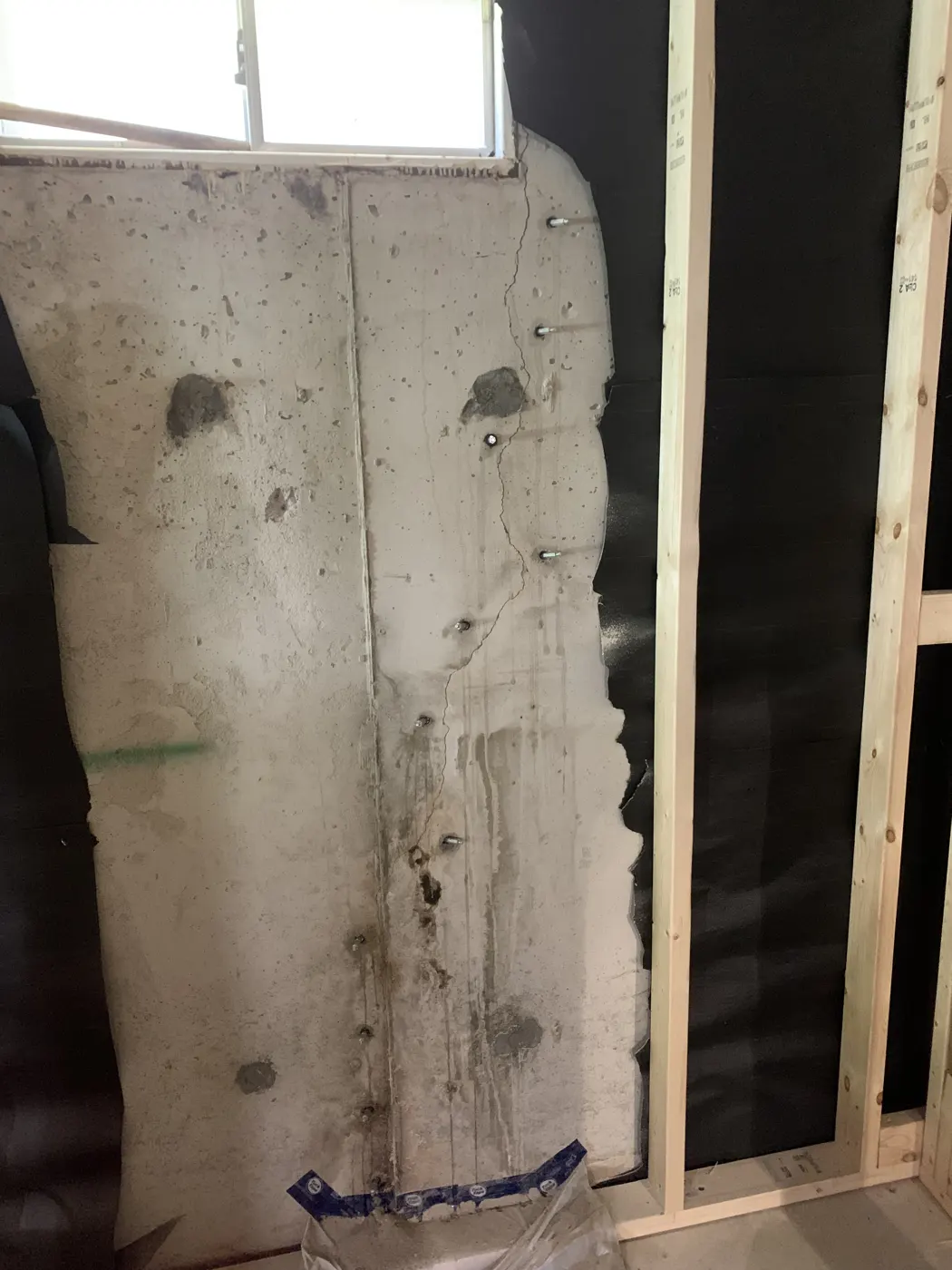
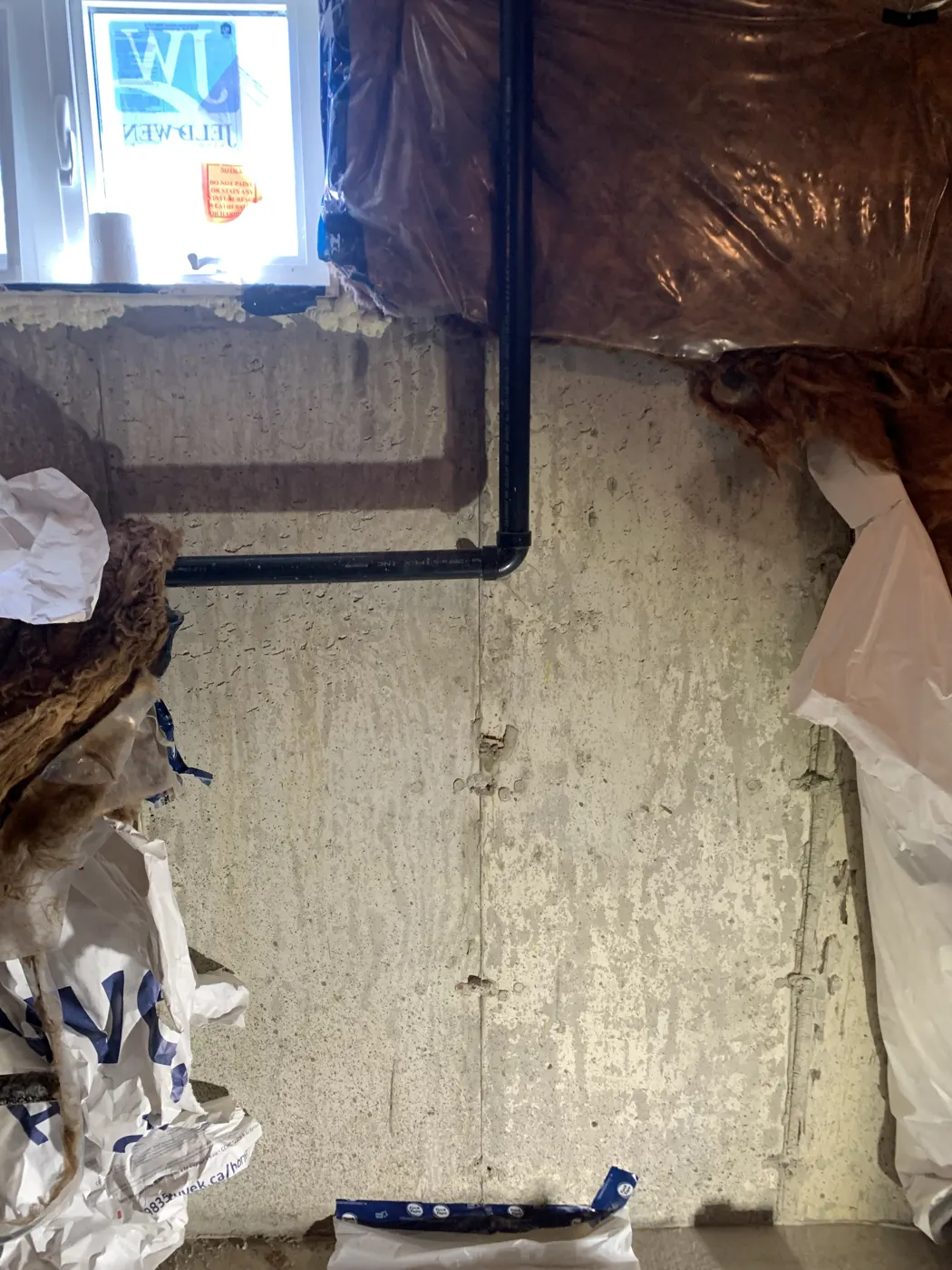
Upward pressure and structural movement want different resins.
A crack under live water pressure — the common case south of the shoreline — gets hydrophobic polyurethane ($750–$1,000). It cures against running water and stays flexible. A crack that has grown across seasons, or one carrying structural load, gets epoxy injection that re-bonds the wall ($850–$1,500). Tie-rod leaks run $75–$150, extra cracks are 5% off each, and the complete method guide, the polyurethane page, the epoxy page and the open price sheet hold nothing back. Not sure which pattern you are looking at? Our guide to the five types of foundation crack explains what each orientation indicates, and why width alone tells you very little.
No other GTA town has a housing history quite like this.
Ajax did not grow — it was built. The Ontario Heritage Trust’s provincial plaque records that “in 1941, the Canadian Government established here a shell-filling plant operated by Defence Industries Limited,” and that “at peak production, over 9,000 persons from across Canada lived and worked on this site.” The town took its name from HMS Ajax, the cruiser that fought at the River Plate in 1939. After the war it became a temporary campus of the University of Toronto for returning veterans, employees were given the option to buy the wartime houses, and the community was incorporated as an Improvement District in 1950 and as a town effective January 1, 1955.
Then it changed shape again. On June 22, 1973 the Ontario Legislature passed Bill 162 amalgamating the Town of Ajax with the Village of Pickering, and Ajax went from 2,985 acres to 16,729 — more than five times its former size. Almost everything north and east of the original townsite is therefore post-1973 municipal Ajax. And tucked inside it is something far older: Pickering Village, where a settlement developed between 1801 and 1807 where the Danforth Road crossed Duffin’s Creek, with a saw and grist mill by 1809 and a post office by 1829. Three distinct foundation eras in one town — pre-Confederation stone, 1940s wartime housing, and everything built since 1973.
One visit — and a straight answer on permits.
Photo quotes come back the same day; the on-site assessment is free either way. A typical crack takes 60–90 minutes from the basement side — no excavation through Ajax landscaping, no seasonal blackout. On permits, we will not give you the convenient answer. The Town of Ajax publishes no exemption list at all; its stated position is that “a building permit is required for all construction work,” and it tells homeowners “if you are unsure if your project requires a permit, contact us.” Interior crack injection is not named either way. So we call Ajax Building Services on 905-683-4550 (Town Hall, 65 Harwood Avenue South) before we start. Any contractor who tells you flatly that Ajax needs no permit is guessing.
The honest variables inside the published ranges.
Lots south of the Iroquois shoreline, where beach sand meets an upward groundwater gradient, can need patient multi-port injection because water keeps arriving during the work. Cove-joint and slab seepage is a different repair from a wall crack and we price it honestly rather than pretending injection solves everything. Long full-height cracks use more resin than hairlines, finished basements add access care, and heritage foundations in Pickering Village may rule out injection entirely — rubble and fieldstone have no single crack plane for resin to seal against, and we say so at the assessment. Every crack after the first is 5% off, and all of it is on the published cost breakdown before we ever ring your doorbell.
Wartime townsite to Audley, and Pickering Village in between.
Downtown and the original townsite, Pickering Village, Pickering Beach, Lakeside, Applecroft, Duffin’s Bay, Nottingham, Southwood, Central West, Northwest Ajax, Audley, Riverside and Carruthers Creek. A note on how we describe these: the Town’s own open data records that its neighbourhood boundaries were set in a 2011 review and that the names “lack official titles throughout the municipality,” and no municipal or census source assigns a construction decade to any of them. Rather than repeat the decades that circulate on property websites, we use what is documented — 1941 for the wartime townsite, 1801–1807 for Pickering Village, and post-1973 for the lands added at amalgamation. Our Pickering guide covers the city west, our Oshawa guide Durham east, and the full service-area index lists every city we publish for.
The numbers behind the warranty.
A quarter-century of GTA basements kept dry.
Injection repairs warrantied for life — and the warranty moves with the house when you sell.
Full commercial coverage on every job, every crew, every home.
Eligible contractor for City of Toronto, Peel & Halton basement-flooding subsidy programs.
Inspection, honest diagnosis, and an exact per-crack quote — free, no pressure.
Your price is confirmed in writing before any work starts — no hourly surprises.
Every review below is a real, verifiable Google review of Concrete Crack Repair Pros. Nothing is paraphrased, and nothing is borrowed from a sister company.
Are these reviews genuine? Every review shown above is pulled live from the Concrete Crack Repair Pros Google Business Profile at 64 Millwick Dr, North York — not from a parent or sister brand’s listing. The rating and the count update automatically as new reviews arrive, so what you see here is what is on Google right now.
The same name, address and phone number we publish everywhere, so you can check us before you call.
Because in south Ajax the pressure often comes from below. TRCA records that in the southern reaches of the Duffins and Carruthers watersheds, “groundwater flow from the deeper aquifer systems is vertically upwards” — an upward hydraulic gradient discharging toward the surface. Add beach sand and gravel south of the Iroquois shoreline and a shallow lakeshore water table, and water appears at the cove joint where the floor meets the wall, or through the slab. Injection seals a wall crack; it does not fix an upward gradient, and we will tell you which one you have before quoting.
No — and the Region’s own page really does list “a leak in your home’s foundation, basement walls or basement windows or doors” first among the causes. What Durham offers is an interest-free loan of up to $3,000, repaid on your quarterly water bill, covering only a backwater valve and a sump pump, and only if you have already had a sanitary sewer backup. The Town of Ajax has no program of its own. Toronto homeowners get up to $6,650 in actual subsidy for comparison. The wall is entirely out of pocket in Ajax.
The Town does not publish an answer, and we would rather tell you that than guess. Unlike Pickering or Toronto, Ajax publishes no list of permit-exempt work — its stated position is that “a building permit is required for all construction work,” and it directs homeowners who are unsure to contact the Town. Interior crack injection is not named on any Ajax list either way. We call Building Services on 905-683-4550 before starting. Treat a flat “no permit needed in Ajax” from any contractor as an assumption, not a fact.
Possibly. TRCA designates a Flood Vulnerable Cluster called Lower Carruthers “between Pickering Beach Road and Shoal Point Road and south of Bayly Street,” naming the Pickering Beach community, Paradise Park, Paradise Beach, Seabreeze Road and Ruthel Road. In a regulatory storm event TRCA models 89 affected households there. That is riverine flood risk, which is a different problem from groundwater against your foundation — but if you are in that cluster it is worth knowing both, because the remedies are entirely separate and only one of them is ours.
It affects what we expect to find. The Defence Industries Limited site housed over 9,000 people at peak, and after the war employees were given the option to buy the wartime houses — so the original townsite has a concentration of 1940s construction unlike anywhere else in Durham. We have not found a municipal source documenting foundation types for that housing, so we do not make claims about it sight unseen; we assess and tell you. Everything north and east of the old townsite is post-1973, when amalgamation took Ajax from 2,985 to 16,729 acres.
Considerably. Pickering Village predates Ajax by 140 years — a settlement grew there between 1801 and 1807 where the Danforth Road crossed Duffin’s Creek, with a mill by 1809 and a post office by 1829. Foundations of that vintage are typically stone or rubble, and injection is engineered for poured concrete, where a crack is a discrete plane through a monolithic pour. Rubble walls have no such plane, so there is nothing for resin to seal against. If that is what we find, we tell you at the free assessment and point you toward the right repair instead.
Method, resins and money — documented before you commit.
Lakeshore ground with pressure from below is our daily work: free assessment, flat published pricing, one-visit repair, lifetime transferable warranty — and an honest answer when the water is not coming through your wall at all.