
See the full foundation crack repair cost guide for every range and the discount math.
#eef2f7}}
Home › Service Areas › East York
When East York was created there were no sewers at all. Everything drains through infrastructure retrofitted around houses that were already standing. Flat pricing from $750, one visit, lifetime transferable warranty.
Coverage: We service Toronto, the GTA and Southern Ontario, and East York is home ground — crews run the Don Valley corridor daily, travel folded into the flat pricing. The assessment is free, and most East York cracks are injected in the same visit.
Foundation crack repair in East York costs a flat $750–$1,000 per crack for polyurethane injection and $850–$1,500 for structural epoxy, with every additional crack 5% off. No building permit is required — Toronto lists “undertaking waterproofing repairs to a basement” as work that needs none. Toronto’s Basement Flooding Protection Subsidy pays up to $6,650 across five measures, and crack repair is not one of them.
The founding fact that still shapes East York basements.
East York separated from York Township at the turn of 1923–24, with a population just under 20,000. The City of Toronto’s own centenary exhibit describes what residents were working with: “There were few roads and schools, no sewers or sidewalks, and most dwellings lacked electricity and indoor plumbing.”
Read that as a foundation contractor and it says something specific. A great deal of East York housing went up before there was a drainage system to connect it to. Sewers, storm drains and graded roads were retrofitted around houses that already existed, rather than laid down first and built onto — which is the reverse of how a modern subdivision works. Weeping tile from that era, where it exists at all, was often connected into whatever was available at the time. It is the single most useful thing to understand about why a 1930s East York basement behaves differently from a 1990s one.
The municipal timeline runs: township at the turn of 1923–24, one of the thirteen Metropolitan Toronto municipalities from 15 April 1953, amalgamated with Leaside on 1 January 1967 to form the Borough of East York, and folded into the amalgamated City of Toronto on 1 January 1998.
What is actually under East York — and the part nobody can tell you honestly.
Two sourced facts matter here. First, the Danforth corridor sits on high ground: City of Toronto planning records that “Danforth Avenue is situated on a ridge in the Don River watershed and it is the highest point in the local area,” and that “the area’s rich soil supported farming and market gardening, and the large clay deposits led to a significant brickmaking history.” Clay heavy enough to support brickworks is clay heavy enough to hold water against a foundation wall rather than let it drain away.
Second, the old glacial Lake Iroquois shoreline runs straight through East York. The City’s Taylor-Massey Creek master plan lists the “Iroquois shoreline (through Taylor Creek Park)” among the study area’s heritage features, and the escarpment marking that shoreline runs “from the Humber River in the west to the Don River in the east along the base of the ancient Lake Iroquois escarpment.”
Here is where we stop, because the honest answer is that we cannot tell you which side of that line your street is on. No published municipal source maps the shoreline’s alignment east of the Don at neighbourhood level. What is defensible: the line crosses East York at Taylor Creek Park, so parts of the district sit on the old lake plain and parts on the tableland above it. Anyone who tells you with confidence that your specific street is on Iroquois sand is guessing. We work it out from how and when your wall actually gets wet, which is a better method anyway.
The drainage picture, from TRCA and the City’s own reports.
Taylor-Massey Creek runs nearly 17 kilometres and drains 2,863 hectares through the middle of this district. Its present course is not natural: the City records that “the present Taylor Massey Creek alignment was based on a 1958 design Study for Metropolitan Toronto. The Creek was straightened, channelized and lined, mainly with gabion basket structures,” work carried out between 1959 and 1970. Two parallel sanitary sewers run through much of the valley, and combined sewer overflows are a named concern. Most striking of all: “over half of the Study Area’s land area is encompassed by floodplain.”
The wider picture is worse. TRCA’s Don River watershed report card covers 358 square kilometres that are 96% urban with only 14% natural cover. It awards the watershed an F for stormwater management, noting that just 23% of developed areas have stormwater controls in place, and describes the Don as “highly susceptible to flooding, stream erosion and water pollution.”
What that means for your basement is not dramatic, but it is consistent: rainfall that would once have soaked in now arrives fast and all at once, through a system that was never designed for the volume, in a watershed where three quarters of the developed area has no stormwater control at all. That finds existing cracks. It rarely creates new ones.
Worth claiming. Just not for your wall.
| Eligible measure | City pays | Maximum |
|---|---|---|
| Home plumbing assessment | 80% of invoice | $500 |
| Backwater valve | 80% of invoice | $1,600 per device, up to 2 |
| Sump pump | 80% of invoice | $2,250 |
| Sump pump battery backup | 80% of invoice | $300 |
| Severing and capping the weeping tile connection | 80% of invoice | $400 |
| Combined maximum per property | $6,650 | |
| Foundation crack injection | Not among the eligible measures — flat-priced from $750 instead | |
Crack repair is not excluded by a clause; the list of eligible measures is simply exhaustive and it is not on it. Meanwhile the City’s own basement flooding page names “a crack or leak in your home’s foundation, basement walls, or basement windows or door” as a cause, and states that where flooding results from leaking foundation walls or poor lot drainage on your property, you are responsible for the repairs. On permits, Toronto’s published list of work that does not require one includes “undertaking waterproofing repairs to a basement” — interior injection sits there, provided there is no structural alteration, excavation, underpinning or new plumbing. Note that a backwater valve installation does need a permit, while a sump pump does not.
Four questions, instant range — polyurethane or epoxy, multi-crack discount included, no obligation.
Where the City has already identified a problem in East York.
Four of Toronto’s 67 basement flooding study areas cover this district: East York — O’Connor Drive and St. Clair Avenue East (Study Area 1, EA completed 2014), Leaside (Area 2, 2014), East York — Broadview Avenue and O’Connor Drive (Area 46, 2022) and Don River — Eglinton (Area 55, 2022). All 67 environmental assessments across the city are now complete, and roughly $1.15 billion has been spent on 167 projects benefitting around 31,000 properties.
One of those projects is live in East York as you read this. The Topham Park Basement Flooding Protection Program — described by the City as “the final phase of basement flooding mitigation efforts in the O’Connor Drive area” — covers the area bounded by Northline Road, Victoria Park Avenue, Massey Creek and Dranfield Road. Construction commenced in spring 2025 and is anticipated to finish in 2027. The work includes storm and sanitary sewer modifications on St. Clair Avenue East and surrounding streets, watermain replacement on Westview Boulevard, and a rain garden in the Valor Boulevard median.
Further downstream, the Don River and Central Waterfront programme — including the Coxwell Bypass Tunnel and a dedicated Massey Creek Tunnel, budgeted at more than $3 billion and under construction since 2018 — is rebuilding how this whole system handles a storm.
The honest caveat is the same one we give everywhere: all of that is public infrastructure in the right-of-way. It reduces the odds the municipal system backs up into your basement. It does nothing about groundwater pressing on your foundation wall, and no part of it crosses your property line. If your basement only takes water when the sewer surcharges, this work may genuinely solve your problem for free.
Two frames from our crews’ recent work.
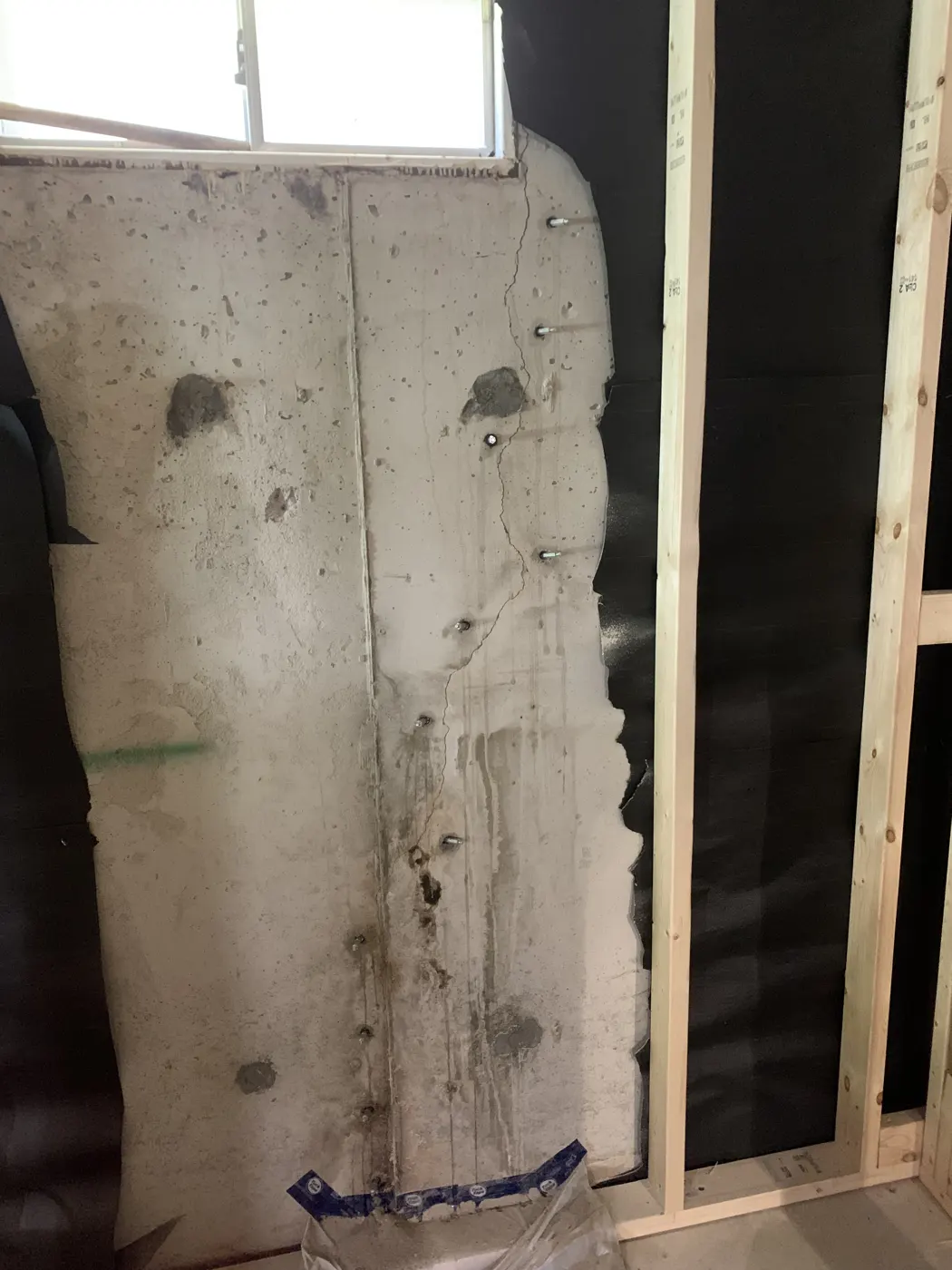
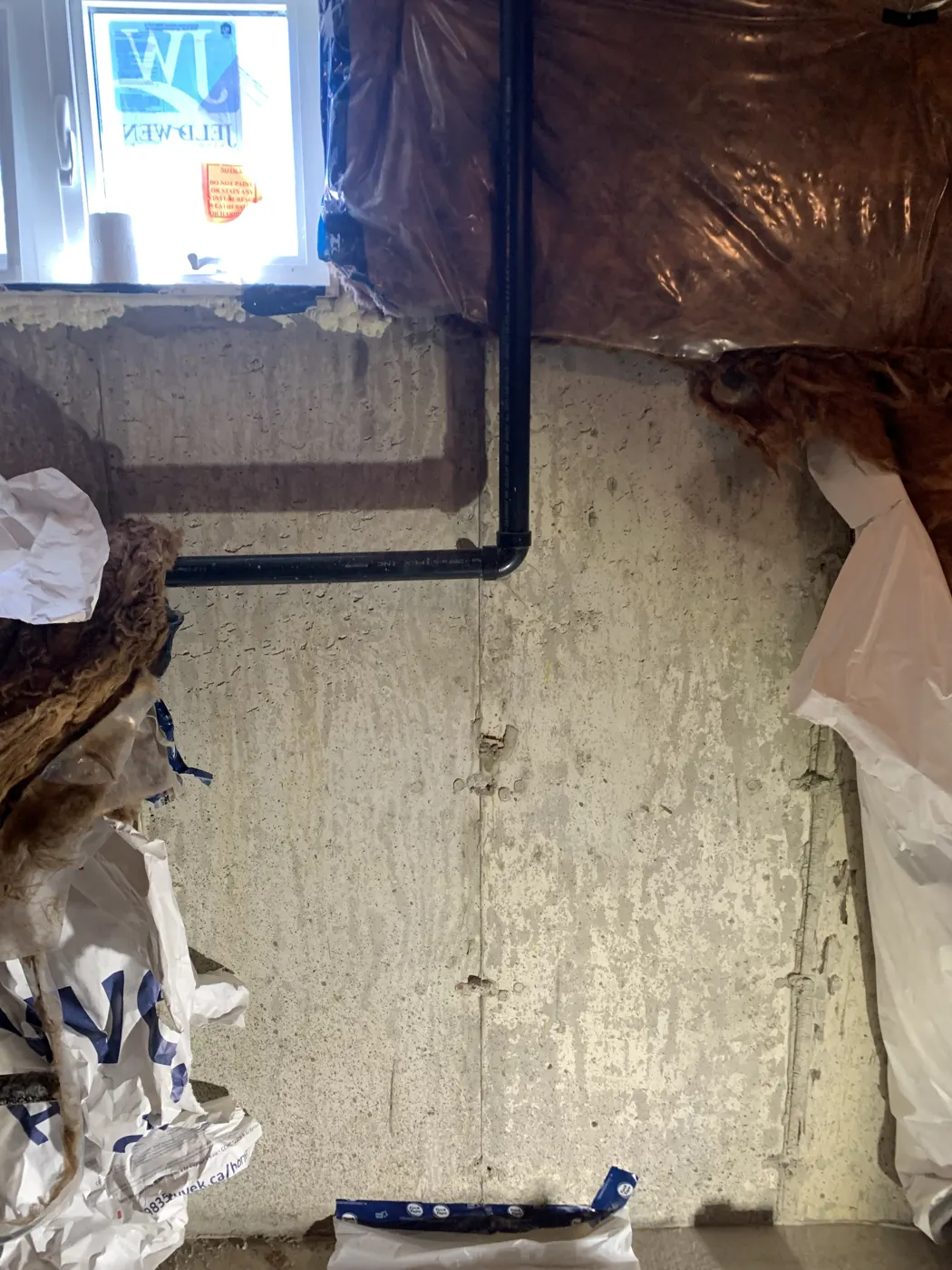
Old walls and storm loading want different resins.
A crack that weeps during and after heavy rain — the pattern in a watershed with almost no stormwater control — gets hydrophobic polyurethane ($750–$1,000). It cures against live water and stays flexible. A crack that has grown across seasons, or one carrying structural load, gets epoxy injection that re-bonds the wall ($850–$1,500). Tie-rod leaks run $75–$150, extra cracks are 5% off each, and the complete method guide, the polyurethane page, the epoxy page and the open price sheet hold nothing back. Not sure which pattern you are looking at? Our guide to the five types of foundation crack explains what each orientation indicates, and why width alone tells you very little.
The most misunderstood housing stock in East York.
Leaside has a documented origin most neighbourhoods would envy. The Canadian Northern Railway bought over 1,000 acres including the former Lea family holdings, commissioned landscape architect Frederick Todd to design a “model town” in 1912 — a grid of curving and radial streets, conceived as a northern version of Rosedale — and the Town of Leaside was incorporated in 1913. Wartime industry followed, with Leaside Munitions employing 4,000 people and an aerodrome nearby.
And then almost nothing happened. City heritage research records the detail that matters: “By the late 1920s only 68 homes had been built” in a community planned for 3,000. The First World War and the Depression stalled it completely.
So if you own in Leaside, your street layout is from 1912 but your foundation almost certainly is not. The houses came later — predominantly through the 1930s, 40s and 50s, laid onto a street plan drawn a generation earlier. That is a genuinely useful distinction when someone tells you your home is “over a century old.” The plan is. The concrete usually is not, and walls of that later vintage finished their drying shrinkage decades ago, which typically makes their cracks mature and stable rather than active.
Thorncliffe Park next door is a different story again: a racetrack from 1920 to 1952, annexed by Leaside in 1954, then built out with thirty mid- and high-rise complexes through the 1960s and the tallest towers completed in 1971. If you are in one of those, the foundation is common element and the decision belongs to your corporation rather than to you — we work with boards and property managers on that basis.
One visit, no permit, and a clear line on what does need one.
Photo quotes come back the same day; the on-site assessment is free either way. A typical crack takes 60–90 minutes from the basement side — no excavation through East York landscaping, no seasonal blackout. Toronto’s published list of work not requiring a building permit includes “undertaking waterproofing repairs to a basement,” and separately confirms that a sump pump needs no permit. What does require one: structural or material alterations, excavating or constructing foundations, basement underpinning, a basement entrance, and installing a backwater valve. Toronto Building is on 416-397-5330, or 311 within the city.
The honest variables inside the published ranges.
Older walls in the pre-1960 stock — which is more than half the housing here — are more likely to be block or rubble than poured concrete, and injection is engineered for poured walls where a crack is a discrete plane through a monolithic pour. Mortared block moves water through joints and voids instead, so there is nothing for resin to seal against; we tell you that at the assessment rather than inject a wall that will not hold it. Long full-height cracks use more resin than hairlines, and finished basements add access care. Every crack after the first is 5% off, and all of it is on the published cost breakdown before we ever ring your doorbell.
Leaside to Woodbine-Lumsden, Topham Park to the Danforth.
Leaside, Thorncliffe Park, Broadview North, Danforth Village, East Danforth, Woodbine-Lumsden, Old East York, Topham Park, O’Connor-Parkview and Crescent Town. We publish build eras only where a municipal source supports them — Leaside’s 1912 plan and 1913 incorporation, Thorncliffe’s 1960s towers, and the Danforth corridor, where City planning records that roughly 69% of properties existing in 2021 were constructed between 1910 and 1929, following the streetcar’s electrification in 1894 and the completion of the Bloor Viaduct’s Don section in 1918. For the rest we use the ward-level census profile rather than decades we cannot source. Our Scarborough guide covers the district east, our North York guide the district north, and the full service-area index lists every city we publish for.
The numbers behind the warranty.
A quarter-century of GTA basements kept dry.
Injection repairs warrantied for life — and the warranty moves with the house when you sell.
Full commercial coverage on every job, every crew, every home.
Eligible contractor for City of Toronto, Peel & Halton basement-flooding subsidy programs.
Inspection, honest diagnosis, and an exact per-crack quote — free, no pressure.
Your price is confirmed in writing before any work starts — no hourly surprises.
Every review below is a real, verifiable Google review of Concrete Crack Repair Pros. Nothing is paraphrased, and nothing is borrowed from a sister company.
Are these reviews genuine? Every review shown above is pulled live from the Concrete Crack Repair Pros Google Business Profile at 64 Millwick Dr, North York — not from a parent or sister brand’s listing. The rating and the count update automatically as new reviews arrive, so what you see here is what is on Google right now.
The same name, address and phone number we publish everywhere, so you can check us before you call.
Indirectly, and it is the most useful thing to know about the district. The City’s own centenary history records that at incorporation in 1923–24 there were “few roads and schools, no sewers or sidewalks.” A great deal of East York housing therefore went up before there was a drainage system to connect to, and sewers were retrofitted around existing houses rather than laid first. Weeping tile from that era, where it exists, was connected to whatever was available. That is why we check drainage before quoting a wall repair here more often than almost anywhere else we work.
Almost certainly not. Frederick Todd drew the Leaside plan in 1912 and the town was incorporated in 1913, but City heritage research records that “by the late 1920s only 68 homes had been built” in a community planned for 3,000 — the war and the Depression stalled it. Most Leaside houses came in the 1930s, 40s and 50s, built onto a street plan drawn a generation earlier. Walls of that vintage finished their drying shrinkage long ago, so their cracks are usually mature and stable, which is good news for the repair.
It may well reduce your risk of sewer backup, but it will not touch your foundation. The Topham Park Basement Flooding Protection Program is the final phase of mitigation in the O’Connor Drive area, bounded by Northline Road, Victoria Park Avenue, Massey Creek and Dranfield Road; construction began in spring 2025 and runs to 2027. Like the whole $1.15-billion programme, it is confined to the public right-of-way. If your basement only floods when the municipal system surcharges, this genuinely helps and you may not need us at all.
It means the ground around you absorbs very little. TRCA’s report card covers 358 square kilometres that are 96% urban with 14% natural cover, grades stormwater management F, and records that only 23% of developed areas have stormwater controls in place. Rain arrives fast and concentrated rather than soaking in. For a foundation that means short sharp loading events rather than gentle seasonal wetting — which is the pattern that finds an existing crack rather than creating a new one.
Enough that it supported an industry. City planning records that Danforth Avenue “is situated on a ridge in the Don River watershed and it is the highest point in the local area,” and that “the area’s rich soil supported farming and market gardening, and the large clay deposits led to a significant brickmaking history.” Clay heavy enough to make bricks from is clay that holds water against a wall rather than letting it drain away. It is why so many cracks here weep slowly for days after rain rather than running during it.
It is worth knowing. The creek’s present alignment came from a 1958 design study for Metropolitan Toronto; it was straightened, channelized and lined mainly with gabion baskets between 1959 and 1970, and two parallel sanitary sewers run through much of the valley. The City also records that over half the study area’s land is inside the floodplain. A channelized creek moves water faster rather than storing it, and combined sewer overflows are a named concern in that corridor. None of that is a foundation problem in itself — but it does mean storm-driven basement water here is often a system issue rather than a wall issue, and we will say so if that is what we find.
Method, resins and money — documented before you commit.
Pre-war walls on Danforth clay are our daily work: free assessment, flat published pricing, one-visit repair, lifetime transferable warranty — and an honest answer when the City’s sewer programme is about to solve your problem for free.