
All ranges in one place: foundation crack repair costs, published.
#eef2f7}}
Home › Service Areas › Scarborough
The City tells you to seal cracks in your foundation. It will pay up to $6,650 toward five other things and nothing toward that one. Flat pricing from $750, one visit, lifetime transferable warranty.
Coverage: We service Toronto, the GTA and Southern Ontario, and Scarborough is home ground — east-end routes run daily, travel folded into the flat pricing. The assessment is free, and most Scarborough cracks are injected in the same visit.
Foundation crack repair in Scarborough costs a flat $750–$1,000 per crack for polyurethane injection and $850–$1,500 for structural epoxy, with every additional crack 5% off. Toronto’s Basement Flooding Protection Subsidy rose to a combined $6,650 per property on May 1, 2026 — but its five eligible measures are a plumbing assessment, backwater valve, sump pump, battery backup and weeping tile severance. Crack injection is not among them. And you do not need a building permit: the City lists “undertaking waterproofing repairs to a basement” as work that requires none.
Scarborough has the best-documented geology in the GTA — and it explains the leaks.
The Scarborough Bluffs are a 15-kilometre cross-section through everything under this district, rising to roughly 110 metres above Lake Ontario at their highest. Reading TRCA’s stratigraphy from the bottom up: the Scarborough Formation, whose lower half is fine silt and clay and whose upper part is sand; the Sunnybrook Drift, “a cohesive silty clay” that restricts downward groundwater flow; the Thorncliffe Formation, which “contains layers of riverine sands interbedded with fine-grained glacial tills”; and at surface the Leaside and Halton Tills — sandy silt tills — with Lake Iroquois Sand present “in place of or overlying the tills in several areas.”
That last unit is the one under a great many Scarborough basements. Glacial Lake Iroquois stood about 60 metres higher than today’s lake, and Parks Canada places its old shoreline 4 to 15 kilometres inland, “passing through areas that are now the Toronto Zoo, and the former Beare Road landfill site.” Where you sit relative to that line changes your basement’s failure mode. On the Iroquois sand, water moves freely and arrives at the wall fast — free-draining ground, but any crack sees pressure quickly. On the tills, which are low-permeability, water perches in the backfill zone instead of soaking away, and the wall carries the load. TRCA’s own observation that groundwater “moves readily through the sands, but more slowly through the lower permeability tills” is the whole story in one sentence, and it is why two houses three streets apart behave nothing alike.
Then there is the watershed. Highland Creek drains about 102 square kilometres and TRCA calls it “the most urbanized watershed in the Toronto region” — just 6% forested, only 11.4% of the landscape still natural cover, and roughly 9% of it served by stormwater management controls. Water that lands on Scarborough has very little ground left to soak into, so it moves fast and it arrives all at once. The Rouge to the east is a different animal at roughly 339 square kilometres and about 26% natural, anchored by the 79-square-kilometre Rouge National Urban Park established in 2015.
The program nearly doubled in May 2026. Crack repair still is not on it.
| Eligible measure | City pays | Maximum |
|---|---|---|
| Home plumbing assessment (new in 2026) | 80% of invoice | $500 |
| Backwater valve | 80% of invoice | $1,600 per device, up to 2 |
| Sump pump | 80% of invoice | $2,250 |
| Sump pump battery backup | 80% of invoice | $300 |
| Severing and capping the weeping tile connection | 80% of invoice | $400 |
| Combined maximum per property | $6,650 | |
| Foundation crack injection | Not among the eligible measures — flat-priced from $750 instead | |
The increase was real and worth claiming: the combined cap went from $3,400 to $6,650, backwater valve and sump pump amounts rose 28%, a second valve became eligible for homes with multiple sewer connections, and the application window doubled from one year to two. The program has paid roughly $85.6 million across 59,173 applications since 2007, reaching about 14% of Toronto’s residential properties.
What it will not do is fix your wall. And the City is not shy about whose job that is — its own prevention page tells homeowners to “seal cracks or leaks in walls, floors, windows, window wells and your home’s foundation,” and states that “homeowners are responsible for plumbing from the property line to inside the home.” We are injection specialists, not plumbers: the subsidy measures belong to a licensed plumbing or drain contractor holding a City business licence, and note that a backwater valve installation does require a building permit even though your crack repair does not. Where your flood plan pairs a wall repair with subsidised drainage work, we time our visit around it and hand you a documented, itemised record for the wall side of the file.
Four questions, instant range — polyurethane or epoxy, multi-crack discount included, no obligation.
Where Toronto has already identified a flooding problem — and what that does not mean for you.
Toronto ran Environmental Assessments across 67 basement flooding study areas between 2006 and 2024. Twelve of them are in Scarborough: Victoria Park from Eglinton to Steeles (2008), Warden and Finch East (2011), Clairlea–Birchmount (2018), Scarborough Waterfront (2021), Steeles East and Port Union (2022), Rouge River South and North, Agincourt–Highland Creek West and East (all 2023), and South Scarborough–Highland Creek, West and East (2024). The clustering on Highland Creek is not a coincidence — it is the most urbanized watershed in the region, with the least ground left to absorb anything.
Here is the part worth being straight about. That $2 billion capital program addresses infrastructure “within the City’s right-of-way and public property like parks and ravines” — explicitly not private property. Being inside a study area tells you the City has identified a surcharge risk on your street. It does not mean anyone is coming to look at your wall, and it does not entitle you to anything beyond the subsidy above. What it does tell you honestly is that if your basement takes water only during heavy storms, the cause may sit in the sewer rather than in your foundation — and we would rather say that at a free assessment than sell you an injection that fixes nothing.
Two frames from our crews’ recent work.
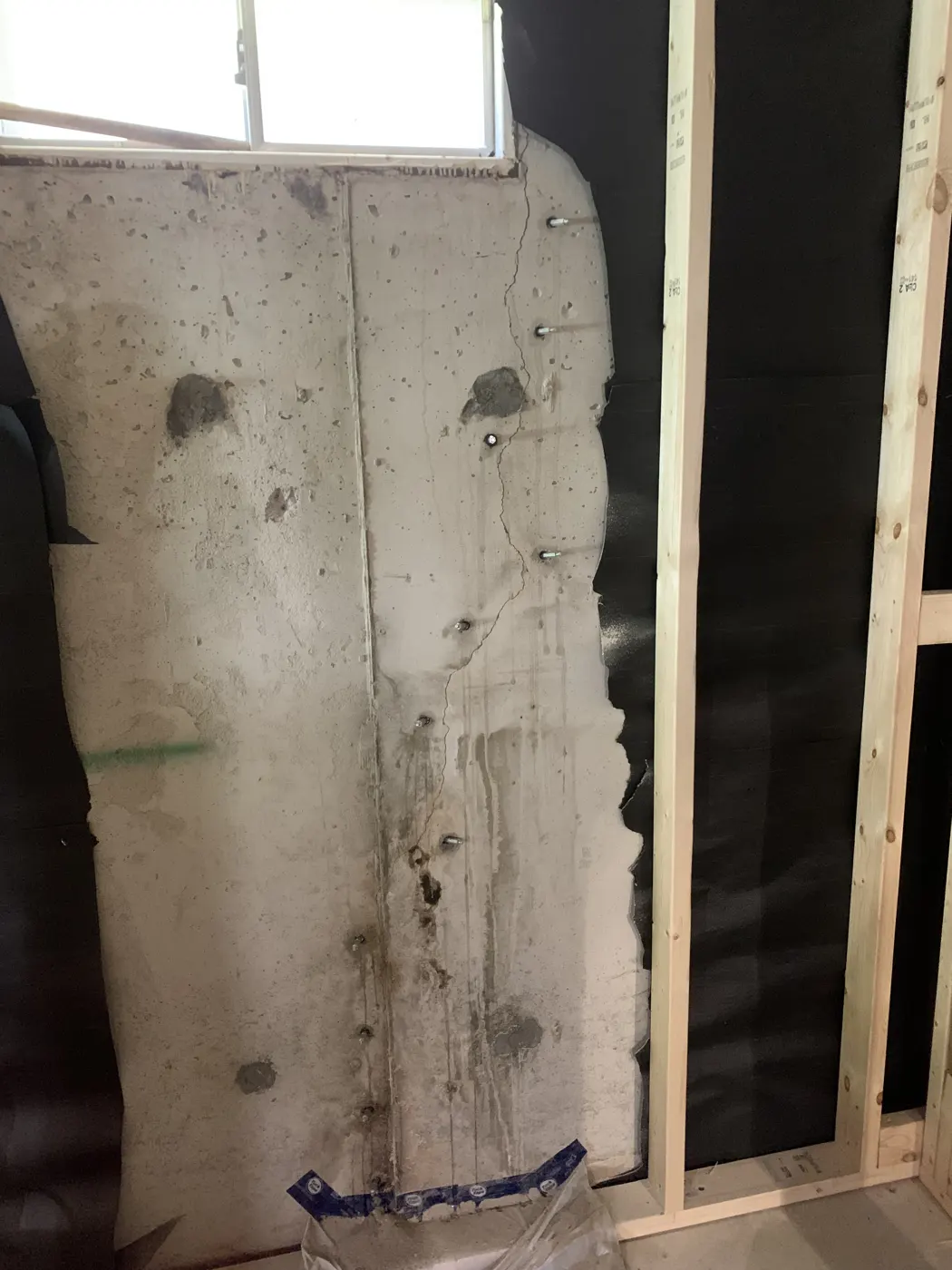
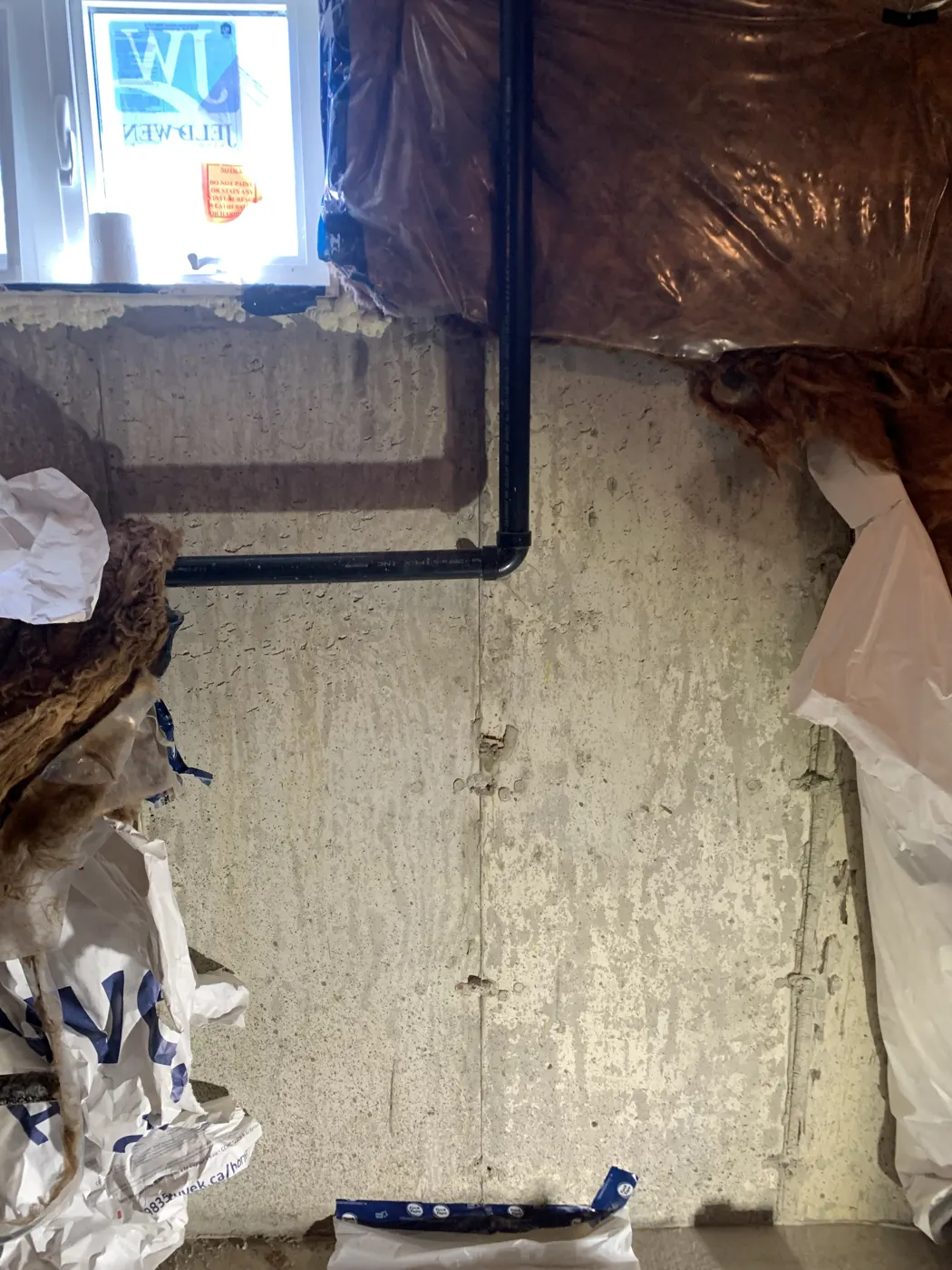
Sand-driven pressure and structural movement want different resins.
A crack that runs during and after heavy rain — the signature of free-draining Iroquois sand delivering water straight to the wall — gets hydrophobic polyurethane ($750–$1,000). It cures against live water and stays flexible. A crack that has grown across seasons, or one carrying structural load, gets epoxy injection that re-bonds the wall ($850–$1,500). Tie-rod leaks run $75–$150, extra cracks are 5% off each, and the complete method guide, the polyurethane page, the epoxy page and the open price sheet hold nothing back. Not sure which pattern you are looking at? Our guide to the five types of foundation crack explains what each orientation indicates, and why width alone tells you very little.
Why so much of Scarborough’s concrete is the same age.
Scarborough Township was established in 1850 with a population of about 3,000. It stayed that way for a century. Then, in the City of Toronto Archives’ own words, “between 1950 and 1955, its population doubled from 48,000 to 110,000, tripling again between 1955 and 1970.” Highway 401 opened through it in 1956 and the farms went under subdivisions of single-family homes almost overnight.
The census still shows it. Of 218,920 private dwellings in the Scarborough Community Council area at the 2021 census, 48,370 date from 1960 or earlier and 80,740 from 1961 to 1980 — 129,110 homes, 59% of the district, built in 1980 or before. Poured foundation walls from that era are now 45 to 75 years old, sitting in ground that has been urbanising around them the whole time. That is the single most useful thing to know about foundations here, and it is why we see the same three or four crack patterns across whole streets.
No permit, one visit, and a clear line about what does need one.
Photo quotes come back the same day; the on-site assessment is free either way. A typical crack takes 60–90 minutes from the basement side — no excavation through Scarborough landscaping, no seasonal blackout. On permits, Toronto is unusually clear and it works in your favour: the City’s published list of work that does not require a building permit includes “undertaking waterproofing repairs to a basement.” Interior crack injection is a waterproofing repair with no structural alteration, no excavation, no underpinning and no plumbing work. What does require a permit is structural or material alteration, excavating or constructing foundations, basement underpinning, a basement entrance, and — worth knowing if you are also claiming the subsidy — installing a backwater valve. Questions go to 311 within Toronto, or 416-392-2489 from outside the city.
The honest variables inside the published ranges.
Walls in the Iroquois sand belt can need patient multi-port injection because water keeps arriving during the work. Long full-height cracks use more resin than hairlines. Finished basements — common in a district of 1960s and 70s homes that have been renovated twice — add access care. Block foundations, which do turn up in the older stock, are a different conversation: injection is engineered for poured concrete, where a crack is a discrete plane through a monolithic pour, and mortared block has no such plane for resin to seal against. We tell you that at the assessment rather than inject a wall that will not hold it. Every crack after the first is 5% off, and all of it is on the published cost breakdown before we ever ring your doorbell.
Bluffs to Rouge, Birch Cliff to Milliken.
Birch Cliff, Cliffside, Cliffcrest, Guildwood, West Hill, Highland Creek, Rouge, Malvern, Agincourt, L’Amoreaux, Wexford, Dorset Park, Bendale, Woburn, Eglinton East, Ionview, Kennedy Park, Scarborough Village, Morningside, Centennial, Milliken and Steeles. Rather than guess at build decades street by street, the honest frame is the district one: 59% of Scarborough’s housing predates 1981, and the great bulk of it went up in the two decades after Highway 401 opened in 1956. Our Markham guide covers the next municipality north, our Oshawa guide the Durham lakeshore east, and the full service-area index lists every city we publish for.
The numbers behind the warranty.
A quarter-century of GTA basements kept dry.
Injection repairs warrantied for life — and the warranty moves with the house when you sell.
Full commercial coverage on every job, every crew, every home.
Eligible contractor for City of Toronto, Peel & Halton basement-flooding subsidy programs.
Inspection, honest diagnosis, and an exact per-crack quote — free, no pressure.
Your price is confirmed in writing before any work starts — no hourly surprises.
Every review below is a real, verifiable Google review of Concrete Crack Repair Pros. Nothing is paraphrased, and nothing is borrowed from a sister company.
Are these reviews genuine? Every review shown above is pulled live from the Concrete Crack Repair Pros Google Business Profile at 64 Millwick Dr, North York — not from a parent or sister brand’s listing. The rating and the count update automatically as new reviews arrive, so what you see here is what is on Google right now.
The same name, address and phone number we publish everywhere, so you can check us before you call.
No. The increase on May 1, 2026 was substantial — the combined cap nearly doubled from $3,400, valve and pump amounts rose 28%, and the claim window went from one year to two. But the five eligible measures are a home plumbing assessment, a backwater valve, a sump pump, a battery backup, and severing and capping the weeping tile connection. Foundation crack repair is not one of them and never has been. It is worth claiming what you can — just do not expect it to touch your wall.
No. Toronto’s published list of work that does not require a building permit includes “undertaking waterproofing repairs to a basement,” and interior crack injection sits squarely in that category — no structural alteration, no excavation, no underpinning, no plumbing. Permits are required for structural or material alterations, excavating or constructing foundations, basement underpinning, a basement entrance, and installing a backwater valve. If your job crosses into any of those, we say so before we start. Questions go to 311, or 416-392-2489 from outside Toronto.
No, and it is worth being clear about. Twelve of Toronto’s 67 study areas are in Scarborough, mostly on Highland Creek and the Rouge, and the associated capital program runs to roughly $2 billion. But that work is confined to infrastructure in the City’s right-of-way and on public land — parks and ravines — explicitly not private property. Being in a study area tells you the City has identified a sewer surcharge risk on your street. It is genuinely useful information, because it raises the odds that your storm-only flooding is a drainage problem rather than a crack problem.
Bluff erosion and foundation cracking are two different problems and it helps not to conflate them. TRCA records average toe recession as high as 0.3 metres a year where there is no protection at the base, and notes that freeze-thaw can take 1 to 3 metres of tableland in a single event — that is a slope stability and setback issue, managed by TRCA and the City, and no injection addresses it. What the Bluffs stratigraphy does explain is water: groundwater seeps from the bluff face at anywhere from 0.1 to 50 litres per day per metre, moving through the sand layers. The same sands sit under inland basements. If you are close to the crest, talk to the City about the slope; we will talk to you about the wall.
Age is context rather than cause. Of 218,920 dwellings in the Scarborough Community Council area, 129,110 — 59% — were built in 1980 or earlier, most of them in the two decades after Highway 401 opened in 1956, when the population doubled and then tripled. A poured wall of that vintage has had 45 to 75 years of seasonal moisture cycling, urbanisation and settlement around it. That does not make cracking inevitable, but it does mean most Scarborough cracks are mature and stable rather than active — which is usually good news for the repair.
Because Scarborough has very little ground left to absorb rainfall. Highland Creek drains about 102 square kilometres and TRCA calls it the most urbanized watershed in the Toronto region — 6% forested, 11.4% natural cover, and roughly 9% of the watershed served by stormwater controls. Water arrives fast and all at once. A wall that is dry between storms and wet only during them often has a drainage or sewer surcharge problem rather than a foundation problem, and injection may not be your answer. That is exactly what a free assessment is for, and it is fine with us to leave without a sale.
Method, resins and money — documented before you commit.
Post-war walls in Iroquois sand are our daily work: free assessment, flat published pricing, one-visit repair, lifetime transferable warranty — and an honest answer when the water is coming from the sewer, not your foundation.