
For the complete picture, read what foundation crack repair costs in the GTA.
Cambridge, Ontario
Leaking foundation cracks sealed from inside by polyurethane injection — one visit, no excavation, transferable lifetime warranty. And an honest answer first, because a good share of old Cambridge cannot be injected at all.
Quick Answer
Can my Cambridge foundation crack be injected? It depends which Cambridge you live in. In the poured concrete walls of Clemens Mills, Westwood, Southwood and the newer parts of Hespeler, yes — resin fills the crack through the full thickness of the wall and the repair is done from inside in an afternoon. In the stone and rubble foundations under much of old Galt and Preston, no, and any contractor who tells you otherwise is selling you something that will fail. Cambridge is the one city we serve where the first question is not how bad the crack is, but what the wall is made of.
Poured concrete, concrete block, or stone. Only the first is injectable. In Cambridge this is a live question, not a formality.
Galt, Preston and Hespeler were separate towns until 1973. Their housing stock is genuinely different and so are their foundations.
The Grand does not come in through a crack. If you are in the flood fringe, sealing a crack is not the repair that matters.
Exterior excavation in a GRCA regulated area can need a permit. Interior injection normally does not.
We found no City of Cambridge or Region of Waterloo grant for this work. Budget the full amount.
Cambridge is quoted from the same published per-crack ranges as our Toronto work. No travel surcharge.
Most cities have one story. Cambridge has three, and which one applies to you decides whether we can help.
Cambridge did not exist until 1973. Before that it was Galt, Preston, Hespeler and the hamlet of Blair — separate places with separate histories that were merged into one city by provincial reorganisation, over a good deal of local objection. Fifty years on the seams are still visible, and they are visible in the basements.
Galt is the oldest. It was founded in 1816 by William Dickson, a Scottish immigrant who had bought roughly 90,000 acres along the Grand River, and it grew up around Shade’s Mills where Mill Creek meets the Grand. That means a core of housing that is, in places, a century and a half old — built long before poured concrete foundations were normal practice in Ontario. Preston, at the confluence where the Speed River joins the Grand, and Hespeler, upstream on the Speed, followed similar mill-town patterns.
Then, layered over all three, came the post-war and modern subdivisions — Clemens Mills, Westwood, Southwood, the newer streets on Hespeler’s edges — which are conventional poured concrete like anywhere else in southern Ontario.
The practical consequence: two houses fifteen minutes apart in Cambridge can need completely different repairs for what looks like exactly the same crack. We would rather say that on the phone than after we have taken your deposit.
Cambridge by river, and what tends to be under the house
The Speed joins the Grand at Preston; Hespeler sits upstream on the Speed and Galt downstream on the Grand. The three historic cores hug the water, which is also where the oldest foundations are.
This is the section that costs us work in this city. We are leaving it in anyway.
Crack injection is a poured concrete repair. The method depends on one physical fact: a poured wall is a continuous mass, so resin pushed in under pressure has nowhere to go except along the crack, front to back. It fills the void and cures into a flexible seal that spans the full thickness of the wall.
A stone or rubble foundation is the opposite of continuous. It is fieldstone or quarried stone bedded in lime mortar, with voids, mortar joints and irregular gaps running through the whole assembly. Push resin into that and it does not fill a crack, because there is no single crack to fill — it disappears into the wall, finds the paths of least resistance, and comes out somewhere you did not expect. You have spent money and the water still arrives.
Concrete block is the same problem in a tidier shape. Block walls are hollow, and the mortar joints between them are a continuous escape route. When a block wall leaks, water is usually travelling inside the cores, which is a drainage problem, not a crack.
So what do you do instead? For a leaking stone or rubble wall the honest options are exterior excavation with a membrane and proper drainage, or an interior drainage system with a sump. Both are bigger jobs than injection and neither is what we do. We will tell you which one we think your wall needs, and then we will get out of your way. We would rather be the company that told you the truth in Galt than the company that injected your rubble wall in March and stopped answering the phone in May.
| Foundation type | Where you will find it in Cambridge | Can it be injected? |
|---|---|---|
| Poured concrete | Post-war and modern subdivisions — Clemens Mills, Westwood, Southwood, newer Hespeler | Yes. The standard repair, done from inside. |
| Concrete block | Mid-century infill across all three cores | No. Hollow cores and mortar joints let resin escape. |
| Cut stone | Nineteenth-century houses in old Galt and Preston | No. Exterior membrane or interior drainage instead. |
| Fieldstone or rubble | The oldest Galt and Preston stock, and rural properties on the edges | No. Nothing continuous for resin to travel through. |
| Poured concrete over an older stone footing | Additions and underpinned houses anywhere in the old cores | Sometimes — the poured section only. Needs looking at. |
Not sure which you have? Send us a photo of a bare section of basement wall. We will tell you for free, and we will tell you if the answer means we are not the right company.
The most important flood fact in this city is also the one most often misapplied to foundation cracks.
On 17 May 1974 the Grand River went through downtown Galt. The river runs at a depth of roughly 0.61 metres — two feet — through a normal May. That day it peaked at over five metres, around eighteen feet. Water reached Dickson Street in the downtown core and Riverside Park in Preston went under. It remains the reference event in Cambridge, and the dykes, berms and levee work along the Grand exist because of it.
Here is the part that matters for your basement, and it is the opposite of what people assume. A river flood does not enter through a foundation crack. When the Grand comes over its bank, water arrives over the top of the ground and in through everything at once — windows, doors, the slab, the floor drain. Sealing a crack changes nothing about that scenario, and a contractor who sells you crack injection as flood protection in a Cambridge flood-fringe property is either confused or dishonest.
What injection does address is the ordinary, unglamorous case: groundwater under pressure finding a crack in a poured wall and coming through it after heavy rain. That is most leaking basements in Cambridge, including plenty in the flood fringe, and it is a genuinely permanent fix. The two problems simply are not the same problem.
One practical note on permits. If the repair you need involves excavating outside the wall and your property sits within a Grand River Conservation Authority regulated area — which a lot of riverside Cambridge does — that work may require a GRCA permit before it starts. Interior crack injection normally does not, because nothing is disturbed outside the building. Check with the GRCA before anyone digs; it is a phone call, and it is much cheaper than an order to stop work.
Assuming you have established the wall is poured concrete, the shape narrows it down fast.
| What you are looking at | Usual cause | Is it injectable? |
|---|---|---|
| Vertical or near-vertical, hairline to a few millimetres | Concrete shrinkage as the wall cured, usually in the first year or two | Yes. The everyday case. |
| Diagonal from a window or door corner | Stress concentrating at an opening | Yes, once movement has stopped. |
| Horizontal along the wall | Lateral soil or ice pressure pushing inward | No, not on its own. Structural question first. |
| A straight line where two pours met | A cold joint — not a crack at all | Yes, and it seals reliably. |
| Stair-stepping through mortar joints | A block or stone wall moving at the joints | No. See the section above. |
| Cracks in the floor slab | Slab shrinkage or heave — the slab is not structural | Usually not worth it unless water is coming through. |
On a poured wall, the whole thing is usually an afternoon.
In Cambridge this is step one and it is not a formality. Poured concrete goes ahead; stone, rubble or block gets a different recommendation and no invoice.
Water that appears at a crack has not always come through it. We check grading, the slab edge and the floor drain before committing.
Drilled on alternating sides of the crack and angled to intersect it near the middle of the wall, spaced to the wall thickness.
A surface seal bridges the crack so resin travels into the wall under pressure. We inject from the lowest port up, moving on when resin shows above.
Polyurethane reacts with the water already in the crack and cures flexible. Ports come off, the seal is trimmed, and the wall can be closed.
Why resin works in a poured wall and disappears in a rubble one
This is the whole reason we decline stone and rubble work. It is not caution, it is that the material cannot hold an injection.
Photographs from our own jobs. The same method and materials we bring to Cambridge.
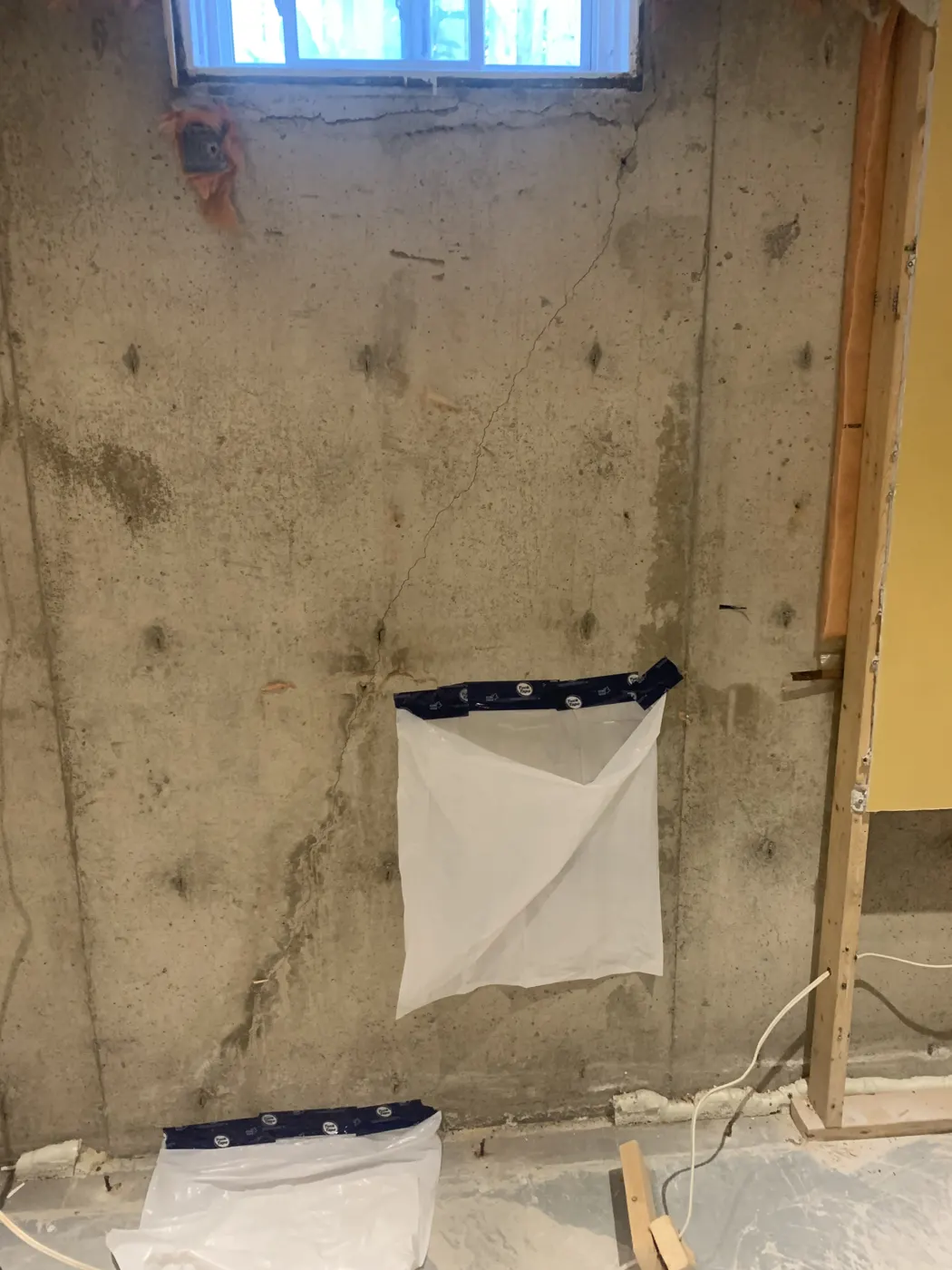
Before — a diagonal crack from a window corner. Stress concentrating at an opening. Damp at the surface with staining running below it.
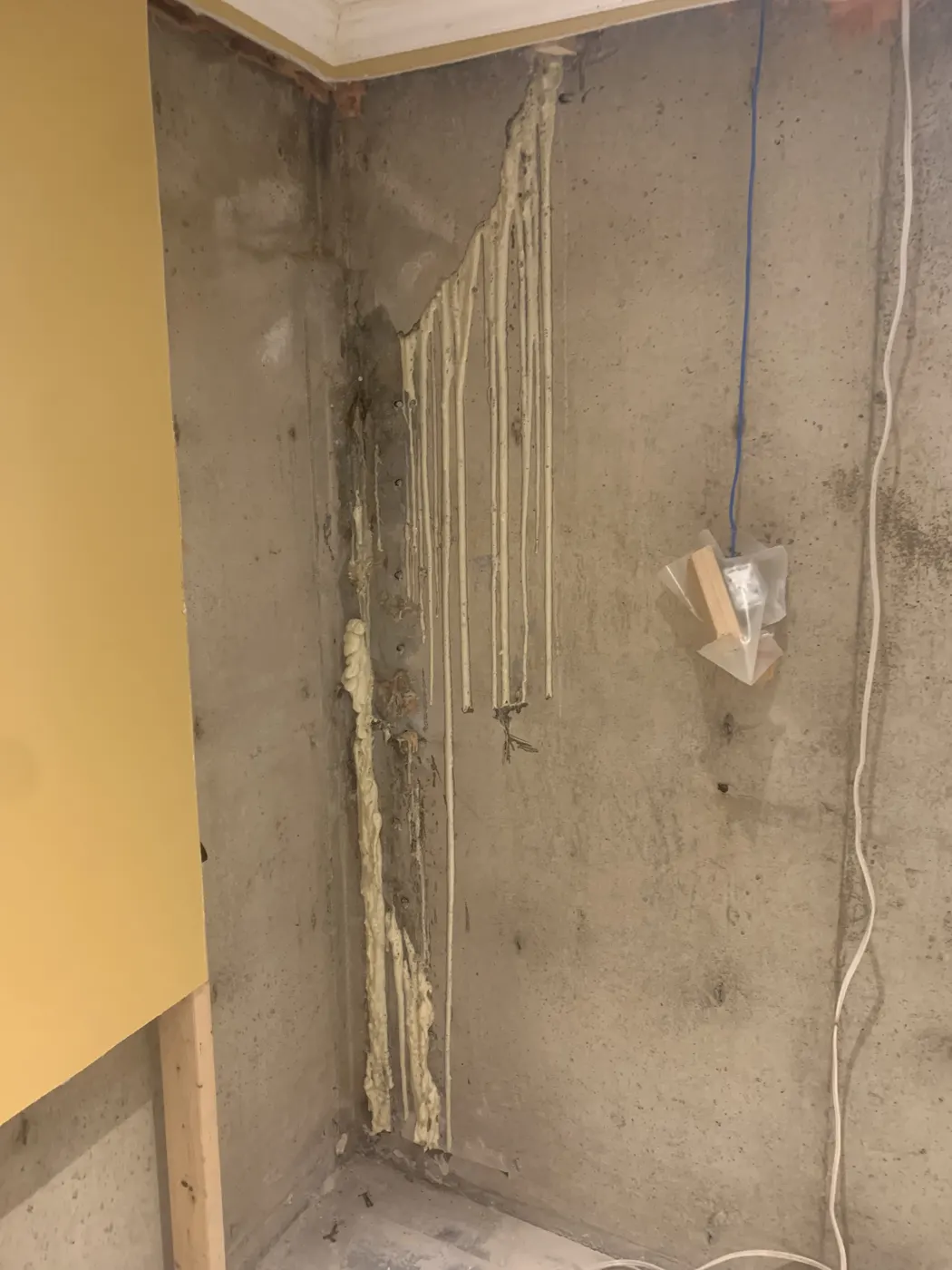
A cold joint, not a crack. The straight line where two pours met. Extremely common, reliably sealed, and frequently misdiagnosed as structural damage.
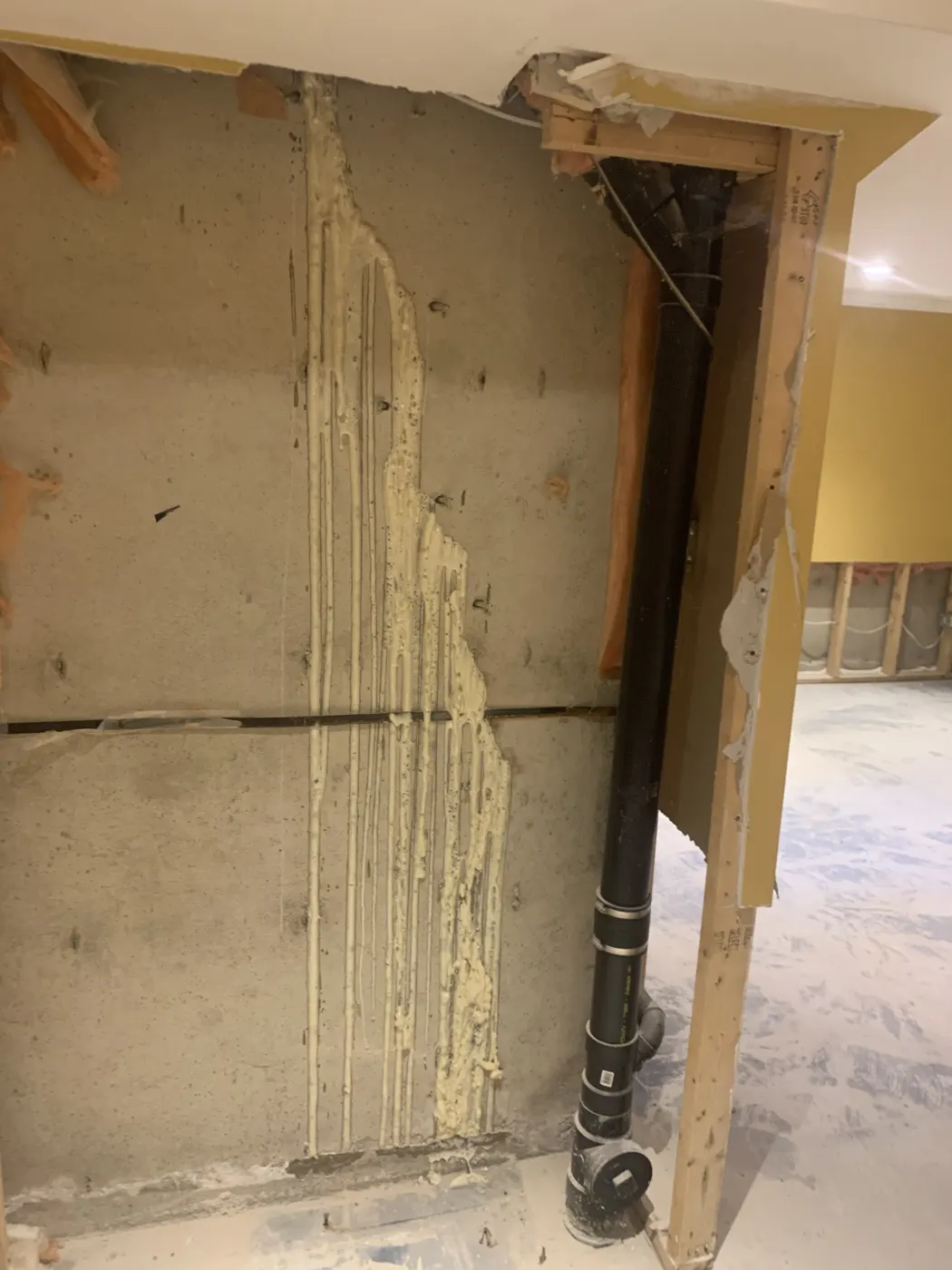
During — resin arriving full depth. Foam showing at the surface means that section is full. It reacts with the water already in the joint.
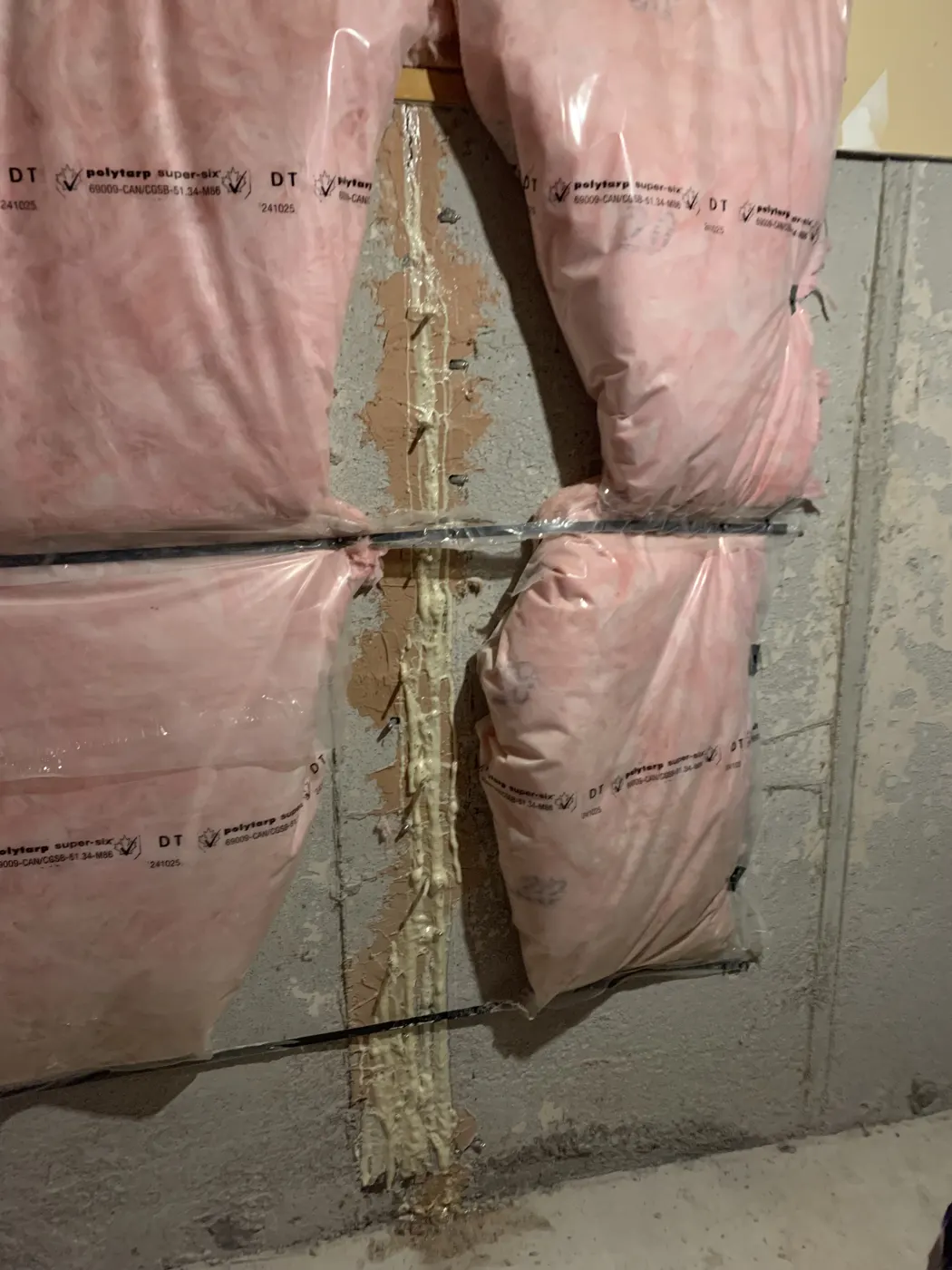
After — sealed through the wall. Not a skim over the visible line. The wall can be insulated and boarded over the same week.
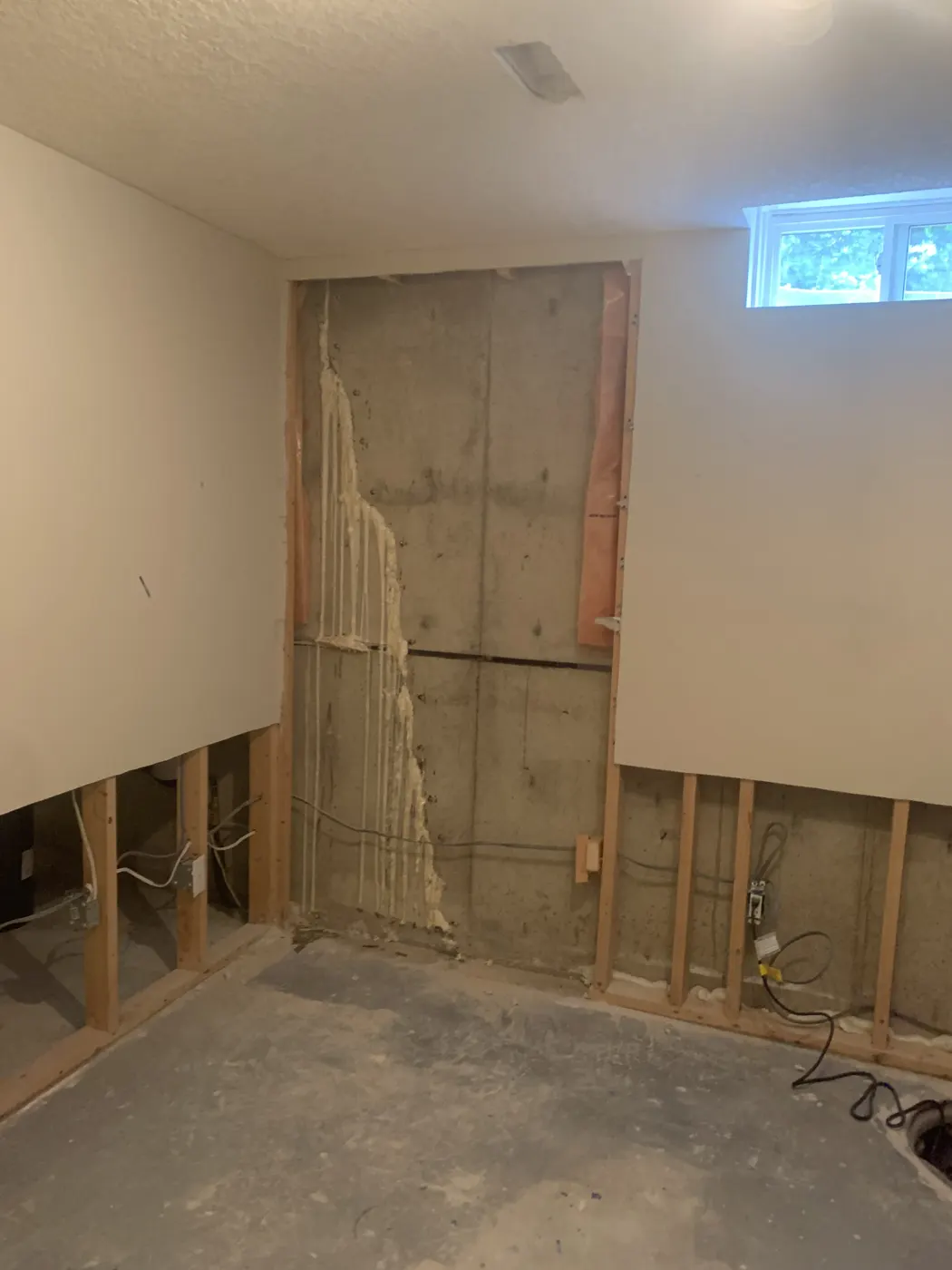
Ready to close up. What a finished repair looks like before the drywall goes back. Nothing to maintain and nothing to revisit.
Per crack, in writing, before anything starts. No hourly billing and no travel surcharge.
| Factor | Effect | Why |
|---|---|---|
| Number of cracks | Largest single factor | Each crack is its own set-up: ports, surface seal, resin, cure. |
| Height of the crack | Moderate | Full height takes more ports and more material than a metre near the floor. |
| Wall thickness | Moderate | Thicker walls need deeper ports and more resin to fill front to back. |
| Finished vs bare wall | Can be significant | Insulation and board must come off to reach concrete, and go back after. |
| Access | Minor to moderate | A wall behind storage, a furnace or a stairwell takes longer. |
| Travel to Cambridge | None | Quoted from the same published ranges as our Toronto work. |
Ranges are published openly on our crack injection cost page rather than held back for a sales call. If you have more than one crack, book them together — the second and third on the same visit cost considerably less than the first.
All of Cambridge. What changes is the answer you get.
Find a section of basement wall with nothing covering it and look at it closely. Poured concrete is a single grey mass, usually with faint horizontal form lines and sometimes small round tie-rod holes at regular spacing. Stone is obvious once you see it — individual rocks with mortar between them. Block is regular rectangles with mortar joints in a grid. If it is painted or parged you may need to look at an unfinished corner or behind the furnace. Send us a photo and we will tell you for nothing.
No, and we will not take the job. A rubble or stone wall has voids and mortar joints running through it, so injected resin does not fill a single crack — it disperses into the wall and finds its own way out. Your money is gone and the water still arrives. For a leaking stone wall the honest options are exterior excavation with a membrane and drainage, or an interior drainage system with a sump. Neither is what we do, and we will say so.
No, and anyone telling you otherwise is selling. When a river floods, water arrives over the top of the ground and enters through everything at once. A sealed crack is irrelevant to that scenario. Injection solves a different and far more common problem: groundwater under pressure pushing through a crack in a poured wall after heavy rain. Both can be true of the same house, but fixing one does nothing for the other.
For interior crack injection, normally no — nothing outside the building is disturbed. For exterior excavation on a property inside a Grand River Conservation Authority regulated area, quite possibly yes, and a good deal of riverside Cambridge is inside one. Call the GRCA before anyone breaks ground. It costs you a phone call and it avoids a stop-work order.
On 17 May 1974 the Grand River, which runs about 0.61 metres deep through a normal May, peaked at over five metres. Water reached Dickson Street in downtown Galt and Riverside Park in Preston went under. The dykes, berms and levee work along the river through Cambridge were built in response. It is the reference event locally, and it is also the reason people wrongly assume every Cambridge basement problem is a river problem.
We could not find one. Toronto, Peel and Halton run basement flooding subsidy programs; we found no City of Cambridge or Region of Waterloo equivalent. Even where such programs exist they fund plumbing work — backwater valves, sump pumps, weeping tile disconnection — and crack injection would not usually qualify. Budget the full cost, and check the city’s own site before taking our word for it.
Yes, regularly. We work out of North York and Cambridge is a little over an hour down the 401. There is no travel surcharge — the published per-crack ranges are the same ones we quote in Toronto. If you have several things you want looked at, get them all on one visit rather than calling us back in a month.
For a leaking crack, polyurethane almost always. It reacts with the water already present, foams to fill irregular voids, and cures flexible so seasonal movement does not break the seal. Epoxy is rigid and far stronger in tension, which makes it right when the goal is to structurally rebond a crack — usually under engineering direction. Epoxy often will not bond properly in a wet crack in the first place.
Most single-crack jobs are a few hours in one visit. The resin cures quickly and there is no waiting period before you can use the space again. Several cracks, or a finished wall that has to be opened up first, will stretch it, but it is usually still the same day.
The repair carries a transferable lifetime warranty. Polyurethane stays flexible, so the ordinary seasonal movement of an Ontario foundation does not break the seal. What we cannot warrant is a new crack elsewhere on the wall, or water arriving by a route the injection was never meant to block — through the slab, over the wall, or up a floor drain.
Usually not, and we will say so at no charge. A hairline vertical crack that has never been wet and is not widening is doing no harm. Pencil a mark at each end with the date, photograph it, and check after a wet spring. If it has moved or wept, call. If not, leave it alone.
Not an injection job on its own. A horizontal crack normally means lateral pressure — soil or ice pushing the wall inward — and that is a structural question before it is a waterproofing one. Sealing it hides the symptom while the cause continues. We will look, give you our honest read, and refer you to an engineer if that is what the wall needs.
It can help, and it is common in the older Cambridge cores. Underpinning often replaces a stone footing with poured concrete, which means the newer poured section may well be injectable even though the original wall above or beside it is not. This is exactly the case where a photo is not enough and someone needs to look at it properly. The assessment is free.
Not for an ordinary vertical or diagonal crack in a poured wall. You do need one when the wall is bowing or moving, when a crack is measurably widening over months, when the foundation is stone and the question is structural, or when a lender, insurer or buyer wants a professional opinion in writing. In Ontario that report comes from a professional engineer, and we will tell you when we think you have reached that point.
Live Google reviews for Concrete Crack Repair Pros, straight from our own Google Business Profile.
What this page is built on, so you can check us rather than trust us.
Free written assessment. An exact per-crack price before anything starts — and a straight answer if your wall is not something we should be injecting.