
All ranges in one place: foundation crack repair costs, published.
#eef2f7}}
Home › Service Areas › Whitby
A two-kilometre band of ancient beach sand runs east–west through Whitby, and the ground either side of it behaves nothing alike. Flat pricing from $750, one visit, lifetime transferable warranty.
Coverage: We service Toronto, the GTA and Southern Ontario, and Whitby sits on our eastern lakeshore route alongside Ajax, Pickering and Oshawa — regular ground for our crews, travel folded into the flat pricing. The assessment is free, and most Whitby cracks are injected in the same visit.
Foundation crack repair in Whitby costs a flat $750–$1,000 per crack for polyurethane injection and $850–$1,500 for structural epoxy, with every additional crack 5% off. Durham Region offers no subsidy — only a $3,000 interest-free loan for a backwater valve and sump pump, and only after a sanitary sewer backup. Whitby runs no program of its own, and the Town publishes no list of permit-exempt work, so we confirm scope with Building Services on 905-430-4305 before starting.
Conservation authority mapping explains why Whitby basements behave so differently street to street.
The Central Lake Ontario source protection assessment divides this area into three physiographic regions, and Whitby crosses all three. In the north, around Ashburn and Myrtle, sits the Oak Ridges Moraine — described as “the most significant groundwater recharge area in the watersheds.” Through the middle runs the South Slope, “a drumlinized plain, consisting of areas of thin aeolian sand deposits underlain by glacial deposits, mainly till.” Along the lake lies the Iroquois Plain, “a remnant of Glacial Lake Iroquois.”
The Iroquois Plain itself splits in two, and this is the part worth knowing if you own a house here. There is the Iroquois Beach — “a northerly, east-west trending band of sandy beach and shallow water lacustrine deposits (approximately 2 km in width)” — and south of it the plain proper, “formed by fine-grained lacustrine deposits.” So a two-kilometre strip of sand and gravel runs across Whitby, with fine silt and clay below it toward the lake. Sand delivers water to a foundation wall fast; fine-grained lakeplain holds it against the wall instead. Same town, two entirely different problems.
At surface across much of Whitby sits Halton Till, “texturally variable, but… generally a sandy silt to clayey silt till,” typically 3 to 6 metres thick though exceeding 15 to 30 metres locally. Its measured horizontal hydraulic conductivity is about 5.0 × 10⁻⁷ metres per second — low permeability, meaning water perches on it rather than draining through. Beneath that, the dense over-consolidated Newmarket Till — up to 60 metres thick — acts as a regional aquitard separating the upper aquifers from the lower. Perched water above a low-permeability layer is the single most common reason a Whitby basement wall carries pressure it was never designed for. Locally the Town’s own Michael Boulevard flood study characterises neighbourhood soils as clay loam with silty clay layers.
Whitby is the municipality Durham Region names by name.
Durham Region’s flooding history records that “over the summer of 2008, Whitby and other areas in Durham experienced extreme rainfall. June, July, and August recorded levels at 185%, 400%, and 150% of monthly averages, with some localized intense storms exceeding the 100-year event.” The consequence, in the Region’s words: “the extreme and constant rainfall saturated the ground and resulted in the capacity of underground storm systems being exceeded and excess stormwater flows that flooded multiple areas. Basement flooding also occurred in at least 150 homes.” Local municipalities upgraded storm systems afterward.
Read the mechanism carefully, because it matters for diagnosis. The Region does not describe foundations failing. It describes ground so saturated that the storm system could not keep up. That is the pattern we still see in Whitby: a wall that is perfectly dry for months takes water during a prolonged wet spell, because the water table rose and the perched water above the till had nowhere to go. Injection seals the pathway through the wall, which is genuinely the right fix in many of those cases — but if your weeping tile has failed or your lot grading sheds water toward the house, sealing one crack just moves the problem. We check all three at the free assessment.
The money position, stated plainly.
| Region | What you get | Maximum |
|---|---|---|
| Durham (Whitby) | Interest-free loan repaid on your water bill — backwater valve and sump pump only, after a sewer backup | $3,000 |
| City of Toronto | Subsidy — 80% of invoice across five measures | $6,650 combined |
| Halton Region | Subsidy — up to 100% across five measures | $6,500 per measure |
| Foundation crack injection | Not covered anywhere — flat-priced from $750 instead | |
The Town of Whitby offers no municipal subsidy, grant, rebate or loan for basement flooding, backwater valves, sump pumps, foundation repair or waterproofing. Its drainage and grading page puts the responsibility squarely on the owner: “as a property owner, it is your responsibility to ensure that the grading on your property” meets municipal standards, and “all construction projects need to meet the drainage provisions within the Town’s Property Standards By-law. Failure to comply could result in a fine.” Because the Durham loan document dates from 2009, confirm the terms are still current with the Region before planning around the figure.
Four questions, instant range — polyurethane or epoxy, multi-crack discount included, no obligation.
Two frames from our crews’ recent work.
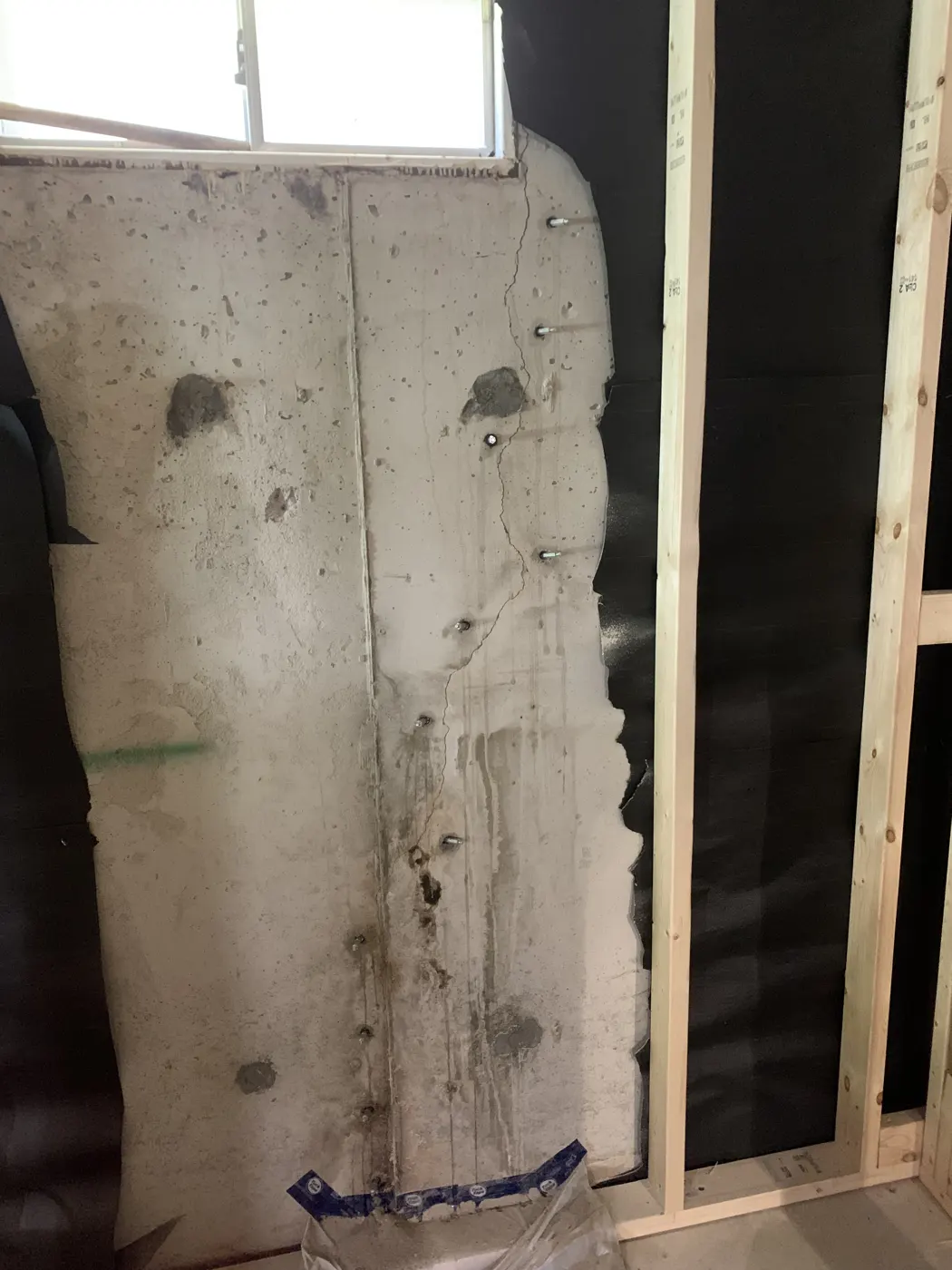
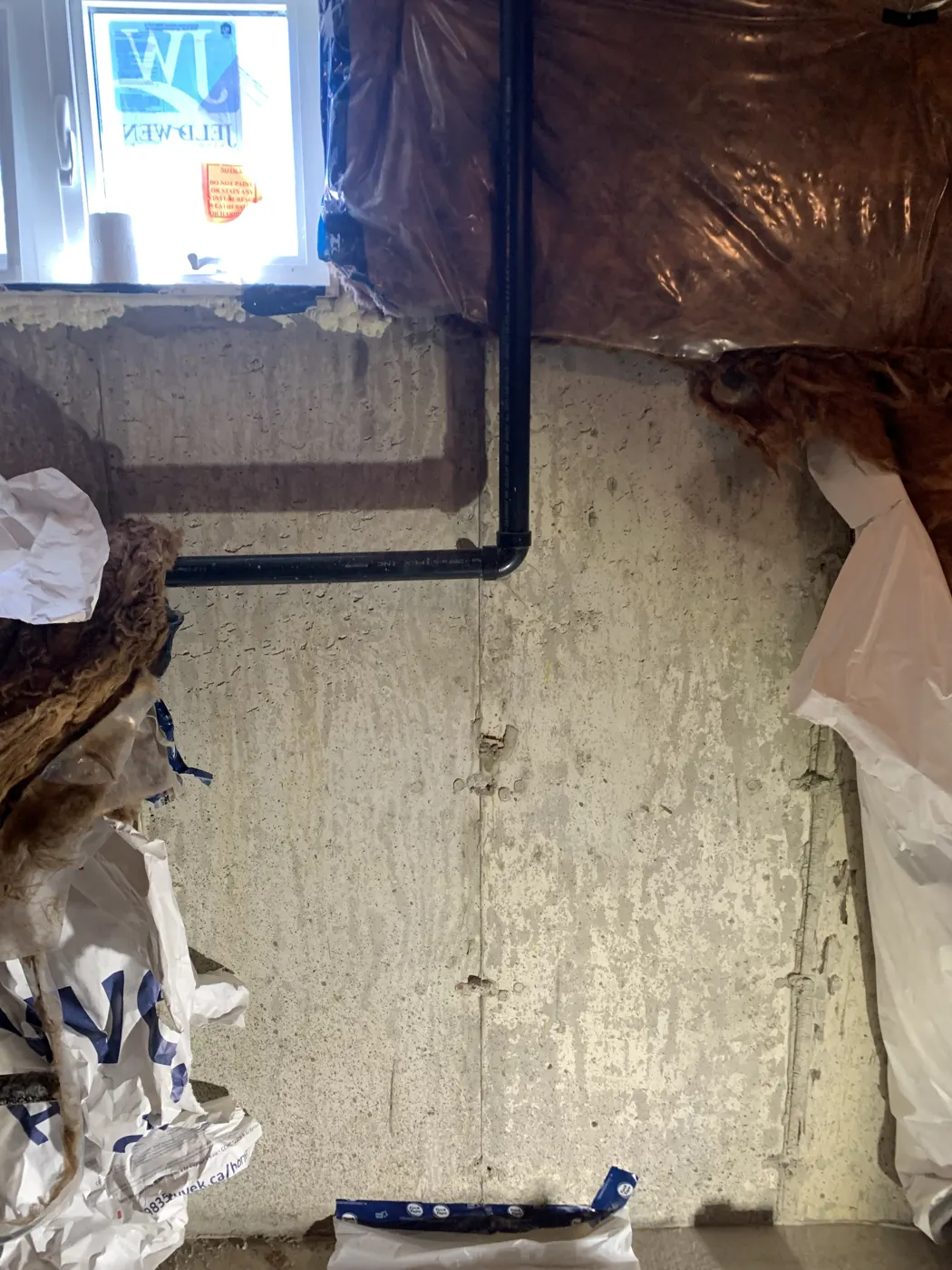
Perched water and structural movement want different resins.
A crack that runs during prolonged wet spells — the Whitby signature, water perched above low-permeability till — gets hydrophobic polyurethane ($750–$1,000). It cures against live water and stays flexible. A crack that has grown across seasons, or one carrying structural load, gets epoxy injection that re-bonds the wall ($850–$1,500). Tie-rod leaks run $75–$150, extra cracks are 5% off each, and the complete method guide, the polyurethane page, the epoxy page and the open price sheet hold nothing back. Not sure which pattern you are looking at? Our guide to the five types of foundation crack explains what each orientation indicates, and why width alone tells you very little.
One visit — and the honest permit position.
Photo quotes come back the same day; the on-site assessment is free either way. A typical crack takes 60–90 minutes from the basement side — no excavation through Whitby landscaping, no seasonal blackout. On permits, Whitby publishes a list of projects that do require a building permit but no list of exemptions, and foundation repair, waterproofing and crack injection appear nowhere in any Whitby permit document. What the Town does list as requiring a permit includes structural alterations, wall modifications, plumbing and drains, finished basements and basement walkouts — so anything beyond a straightforward non-structural interior injection may well need one. We call Whitby Building Services on 905-430-4305 (3050 Garden Street, Unit 102) before we start rather than assume.
The honest variables inside the published ranges.
Lots on the Iroquois Beach band, where sand delivers water quickly, can need patient multi-port injection because water keeps arriving during the work. Long full-height cracks use more resin than hairlines. Finished basements add access care — common in a town that is nearly 70% single-detached homes. Heritage foundations in Port Whitby, the Werden’s Plan district and downtown Brooklin are a different conversation: injection is engineered for poured concrete, where a crack is a discrete plane through a monolithic pour, and stone or rubble has no such plane for resin to seal against. Every crack after the first is 5% off, and all of it is on the published cost breakdown before we ever ring your doorbell.
Port Whitby to Brooklin, Ashburn to Blue Grass Meadows.
Downtown Whitby and the Werden’s Plan neighbourhood, Port Whitby, Brooklin, Pringle Creek, Blue Grass Meadows, Rolling Acres, Williamsburg, Taunton North, Lynde Creek, Otter Creek, plus Ashburn and Myrtle in the rural north. Where the Town’s own heritage documents give us dates we use them: Port Whitby traces to an 1819 land grant and was one of three communities that formed the original Town of Whitby in 1855, with documented houses from 1854–1857; the Werden’s Plan Heritage Conservation District covers roughly 250 properties from Asa Werden’s 1854 plan of subdivision, where growth “stalled and remained slow until the mid-twentieth century” after the 1857 financial panic; and the Brooklin district was “surveyed in the 1840s and early 1850s” with heritage buildings “constructed between 1840 and 1929.” The oldest listed property in Whitby is Lynde House, 900 Brock Street South, from 1812–1814. Our Oshawa guide covers the next city east, our Ajax guide the next town west, and the full service-area index lists every city we publish for.
The numbers behind the warranty.
A quarter-century of GTA basements kept dry.
Injection repairs warrantied for life — and the warranty moves with the house when you sell.
Full commercial coverage on every job, every crew, every home.
Eligible contractor for City of Toronto, Peel & Halton basement-flooding subsidy programs.
Inspection, honest diagnosis, and an exact per-crack quote — free, no pressure.
Your price is confirmed in writing before any work starts — no hourly surprises.
Every review below is a real, verifiable Google review of Concrete Crack Repair Pros. Nothing is paraphrased, and nothing is borrowed from a sister company.
Are these reviews genuine? Every review shown above is pulled live from the Concrete Crack Repair Pros Google Business Profile at 64 Millwick Dr, North York — not from a parent or sister brand’s listing. The rating and the count update automatically as new reviews arrive, so what you see here is what is on Google right now.
The same name, address and phone number we publish everywhere, so you can check us before you call.
Not according to the mapping, and it is worth clearing up because the name circulates locally. The Ontario Geological Survey’s bedrock map of southern Ontario does not carry a Whitby Formation in its legend, and the source protection assessment for this area identifies the bedrock beneath Whitby as the Middle Ordovician Lindsay Formation — limestone and shale — and the Upper Ordovician Blue Mountain Formation shale, which was named from a reference section in Lincoln County on the Niagara Peninsula. The name does appear in older Ordovician literature, but do not let anyone sell you a repair on the strength of it. In any case bedrock is not what cracks your basement here; the till above it is.
The Iroquois Beach is described as “a northerly, east-west trending band of sandy beach and shallow water lacustrine deposits (approximately 2 km in width)” running across the Iroquois Plain, with fine-grained lacustrine silt and clay south of it toward the lake. There is no simple address lookup, but the behaviour tells you: on sand, water arrives at the wall fast during and just after rain and leaves quickly. On the fine-grained plain or on Halton Till, water lingers and pressure builds slowly over a wet season. We can usually tell which you are on from how and when your wall gets wet.
No — and the Region’s own account is clear about it. Rainfall hit 185%, 400% and 150% of monthly averages across June, July and August, with some storms exceeding the 100-year event, and the result was that “the capacity of underground storm systems being exceeded” while saturated ground could absorb nothing more. That is a stormwater capacity failure, not a foundation failure. Municipalities upgraded the storm system afterward. What it does show is how Whitby basements get wet: prolonged saturation raising perched water against walls that are dry the rest of the year.
Whitby does not publish an answer, so we do not pretend to have one. Unlike Pickering, which explicitly exempts basement waterproofing repairs, Whitby publishes only a list of work that does require a permit — structural alterations, wall modifications, plumbing and drains, finished basements, basement walkouts — with no exemption list at all. Foundation repair, waterproofing and crack injection are named nowhere in any Whitby permit document. We call Building Services on 905-430-4305 before starting. Note that “structural alterations” is on the required list, so anything beyond a non-structural interior injection likely needs one.
Sometimes, and we will tell you honestly at the assessment. The Brooklin district was surveyed in the 1840s and early 1850s and its heritage attribute is “buildings constructed between 1840 and 1929” — a range that straddles the arrival of poured concrete. Injection is engineered for poured walls, where a crack is a discrete plane through a monolithic pour. Stone, rubble and mortared block have no such plane, so water moves through joints and voids across the whole assembly and there is nothing for resin to seal against. The district also contains post-1994 infill, which injects perfectly well. It depends on your house, not your postcode.
Worth knowing about, but the honest picture is less alarming than the maps suggest. The Town’s Michael Boulevard study models 24 homes at risk in a 50-year storm, 45 in a 100-year, and over 500 in a Regional (Hurricane Hazel) event, with the large floodplain extent driven mainly by a backwater condition at the CN and Metrolinx rail culverts. But the same report states there have been “no reports of homes damaged by flooding from Lynde Creek,” though floodwater has reached private property in recent severe storms. A recommended flood protection berm is costed around $500,000. Riverine flood risk and groundwater against your foundation are separate problems; only the second one is ours.
Method, resins and money — documented before you commit.
Perched water on Halton Till is our daily work: free assessment, flat published pricing, one-visit repair, lifetime transferable warranty — and an honest answer when your weeping tile is the real problem.