
All ranges in one place: foundation crack repair costs, published.
#eef2f7}}
Home › Service Areas › York
The old Lake Iroquois shoreline runs along St. Clair Avenue here, and behind it sit clay beds thick enough that they once fed the local brickyards. Flat pricing from $750, one visit, lifetime transferable warranty.
Coverage: We service Toronto, the GTA and Southern Ontario, and the former City of York is home ground — crews run the Humber and Black Creek corridors daily, travel folded into the flat pricing. The assessment is free, and most York cracks are injected in the same visit.
Foundation crack repair in York costs a flat $750–$1,000 per crack for polyurethane injection and $850–$1,500 for structural epoxy, with every additional crack 5% off. No building permit is required for interior injection — Toronto lists “undertaking waterproofing repairs to a basement” as exempt. Toronto’s Basement Flooding Protection Subsidy reaches $6,650 across five measures, none of which is crack repair. Toronto’s single largest basement flooding project is being built under these streets right now.
The single most useful piece of geology on this page, and it comes from the City’s own study.
Most Toronto pages repeat that the ancient Lake Iroquois shoreline sits “about five kilometres north of the waterfront.” That figure describes the downtown stretch at Davenport and Casa Loma. Out here it is different, and the City’s own St. Clair Avenue West transportation study — covering St. Clair from Keele Street to Old Weston Road, squarely inside the former City of York — puts it precisely: “Davenport Road, which was shown on maps as early as 1794, followed an early trail along the base of the Lake Iroquois shoreline,” and “the Davenport Bar was located at about St. Clair Avenue.”
Then the sentence that matters most to a foundation: “Large beds of clay that accumulated behind the bars were used for the manufacturing of brick.” That is a municipal document telling you the ground north of the old bar is heavy clay — thick enough to have supported an industry. The Brown family potteries in Mount Dennis were “exploiting the area’s rich clay deposits” by the 1870s, and the Junction had brickyards on the same deposits.
South and west of the bar is old lake bottom. City planning records that Mount Dennis “lay beneath the waters of the ancient Lake Iroquois” whose levels stood “about 30 metres higher than the present Lake Ontario,” leaving “sand, clay and gravel deposits,” while the lower Humber sits in the Iroquois Plain — “a sloping plateau made up of well-drained sandy loam soils deposited by glacial Lake Iroquois.”
So York gives you two different basements in one district: free-draining sandy loam on the old lake plain toward the Humber, where water reaches a wall fast and leaves fast, and heavy brick-grade clay behind the bar, where water perches and pressure builds over days. We can usually tell which one you have from when your wall gets wet, not just whether.
Two major builds are live in York right now — this is not a plan, it is a tunnel boring machine.
The Fairbank Silverthorn Storm Trunk Sewer System is, in the City’s own description, its largest basement flooding prevention project. It serves Basement Flooding Study Area 3, covers a 140-hectare area spanning four wards, and is built to “help mitigate basement flooding and sewer backups for more than 12,500 people living in 4,645 homes.”
The scale is worth stating plainly: a 4.5-metre-diameter tunnel running about 2.4 kilometres at depths of 15 to 40 metres, bored by a 270-tonne machine, with a capacity of 9,500 litres per second, running beneath Fairbank Memorial Park, Kitchener Avenue, Bert Robinson Park, Dunvaven Drive, Nashville Avenue, Bicknell Avenue and Westbury Crescent before discharging to Black Creek near Keelesdale Park. Alongside it: roughly 17 kilometres of new local storm sewers, 20 shafts and 330 inlet control devices. Total cost is around $380 million, including $73.2 million from the federal Disaster Mitigation and Adaptation Fund. Work started in October 2021; Phase 1 finished in 2025 and Phase 2 runs to 2026–27.
Separately, Rockcliffe-Smythe — which the City calls “one of the most flood-prone areas in Toronto” — has its own programme addressing both riverine flooding and sewer overloading, referencing Study Areas 4 and 45. TRCA counts 366 properties in the regulatory floodplain there and records flooding in Hurricane Hazel, July 2013 and August 2018, with new modelling identifying Lavender Creek as a significant source along Hilldale Road. Jane Street bridge construction is expected to begin in late August 2026, with further phases running to 2032.
The honest read: if your basement takes water only when the system surcharges, this work may fix your problem without you spending anything. It will not touch groundwater pressing on your foundation wall, and none of it crosses your property line. We will tell you which one you have.
Worth claiming. Just not for your wall.
| Eligible measure | City pays | Maximum |
|---|---|---|
| Home plumbing assessment | 80% of invoice | $500 |
| Backwater valve | 80% of invoice | $1,600 per device, up to 2 |
| Sump pump | 80% of invoice | $2,250 |
| Sump pump battery backup | 80% of invoice | $300 |
| Severing and capping the weeping tile connection | 80% of invoice | $400 |
| Combined maximum per property | $6,650 | |
| Foundation crack injection | Not among the eligible measures — flat-priced from $750 instead | |
Crack repair is not excluded by a clause — the eligible list is exhaustive and it simply is not on it. On permits, Toronto’s published list of work that does not require one includes “undertaking waterproofing repairs to a basement,” and a sump pump needs no permit either. A backwater valve installation does. Permits are also required for structural or material alterations, excavating or constructing foundations, basement underpinning and basement entrances. Toronto Building is on 416-397-5330, or 311 within the city.
Four questions, instant range — polyurethane or epoxy, multi-crack discount included, no obligation.
The Humber’s worst night happened here — and Weston had already learned the lesson once.
Hurricane Hazel’s most infamous scene was in Weston. Environment and Climate Change Canada’s archive records that on Raymore Drive the river took 1,200 feet of street, destroyed 14 homes and killed 35 people. The mechanism was brutal: a Bailey bridge spanning the river south of the Weston fairgrounds tore loose and “became a battering ram against homes on Raymore Drive, tearing them from their foundations.” Black Creek, normally “one foot deep and so narrow that a person is able to jump across,” rose to cover Humber Boulevard, Porter Avenue and Cordella Avenue in south Mount Dennis.
What is less often told is that Weston had already been through this twice. The 1850 flood “destroyed most of the buildings on the low west banks of the river,” and the 1878 flood wiped out water-powered mills across the Toronto area including some in Weston. The community responded by relocating to higher ground — a decision that, in ECCC’s words, “undoubtedly saved lives during Hazel.” The part of the community that had not moved was the part that died in 1954.
The aftermath reshaped the district permanently: low-lying land along the Humber was expropriated by Metropolitan Toronto and became the backbone of the regional park system, which is why the lower Humber is parkland today. And Hazel still governs the maps — TRCA’s regulatory floodplain is based on the Hazel event, which is why it is called the Regional Storm.
Two frames from our crews’ recent work.
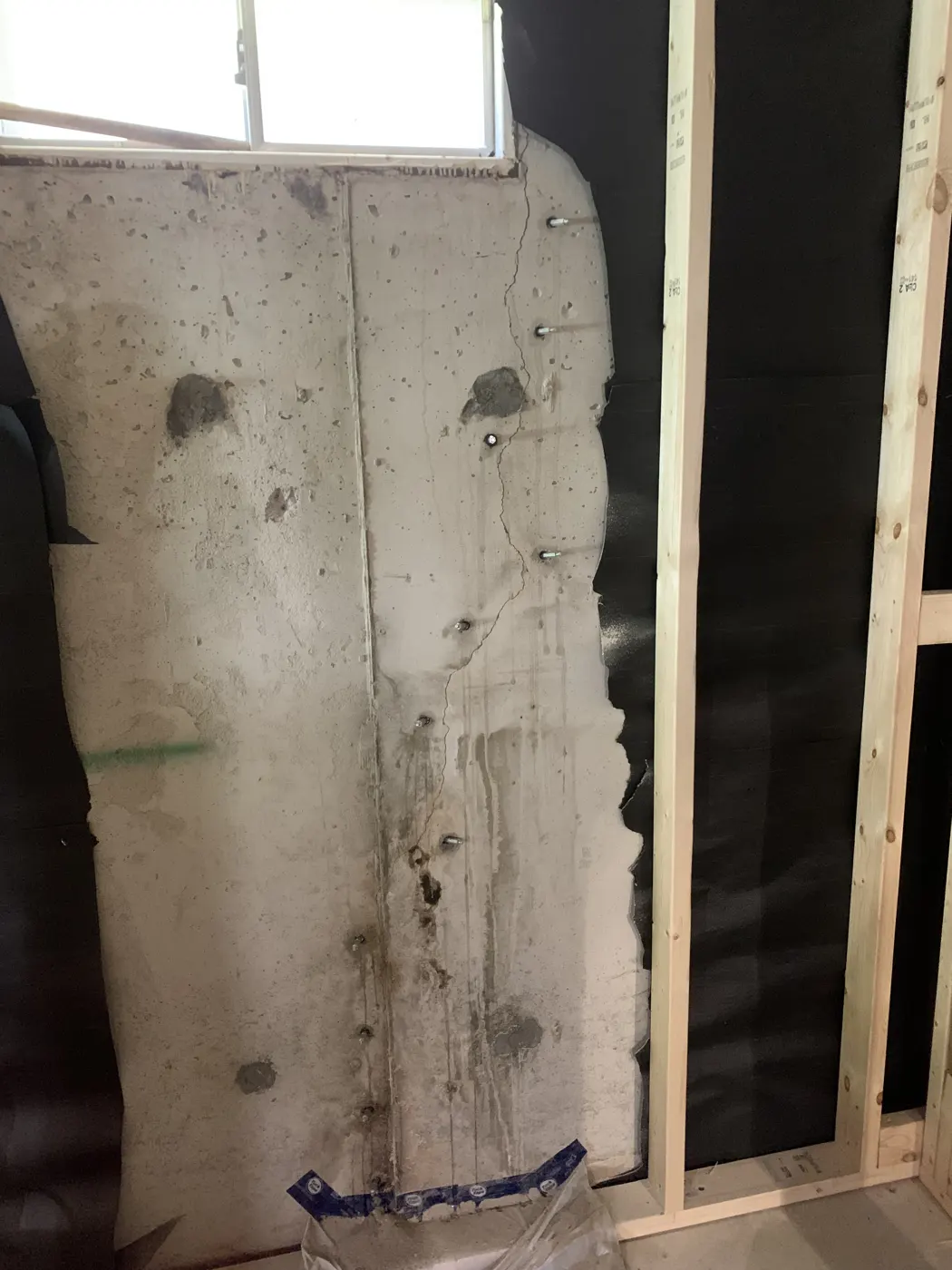
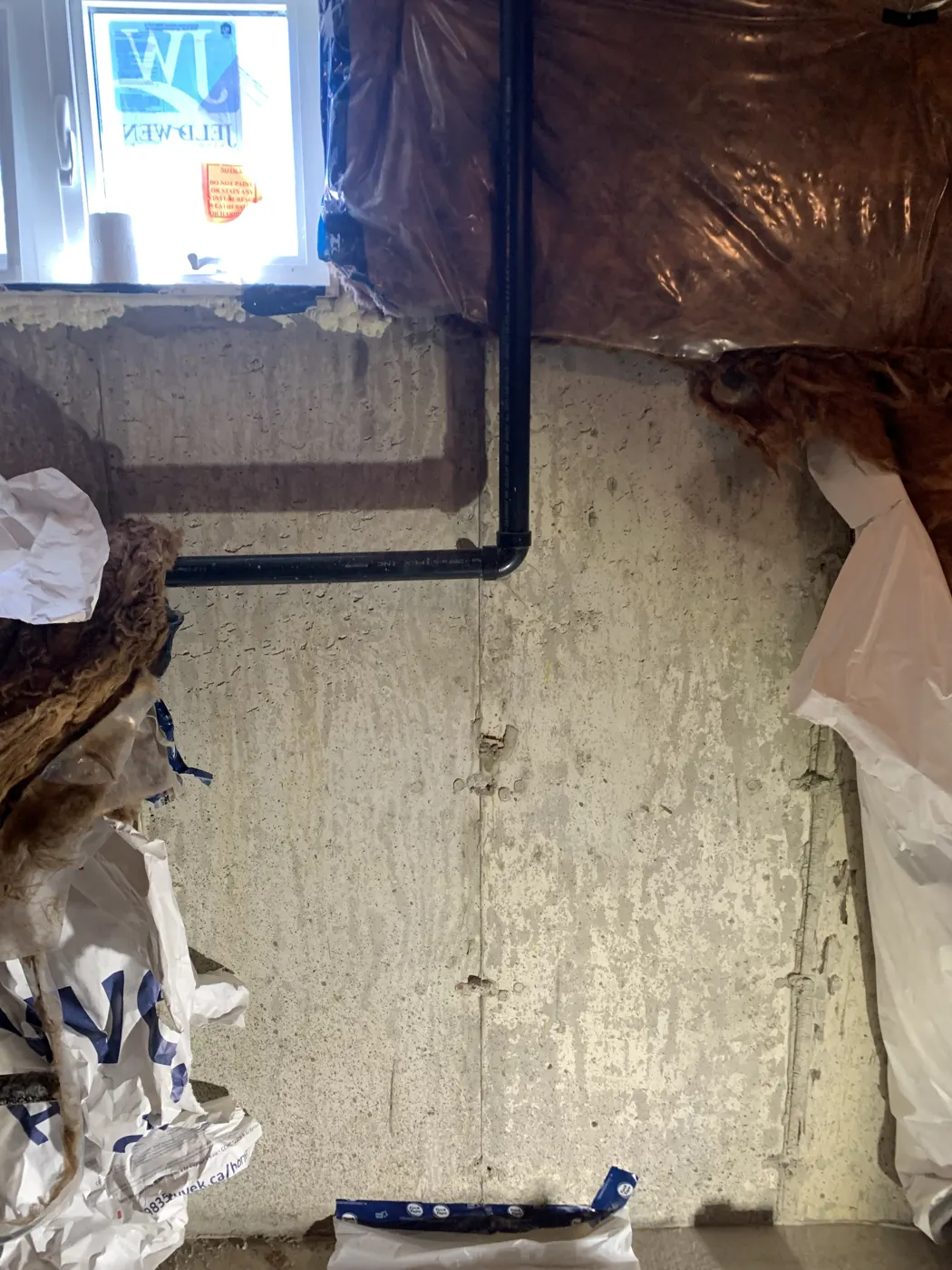
Sand and clay want different resins.
A crack fed by free-draining sandy loam near the Humber runs during and just after rain, then stops — that gets hydrophobic polyurethane ($750–$1,000), which cures against live water and stays flexible. A crack behind the old bar, in brick-grade clay, weeps slowly for days as pressure builds; same resin, more patience, sometimes multi-port. A crack that has grown across seasons or is carrying load gets epoxy injection that re-bonds the wall ($850–$1,500). Tie-rod leaks run $75–$150, extra cracks are 5% off each, and the complete method guide, the polyurethane page, the epoxy page and the open price sheet hold nothing back. Not sure which pattern you have? Our guide to the five types of foundation crack explains what each orientation indicates.
Two of the best-documented build histories in Toronto.
Weston has a paper trail going back to a post office in 1820. Its first registered subdivision, Plan No. 5, dates to 1846. The Grand Trunk Railway arrived in 1856. Significant subdivision continued north of Lawrence Avenue West between the 1850s and 1880s, while the area south of Lawrence — though subdivided by the 1870s — stayed largely agricultural until around 1910. Weston became an incorporated village in 1881 at 1,200 residents, a Town in 1915 at 2,200, and had reached 4,425 by 1929. Within the Weston Heritage Conservation District, roughly a quarter of buildings date from 1902–1918 and about half from 1919–1945. Apartments arrived from 1954, and by 1965 the stretch of Weston Road north of Church Street was “nearly unrecognizable.”
Mount Dennis is even sharper. Named for the Loyalist Dennis family who patented land from 1801, it first appears on maps in 1890. Then it detonates: about 400 people in 1904, roughly 1,750 by 1914 with at least 31 new subdivision plans registered between 1908 and 1915, and 9,878 by 1928 — a twentyfold rise in twenty-four years, driven by Kodak Canada, whose main facility was built in 1917 and stood until 2005. Apartment towers on Emmett Avenue followed in 1969, 1971 and 1975.
The census confirms what those histories imply. In the York South-Weston ward, 35.9% of dwellings predate 1960 and 69.9% predate 1981, while just 3.5% were built after 2010 — one of the lowest new-build shares in the city. This is pre-war and early post-war housing that has largely not been redeveloped, which is precisely the stock where foundation cracks are mature, common, and worth repairing properly.
The honest variables inside the published ranges.
In housing this old, block and rubble foundations are common, and injection is engineered for poured concrete walls where a crack is a discrete plane through a monolithic pour. Mortared block moves water through joints and voids across the whole assembly, so resin has nothing to seal against — we say so at the assessment rather than inject a wall that will not hold it. Properties behind the old shoreline bar, in heavy clay, can need patient multi-port injection because water keeps arriving during the work. Long full-height cracks use more resin than hairlines, and finished basements add access care. Every crack after the first is 5% off, and all of it is on the published cost breakdown before we ever ring your doorbell.
Weston to Humewood, Mount Dennis to Oakwood Village.
Weston, Mount Dennis, Silverthorn, Keelesdale, Rockcliffe-Smythe, Beechborough-Greenbrook, Briar Hill-Belgravia, Caledonia-Fairbank, Oakwood Village and Humewood-Cedarvale. We publish build eras only where a municipal source supports them — Weston and Mount Dennis above — and for the rest we use the ward census profile and the City’s own infrastructure record rather than decades we cannot source. Five basement flooding study areas cover this district: Keele Street and Eglinton Avenue West, Jane Street and St. Clair Avenue West, Weston, York–Cedarvale, and Black Creek. Our Etobicoke guide covers the district west, our North York guide the district north, and the full service-area index lists every city we publish for.
The numbers behind the warranty.
A quarter-century of GTA basements kept dry.
Injection repairs warrantied for life — and the warranty moves with the house when you sell.
Full commercial coverage on every job, every crew, every home.
Eligible contractor for City of Toronto, Peel & Halton basement-flooding subsidy programs.
Inspection, honest diagnosis, and an exact per-crack quote — free, no pressure.
Your price is confirmed in writing before any work starts — no hourly surprises.
Every review below is a real, verifiable Google review of Concrete Crack Repair Pros. Nothing is paraphrased, and nothing is borrowed from a sister company.
Are these reviews genuine? Every review shown above is pulled live from the Concrete Crack Repair Pros Google Business Profile at 64 Millwick Dr, North York — not from a parent or sister brand’s listing. The rating and the count update automatically as new reviews arrive, so what you see here is what is on Google right now.
The same name, address and phone number we publish everywhere, so you can check us before you call.
At about St. Clair Avenue — not the “five kilometres north of the waterfront” figure that describes downtown. The City’s St. Clair Avenue West study, covering Keele Street to Old Weston Road, states that “the Davenport Bar was located at about St. Clair Avenue,” and adds that “large beds of clay that accumulated behind the bars were used for the manufacturing of brick.” So behind the bar you have heavy clay that holds water against a wall; south and west toward the Humber you have old lake bottom — sand, clay and gravel, with well-drained sandy loam on the Iroquois Plain. The alignment further north through Weston and Silverthorn is not published, so we do not claim it.
It is the Fairbank Silverthorn Storm Trunk Sewer System — Toronto’s largest basement flooding prevention project. A 4.5-metre tunnel running about 2.4 km at 15 to 40 metres depth, 9,500 litres per second of capacity, plus roughly 17 km of new local storm sewers, 20 shafts and 330 inlet control devices, at around $380 million. It is built to protect more than 12,500 people in 4,645 homes across a 140-hectare area, discharging to Black Creek near Keelesdale Park. Phase 2 runs to 2026–27. If your basement floods because the sewer surcharges, this is aimed squarely at you. If your wall weeps in an ordinary wet week, it will not change anything.
Documented and serious, and worth separating from foundation issues. The City calls Rockcliffe-Smythe “one of the most flood-prone areas in Toronto,” with both riverine flooding and sewer overloading. TRCA counts 366 properties inside the regulatory floodplain and records flooding in Hurricane Hazel, July 2013 and August 2018, with newer modelling identifying Lavender Creek as a significant source along Hilldale Road. Jane Street bridge construction is expected to start in late August 2026. That is river flooding — a different problem from groundwater against your foundation, and only the second one is ours to solve.
On the night of 15 October 1954 the Humber took 1,200 feet of Raymore Drive, destroyed 14 homes and killed 35 people. Environment and Climate Change Canada records the mechanism: a Bailey bridge south of the Weston fairgrounds tore loose and “became a battering ram against homes on Raymore Drive, tearing them from their foundations.” It is worth getting right, because the event is often misattributed elsewhere in Toronto. The land along the lower Humber was expropriated afterwards and became parkland, and TRCA’s floodplain maps are still based on the Hazel event to this day.
Because the Humber taught it twice before Hazel. The 1850 flood “destroyed most of the buildings on the low west banks of the river,” and the 1878 flood wiped out water-powered mills including some in Weston. The community rebuilt on higher ground, and ECCC’s account notes that decision “undoubtedly saved lives during Hazel” — the part that had not moved was the part that died. For a homeowner today it is a useful reminder that in this district elevation relative to the river matters more than almost anything else, and that the oldest surviving housing tends to sit where earlier generations decided it was safe to build.
No — it means predictable ones. In the York South-Weston ward 35.9% of dwellings predate 1960 and 69.9% predate 1981, with very little redevelopment since. Walls of that age finished their drying shrinkage generations ago, so their cracks are almost always mature and stable rather than actively moving, which usually makes them straightforward polyurethane work. The real variable in stock this old is not age but construction type: poured concrete injects well, mortared block often does not, and we check that before quoting rather than after.
Method, resins and money — documented before you commit.
Pre-war walls in brick-grade clay are our daily work: free assessment, flat published pricing, one-visit repair, lifetime transferable warranty — and an honest answer when the City’s tunnel is about to solve your problem for free.