
Home › Service Areas › Kitchener
Polyurethane and epoxy injection for leaking poured-concrete foundations across Kitchener — Doon, Forest Heights, Stanley Park, Victoria Park, Bridgeport and the newer Rosenberg and Huron Park subdivisions. Free written assessment, transferable lifetime warranty.
Injection seals a crack in a poured wall. Kitchener’s older core has a lot of block and stone foundations, where injection is the wrong tool. We establish which you have before anything is priced.
No excavation in most cases. Ports are set along the crack, resin is injected through the wall, and the basement is watertight the same day.
A crack that only runs in March is still a real crack. Snowmelt over partly frozen ground is when Kitchener foundations see their highest water pressure of the year.
Not every crack needs repair. If it has never been wet and is not moving, we will say so rather than sell you a job.
A straight, level horizontal crack points to soil pressure, not shrinkage. Injection stops water through it; it does not fix a wall that is bowing. That needs an engineer.
$750–$1,000 per crack for polyurethane, $850–$1,500 for epoxy. No Kitchener travel surcharge. Assessment is free and written.
Quick answer
Can a leaking foundation crack in Kitchener be repaired from inside? In most poured-concrete basements, yes. A crack that is passing water is injected with polyurethane resin through ports set along its length, from inside the basement, without excavating the exterior. The work takes a few hours and the wall is watertight the same day. Kitchener adds two local wrinkles worth knowing about: the city sits on the Waterloo Moraine and its municipal water comes from groundwater wells rather than a lake, so water tables here behave differently from Toronto’s; and a large share of Kitchener’s housing predates the poured-wall era, which changes what can be injected at all.
Kitchener does not behave like Toronto underground, and the difference shows up in basements.
Kitchener sits on the Waterloo Moraine — a thick, complex pile of glacial sand, gravel and till left behind by retreating ice. It is not uniform. Within a few streets you can move from free-draining sand to dense clay till, and the two treat a foundation wall very differently. Sandy ground sheds water quickly and puts little lateral pressure on a wall. Clay till holds water, swells when wet, shrinks when dry, and leans on the wall through both.
The unusual part is the water. Kitchener is part of one of the largest communities in Canada drawing its municipal drinking water primarily from groundwater wells rather than a lake. That is a fact about the water supply, not about your basement — but it points at the thing that matters: this is an aquifer landscape. Groundwater is close, it moves, and its level responds to season and rainfall more directly than in a lake-supplied city. Where your house sits relative to that water is the single biggest factor in whether a hairline crack stays dry or runs every spring.
Add the Grand River and its tributaries cutting through the city — Schneider Creek, Idlewood Creek, the flats around Bridgeport — and you get pockets of genuinely high water table inside an otherwise well-drained region. Two identical houses a kilometre apart can have completely different basements.
Concrete cracks for ordinary reasons everywhere: shrinkage as it cures, settlement as the ground adjusts, thermal movement, and hydrostatic pressure when water builds against the outside. Kitchener does not invent new failure modes. What it changes is the water half of the equation — how much, how often, and how seasonally. A crack that would sit dry and harmless in sandy ground on the west side can run water every March in a low-lying pocket near a creek.
Which is why we will not quote a Kitchener basement from a photograph. The crack tells you one thing. Where the house sits tells you the rest.
The same crack behaves completely differently depending on what your house is sitting in. This is why two neighbours get opposite answers.
Moraine ground: why one street floods and the next one does not
Why we will not quote from a photo. The crack tells you one thing; what the house is founded in tells you the rest. Two identical hairlines a kilometre apart can need completely different answers.
Crack injection works on poured concrete. A good share of Kitchener’s housing stock is not poured concrete, and being straight about that saves everyone a wasted visit.
Kitchener is an old city by Ontario standards, and its building eras are visible street by street. Around Victoria Park, Centreville and the older parts of downtown you find pre-war houses, many with stone, rubble or early block foundations. The post-war and mid-century wave — Forest Heights, Stanley Park, Bridgeport, Country Hills — brought in block and, increasingly, poured walls. From roughly the 1970s onward, and right through Doon, Pioneer Park, Huron Park, Laurentian Hills and the newer Rosenberg lands, poured concrete is the norm.
Why it matters:
If you are not sure what you have, that is completely normal — and it is the first thing we establish on site, before anything is priced. If your wall turns out to be block or stone we will tell you on the day and we will not sell you an injection that cannot work.
What we look for on a first visit, and what each finding usually means.
| What you are seeing | Usual cause | What it needs |
|---|---|---|
| Vertical or near-vertical crack, damp or running | Shrinkage or settlement that has opened a path | Polyurethane injection. Reacts with the moisture in the crack and expands through the full wall thickness. |
| Vertical crack, bone dry, hairline | Curing shrinkage — extremely common, rarely urgent | Often nothing today. If it has never been wet, we will tell you to keep an eye on it rather than sell you a repair. |
| Diagonal crack from a window or door corner | Stress concentration at an opening, usually with some settlement | Injection seals it. If it is still widening, that is a movement question first. |
| Horizontal crack, straight and level | Lateral soil pressure — a different and more serious category | Injection stops water. It does not restore a wall that is bowing. That needs an engineer. |
| Water at the floor/wall joint | The footing-to-wall joint, under-slab water, a crack above draining down, or failed weepers | Four different problems that look identical. See our cold joint page — diagnosis before drilling. |
| Regular small holes in a grid | Tie-rod holes from the original forming, not cracks at all | Sealed individually. See leaking tie-rod holes. |
General guidance from our own site experience, not a diagnosis. Any crack showing movement, offset or inward bowing is a structural question and should be looked at by a professional engineer before any sealing work is considered.
Run it yourself before anyone quotes you. Two of these five outcomes are not an injection at all.
Decision path for a Kitchener foundation crack
Two of five answers are “not injection”. That ratio is roughly what we find on site, and it is why the assessment comes before the price.
Same method we use across the GTA, done in an afternoon.
We confirm the wall is poured concrete, find where water is actually entering, and check whether the crack is the cause or a symptom of something else.
Injection ports are drilled on alternating sides of the crack and angled to meet it at depth, spaced to the thickness of the wall.
A surface seal goes over the crack between ports so the resin travels into the wall under pressure instead of squeezing straight back out.
Resin is pumped port by port, lowest first. Return at the next port up confirms it has bridged the gap — that confirmation is why the sequence matters.
The polyurethane reacts with moisture in the crack and expands into a closed-cell foam through the full depth. Ports come out, the face is dressed back, and we check it against the next real rainfall.
The same published ranges we use across the GTA. Kitchener is not priced differently.
HST extra. Finished-basement access and restoration are quoted separately. Volume pricing applies from three cracks up, which is worth knowing if you have a wall with several.
Final price is confirmed after a free on-site assessment. The ranges above are real published pricing, not a teaser rate.
What actually happens between your call and a dry wall.
Tell us roughly where the water shows up and what the wall is made of if you know. If you have a photo, send it — it helps us come prepared, though it is not enough to quote from.
We come to Kitchener, look at the wall, check what the water is actually doing, and confirm whether injection is the right repair. Written findings, no charge, no obligation.
Scope and price in writing before anything is booked. If the honest answer is drainage rather than injection, that is what the document says.
Most single cracks are a few hours. The wall is watertight the same day and you can put the basement back together immediately.
Our injection work carries a transferable lifetime warranty — it stays with the house rather than with you, so it still means something when you sell.
Photographs from our own jobs, start to finish. Same method we use in Kitchener.
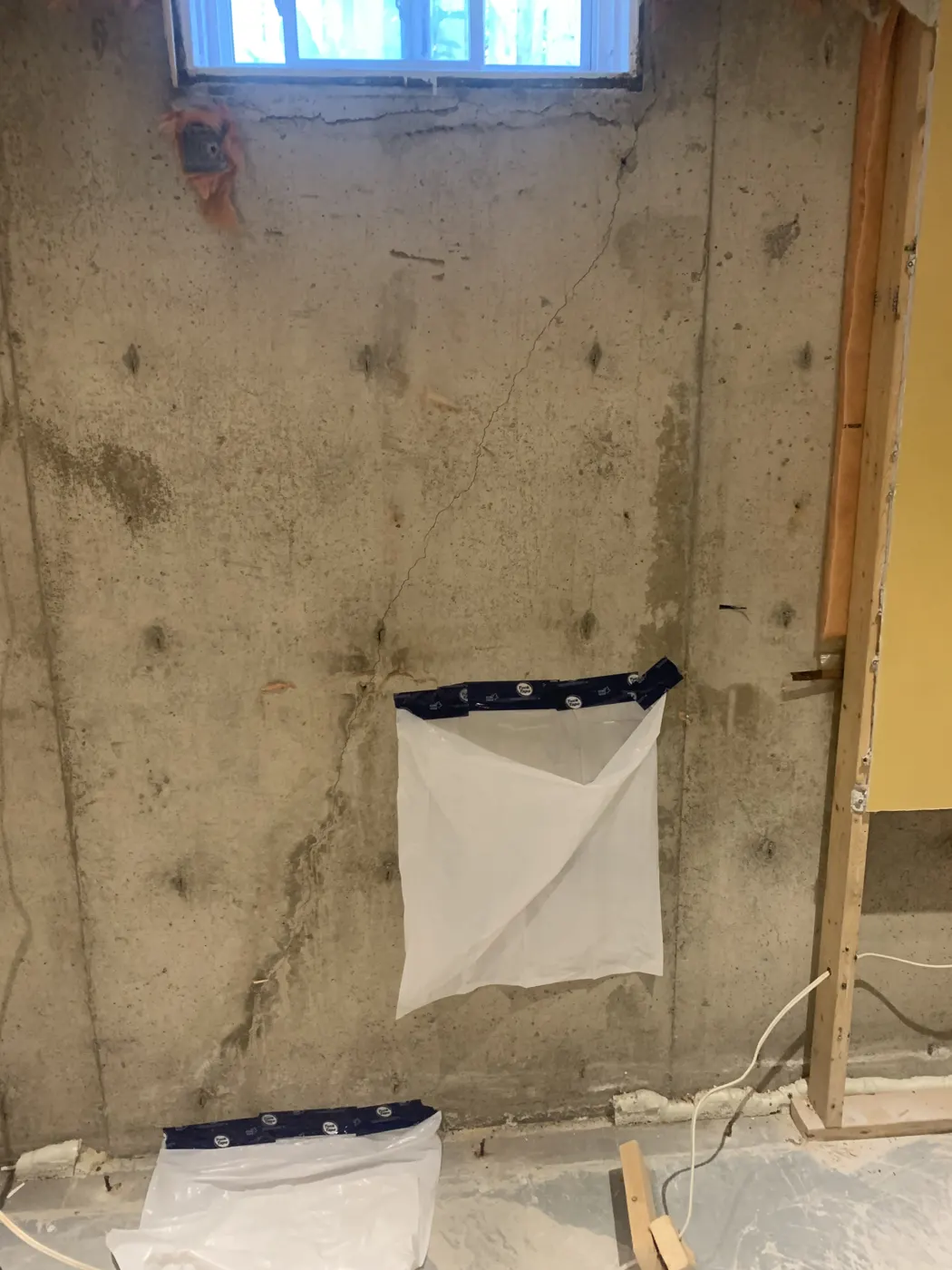
Before — diagonal crack from a window corner. A classic stress crack running down from an opening. Damp on the surface and staining below it, which is what most people first notice.
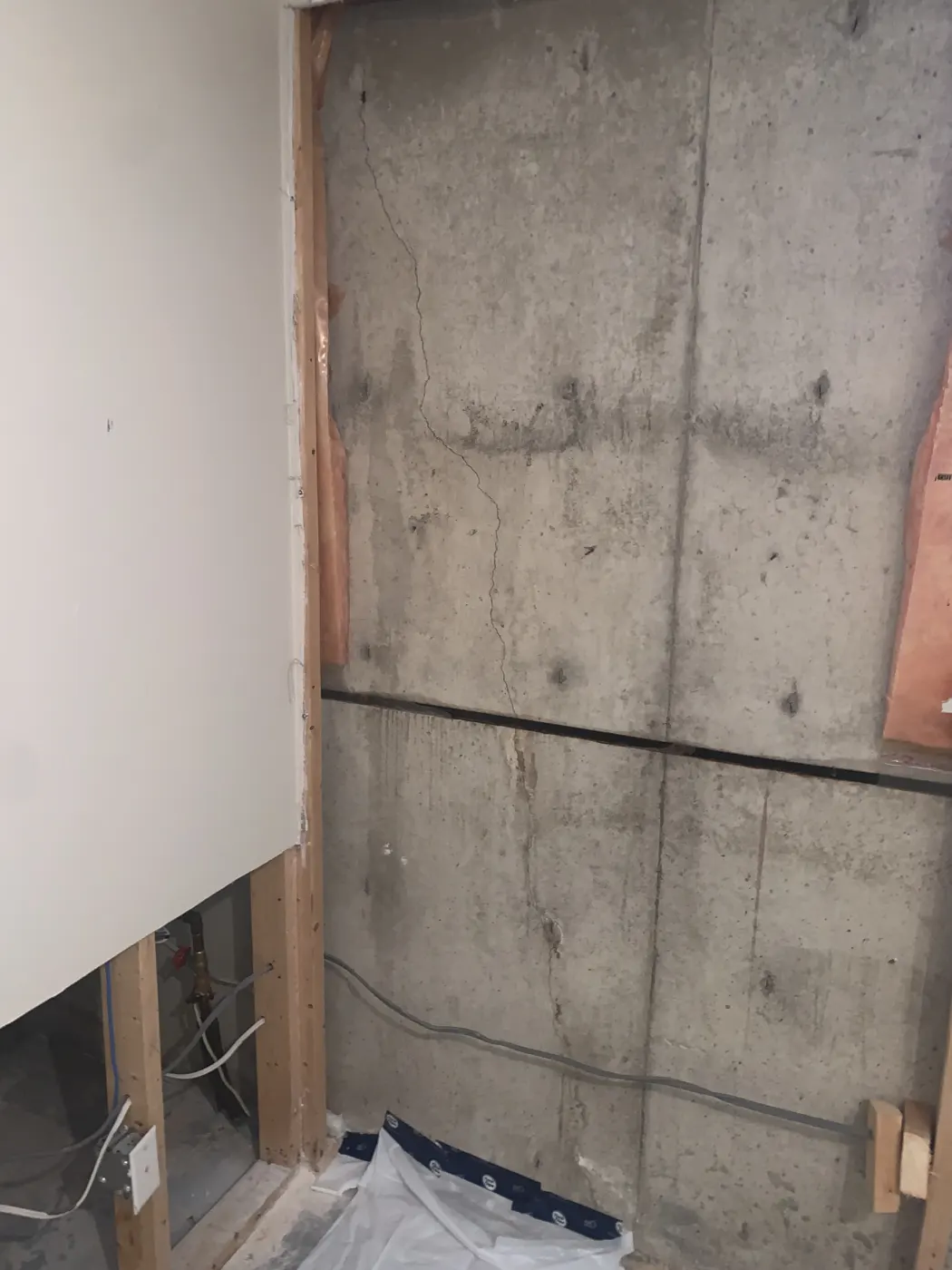
During — resin travelling. Polyurethane pumped port by port from the bottom up. Return at the next port confirms it has bridged the gap through the wall.
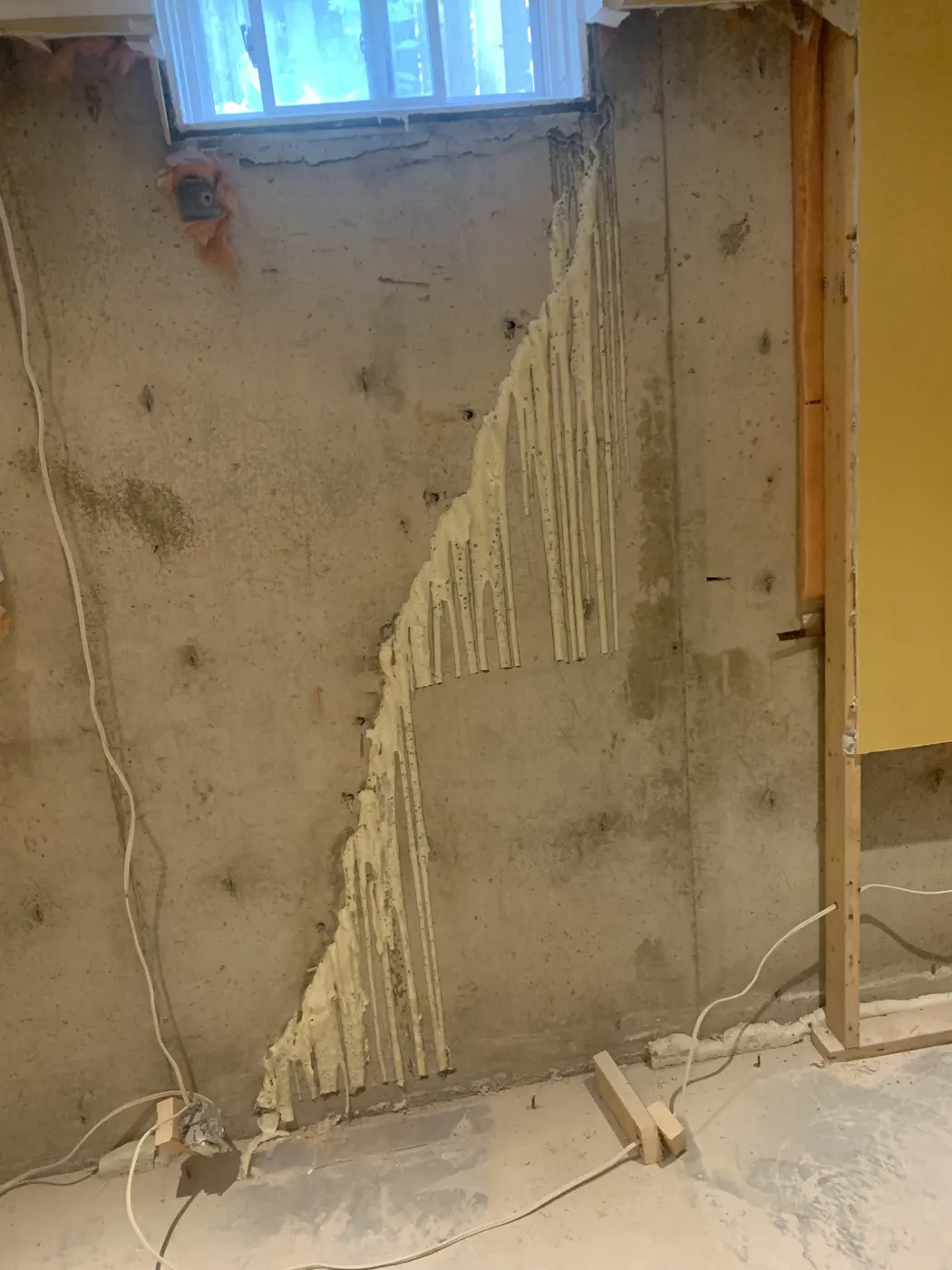
Cured — full depth. The resin has reacted with moisture in the crack and expanded through the full wall thickness. This is what a completed seal looks like.
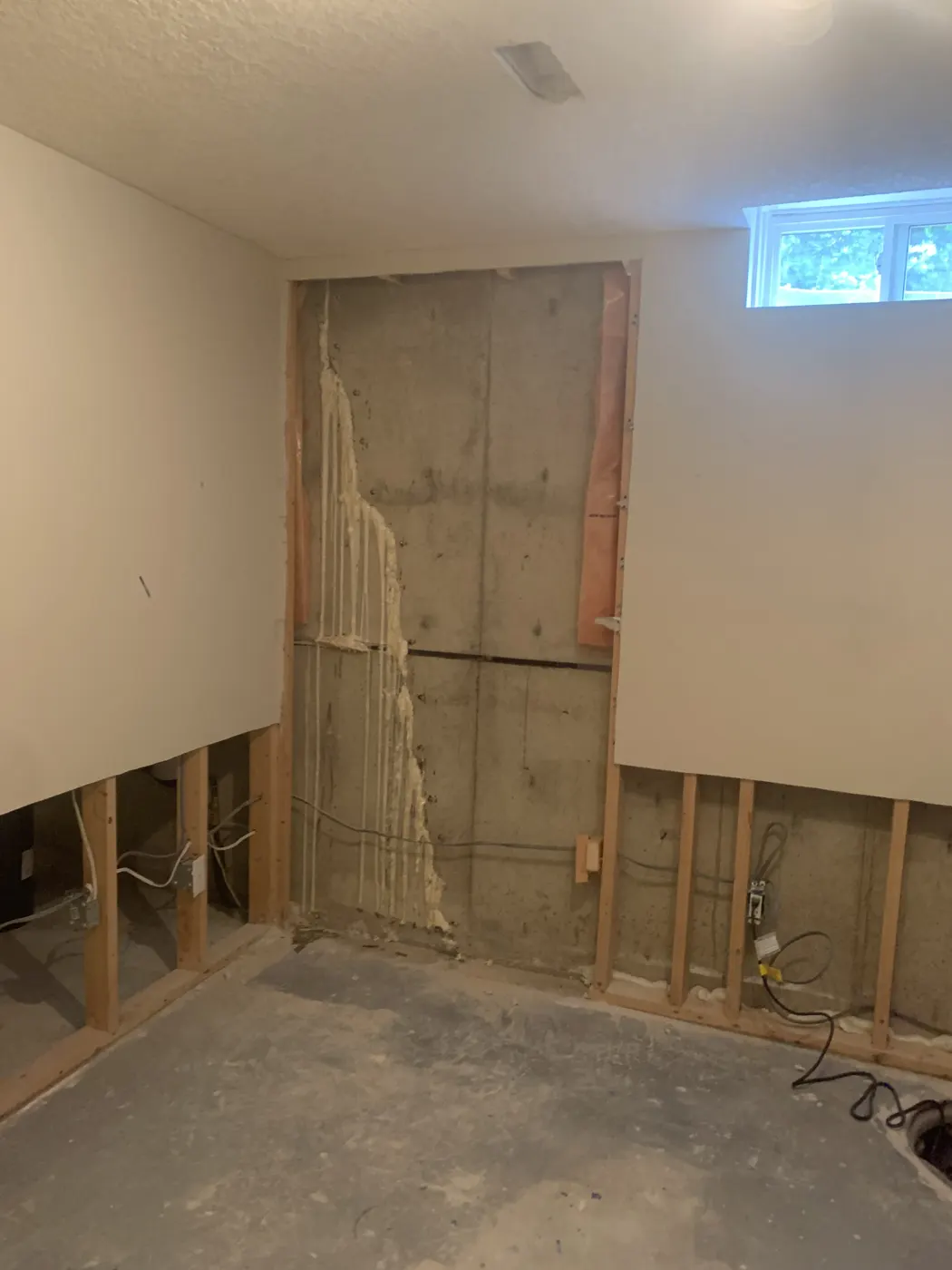
After — dressed back. Ports removed, surface seal finished. We check the repair against the next real rainfall rather than calling it done on the day.
We travel to Kitchener from our North York shop — right across the city.
Central and older Kitchener: Victoria Park, Centreville, Cedar Hill, Mount Hope, Civic Centre, Auditorium, King East, Rockway.
Post-war and mid-century: Forest Heights, Forest Hill, Stanley Park, Heritage Park, Country Hills, Alpine, Bridgeport, Lakeside, Grand River South.
Newer subdivisions: Doon, Doon South, Pioneer Park, Huron Park, Laurentian Hills, Williamsburg, Rosenberg, Idlewood, Grand River North, Trussler.
If you are just outside the city limits and not sure whether we come out that far, call and ask — the answer is usually yes.
Yes. We work out of North York and travel to Kitchener regularly — it is roughly an hour and a quarter each way on the 401. Kitchener jobs are priced from the same published ranges as our GTA work, with no travel surcharge. The practical advice is to book everything you want looked at in one visit rather than calling us back for a second crack a month later.
Indirectly, and it is worth understanding. The Waterloo Moraine is a thick, uneven deposit of glacial sand, gravel and till, and it changes character over short distances. Free-draining sand sheds water away from a foundation; dense clay till holds it, swells when wet and shrinks when dry. Kitchener also draws its municipal water from groundwater wells rather than a lake, which tells you this is an aquifer landscape where groundwater is close and seasonally active. None of that creates new kinds of cracks — it changes how much water ends up pressing against the ones you have.
Usually not, and we would rather say so before we drive out. Injection is designed for poured concrete, where the crack is a single path through a solid wall. A block wall is hollow cores and mortar joints, so water moves sideways and down inside the wall and sealing one joint often just relocates the leak. Older central-Kitchener houses with stone or rubble foundations are further still from what injection can do. If you are unsure what you have, send a photo or describe the wall on the phone and we will tell you honestly whether a visit is worth your time.
Municipal basement flooding subsidy programs in Ontario generally target sewer-related protection — backwater valves, sump pumps, sewer lateral work — rather than foundation crack repair, and the programs change their terms periodically. We are not going to state what the City of Kitchener or Region of Waterloo currently covers, because getting that wrong would cost you money. Check directly with the City of Kitchener and the Region of Waterloo before you assume a crack injection is eligible, and ask specifically about foundation crack repair rather than basement flooding in general.
Almost always groundwater and melt, not a change in the crack. Through winter the ground is frozen and water is locked up as snow and ice. In March that releases all at once, the ground thaws from the top down while deeper soil is still frozen, and water has nowhere to go but sideways and against your foundation. A crack that has been quietly dry for months finds itself under real hydrostatic pressure for a few weeks. It is why spring is our busiest season and why a crack that only leaks in March is still worth sealing — the pressure is real even if the leak is seasonal.
Routine repairs generally do not require a permit, but structural alterations do, and the line between them is a municipal call rather than ours. Straightforward crack injection sits on the repair side in most Ontario municipalities. If your situation involves underpinning, wall replacement, or anything an engineer has specified structurally, that is a different matter. Confirm with the City of Kitchener building division for your specific address and scope — it is a short phone call and it is their answer to give, not ours.
Scope, not just a number. It should name which wall and which crack, the linear length being treated, the resin being used and why, whether the price covers one crack or several, and what happens if the crew opens it up and finds something different. It should also state plainly what is not included — drywall and framing removal, restoration afterwards, HST. Our assessment is written and includes what we found, not only what we propose to do about it. If a quote is a single figure with no findings behind it, ask what the cause was determined to be.
We do. Concrete Crack Repair Pros works out of North York and covers Kitchener regularly. We are a specialist crack injection outfit rather than a general waterproofing contractor, which is why this page spends as much time on when injection is the wrong answer as on when it is the right one. Free written assessment, transferable lifetime warranty, and a 24-hour line on (800) 371-5302 for an active leak.
Yes, in almost every case. Injection is an interior repair — no excavation, no machinery, nothing dug up outside. A typical single crack takes a few hours and the wall is watertight when the crew leaves. You can move furniture back and use the room the same evening. If a finished wall had to be opened up to reach the crack, the restoration of that finish is the part that takes longer, and it is quoted separately so you know in advance.
Yes. This surprises people, but winter is often a good time to do it. The work is entirely inside a heated basement, and polyurethane cures by reacting with moisture in the crack rather than needing warm air. The advantage of booking in winter is that the repair is in place before the spring melt, which is when Kitchener foundations see their hardest test of the year. The one caveat is that a crack which is bone dry in January may be harder to trace than the same crack in April.
For the crack that was injected, yes — the cured polyurethane does not break down, and our work carries a transferable lifetime warranty on that crack. What a warranty cannot promise is that no other crack ever appears, because the ground keeps moving and concrete keeps responding to it. It also cannot fix a cause that was never addressed: if water is arriving because a downspout discharges against the wall, sealing the crack treats the symptom. A good assessment tells you which situation you are in.
Polyurethane for water, epoxy for structure — and most leaking Kitchener basements want polyurethane. Polyurethane reacts with moisture already in the crack and expands to fill it, which is exactly what a wet crack needs. Epoxy is a rigid structural adhesive: it welds the crack faces back together, it needs a dry substrate to bond properly, and it is the right call when a crack has compromised the wall structurally rather than just letting water through. Using epoxy on an actively leaking crack is one of the more common ways a repair fails.
Usually not. The great majority of foundation cracks are shrinkage or minor settlement — the concrete doing what concrete does as it cures and as the ground beneath it adjusts. They let water in, which is a nuisance and a mould risk, but they are not a sign the house is coming down. The cracks that genuinely signal a structural problem look different: horizontal and level, offset where one side has moved relative to the other, widening over time, or accompanied by a wall that is visibly bowing inward. If yours looks like that, the right first call is a structural engineer, not us.
A visible crack will normally be noted by an inspector, and a leaking one will usually be flagged as a deficiency to be addressed. That is not the same as failing — home inspections do not have a pass mark — but it becomes a negotiating point, and buyers tend to assume the worst about anything involving the word foundation. A documented, warrantied injection changes that conversation completely, because you can hand over paperwork showing what was found and what was done. Our warranty transfers with the house, which is the part that matters at closing.
Live Google reviews for Concrete Crack Repair Pros, straight from our own Google Business Profile.
Worth reading before you book anything — here or with anyone else.
Free written assessment across Kitchener — including an honest answer when injection is not the right repair.