
Wondering about the bigger picture? Here’s how much foundation crack repair costs.
#eef2f7}}
Home › Service Areas › Etobicoke
Sixteen City basement flooding study areas cover Etobicoke and three are under construction right now. None of that work touches your foundation. Flat pricing from $750, one visit, lifetime transferable warranty.
Coverage: We service Toronto, the GTA and Southern Ontario, and Etobicoke is home ground — west-end routes run daily, travel folded into the flat pricing. The assessment is free, and most Etobicoke cracks are injected in the same visit.
Foundation crack repair in Etobicoke costs a flat $750–$1,000 per crack for polyurethane injection and $850–$1,500 for structural epoxy, with every additional crack 5% off. Toronto’s Basement Flooding Protection Subsidy rose to a combined $6,650 per property in May 2026, but its five eligible measures are a plumbing assessment, backwater valve, sump pump, battery backup and weeping tile severance — crack injection is not among them. No building permit is required: Toronto lists “undertaking waterproofing repairs to a basement” as work needing none.
One widely repeated claim about Etobicoke ground is simply wrong.
You will read that south Etobicoke sits on heavy lakebed clay. TRCA’s own technical update says otherwise: “in general these watersheds are situated on the South Slope, Peel Plain and Iroquois Sand Plain regions. The South Slope dominates the upper and lower sections of both watersheds. The Peel Plain intersects the middle of the two watersheds, while the Lake Iroquois Sand Plain exists as a narrow strip towards the bottom of both watersheds.” TRCA further identifies “porous sand and gravel deposits associated with the Iroquois Shoreline feature.” So the strip nearest the lake is sand, not clay.
The clay is the till, and it is everywhere else: “Halton Till deposits dominate the surface,” and TRCA describes the watersheds’ “impermeable clay till soils and the lack of natural storage areas.” That combination produces two different basement problems in one district. On the sand strip through Mimico, New Toronto and Long Branch, water reaches a wall quickly and drains quickly — pressure spikes during and after rain. On the till that covers most of Etobicoke, water perches in the backfill and sits against the wall for days.
Then there is what has been built on top. TRCA measures imperviousness in these watersheds ranging “from 7% in the headwaters to as high as 58% in the Etobicoke Creek and 57% in the Mimico Creek.” Etobicoke Creek is the westernmost watershed in TRCA’s jurisdiction at 22,404 hectares, with six Flood Vulnerable Clusters covering 508 hectares. The Humber, at 90,258 hectares, is TRCA’s largest and the only Canadian Heritage River in the Greater Toronto Area. When more than half the ground is roof, road and driveway, rainfall does not infiltrate — it runs, and it arrives at the low points all at once.
The City is digging up Etobicoke right now. Here is what that does and does not do for you.
Of Toronto’s 67 basement flooding study areas, sixteen cover Etobicoke wards. In Etobicoke Centre: Wellesworth Park, Rathburn and Kipling, Burnhamthorpe and Renforth, Glen Park, Silver Creek–Richview, Kingsview–Humber Creek, Etobicoke Creek–The West Mall, North Mimico Creek–West Deane, Islington-Bloor and Park Lawn, Eglinton West and Renforth, and Highway 427–Queensway. In Etobicoke North: Steeles West at Martin Grove and at Islington, Rexdale Boulevard–The Elms, Rexdale–Finch West and Highway 27, and Royal York–Kingsway. In Etobicoke-Lakeshore: Study Area 53, “roughly bordered by Mimico Creek to CN Rail line to Burlington Street to the Lake,” where recommended works include upsizing the Lake Shore Boulevard West storm sewer and the Mimico Creek outfall at Humber Bay Park.
Three sites are under construction as you read this. Martin Grove, Wellesworth and Gentian in Eringate began in summer 2025 and is expected to finish by fall 2026. The Westway and Kipling began in fall 2025 and finishes by fall 2026, with the intersection tentatively closed August or September 2026. Chapman Road, Drury Lane and Craig Alan Court commenced in April 2026.
Here is the honest caveat. That work is sewer capacity in the public right-of-way. It reduces the chance that the municipal system surcharges and backs up into your basement. It does nothing whatever about groundwater pressing against your foundation wall, and no part of the $2 billion capital program crosses your property line. If your basement takes water only when the storm sewer is overwhelmed, this construction may genuinely help you and you may not need us at all — we will say so at the assessment. If your wall weeps in an ordinary wet November, no amount of new sewer pipe will change that.
Worth claiming. Just not for your wall.
| Eligible measure | City pays | Maximum |
|---|---|---|
| Home plumbing assessment | 80% of invoice | $500 |
| Backwater valve | 80% of invoice | $1,600 per device, up to 2 |
| Sump pump | 80% of invoice | $2,250 |
| Sump pump battery backup | 80% of invoice | $300 |
| Severing and capping the weeping tile connection | 80% of invoice | $400 |
| Combined maximum per property | $6,650 | |
| Foundation crack injection | Not among the eligible measures — flat-priced from $750 instead | |
The May 2026 increase was real: the cap nearly doubled from $3,400, valve and pump amounts rose 28%, a second backwater valve became eligible where a home has multiple sewer connections, and the claim window doubled from one year to two. One explicit exclusion worth knowing: “disconnecting the downspouts from your property’s eavestrough system is not eligible for a subsidy.” Contractors must hold a valid City of Toronto business licence, and a backwater valve installation requires a building permit even though your crack repair does not. On permits generally, Toronto’s published list of work that does not require one includes “undertaking waterproofing repairs to a basement” — interior injection sits squarely there, provided the job involves no structural alteration, excavation, underpinning or new plumbing. Toronto Building is on 416-397-5330, or 311 within the city; the Etobicoke York district office is at the Etobicoke Civic Centre, 399 The West Mall.
Four questions, instant range — polyurethane or epoxy, multi-crack discount included, no obligation.
Etobicoke’s real Hurricane Hazel story — and the one it gets confused with.
Hurricane Hazel dropped 285 millimetres of rain on the Toronto region over 48 hours on 15–16 October 1954, killing 81 people across the GTA and causing over $135 million in damage — roughly $1.3 billion today. The image most people carry is Raymore Drive, where the Humber took 366 metres of street, 14 homes and 35 lives. But Raymore Drive is in Weston, not Etobicoke. It falls within today’s Etobicoke York community council district, which is where the confusion comes from, but it was never in Etobicoke Township.
Etobicoke’s own Hazel disaster happened on Etobicoke Creek at Long Branch, and it was severe. Seven people were killed when the creek overflowed and completely flooded three streets south of the Lake Shore highway, including Island Road and 43rd Street. Of 192 properties later requested for expropriation, 43 were totally destroyed, 68 seriously damaged and 37 slightly damaged, along with 30 garages. Four hundred residents were evacuated from the Pleasant Valley Trailer Park and its 140 trailers; 700 were removed from the trailer park and two condemned streets altogether. Five firefighters from the Kingsway-Lambton station died when their truck overturned. Rather than rebuild, the land was cleared and became Marie Curtis Park, named for the reeve.
That history is why Etobicoke’s floodplain is mapped as tightly as it is, and why the modern flooding conversation here is about storm sewer capacity rather than rivers. In the July 2013 storm — close to 140 millimetres in a few hours across western Toronto — the City logged over 4,700 basement flooding complaints citywide and Etobicoke residents lost power for roughly two days. In July 2024, more than 100 millimetres fell in pockets and 311 took over 700 basement flooding calls in a day. Neither figure is Etobicoke-specific and we will not pretend otherwise, but both storms centred on the west end.
Two frames from our crews’ recent work.
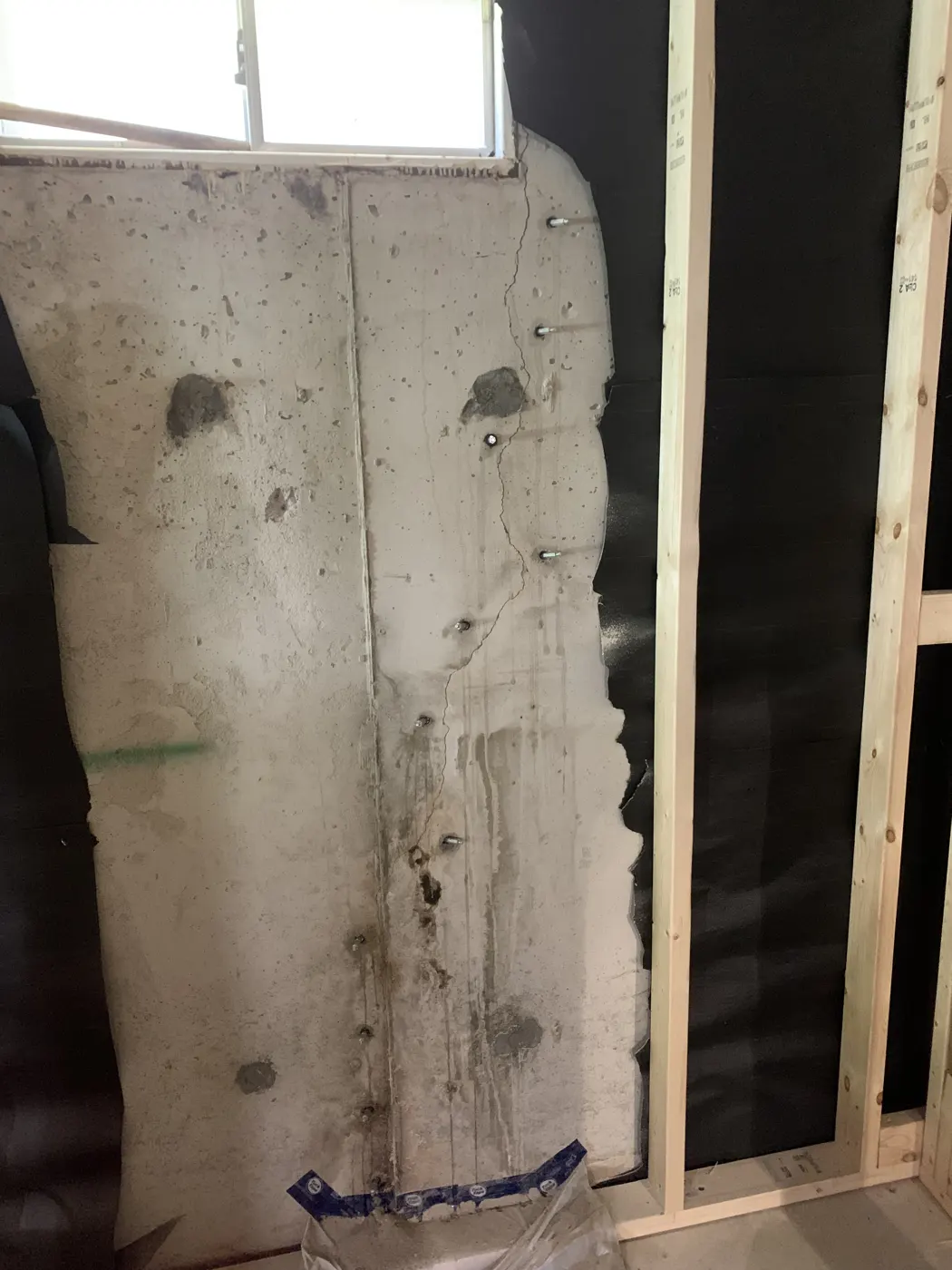
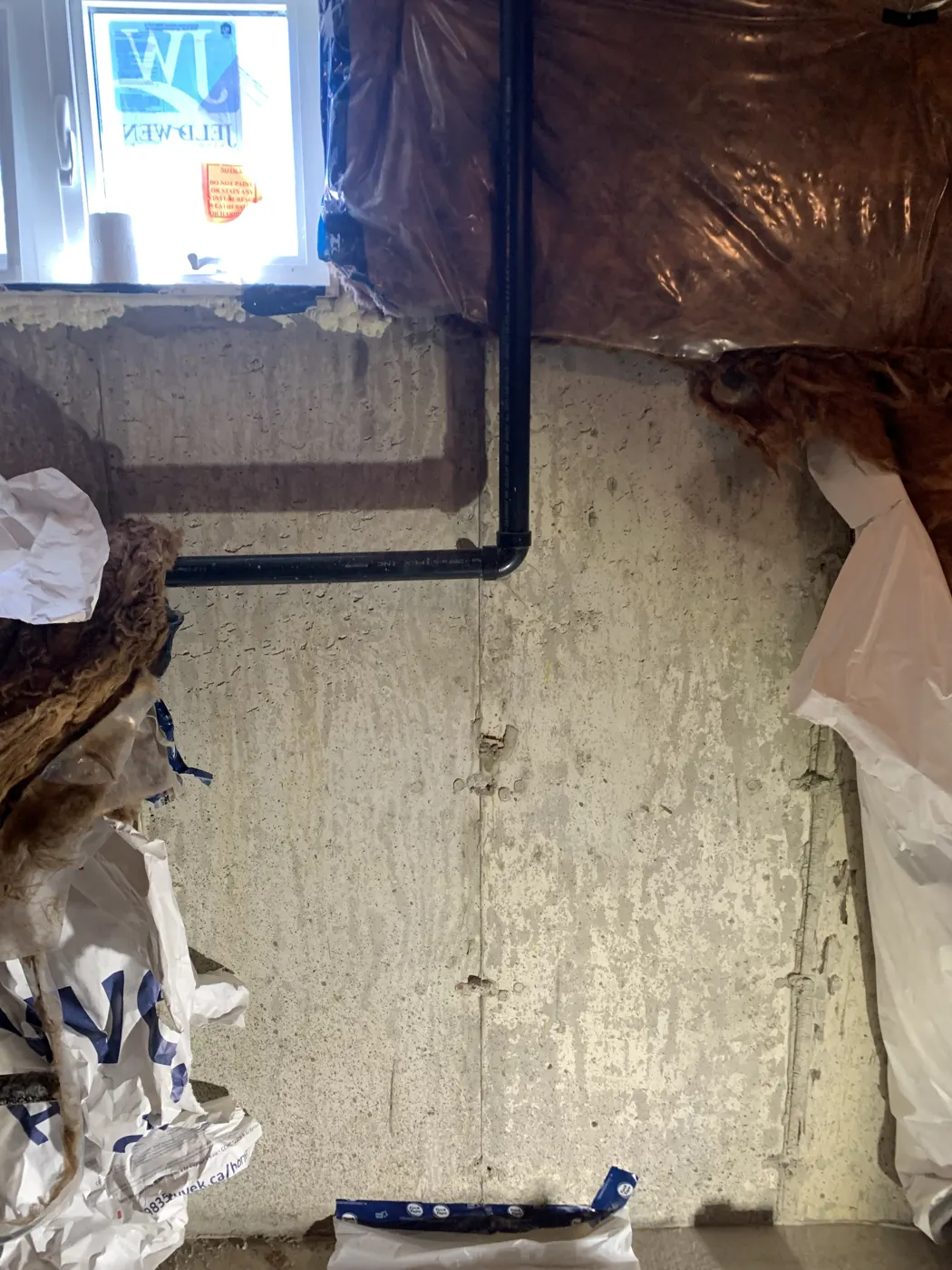
Perched water and structural movement want different resins.
A crack that weeps after heavy rain — water perched on impermeable till, or arriving fast through the sand strip near the lake — gets hydrophobic polyurethane ($750–$1,000). It cures against live water and stays flexible. A crack that has grown across seasons, or one carrying structural load, gets epoxy injection that re-bonds the wall ($850–$1,500). Tie-rod leaks run $75–$150, extra cracks are 5% off each, and the complete method guide, the polyurethane page, the epoxy page and the open price sheet hold nothing back. Not sure which pattern you are looking at? Our guide to the five types of foundation crack explains what each orientation indicates, and why width alone tells you very little.
Etobicoke York skews sharply post-war, and the census proves it.
| Period built | Etobicoke York | City of Toronto |
|---|---|---|
| 1960 or before | 66,105 — 28.5% | 29.3% |
| 1961–1980 | 84,285 — 36.4% | 28.8% |
| 1981–2000 | 39,465 — 17.0% | 17.5% |
| 2001–2021 | 41,920 — 18.1% | 24.4% |
| Built 1980 or earlier | 64.9% | 58.1% |
The 1961–1980 line is the story. Etobicoke York’s share of that era is 36.4% against a city average of 28.8% — 7.6 percentage points higher, and the single most distinctive fact in the whole table. Nearly two thirds of the district’s homes were built in 1980 or earlier, well above the city as a whole. Those are poured foundation walls now 45 to 65 years old, in ground that TRCA describes as impermeable clay till with little natural storage, under a watershed that has been paved to 58% imperviousness in the meantime. That is not a scare story — most of those cracks are mature and stable, which usually makes them straightforward polyurethane work — but it does explain why we see so much repeat work on the same streets.
The honest variables inside the published ranges.
Lots on the sand strip near the lake can need patient multi-port injection because water keeps arriving during the work. Long full-height cracks use more resin than hairlines. Finished basements — very common in a district of 1960s and 70s homes renovated more than once — add access care. Block foundations turn up in the older stock, and injection is engineered for poured concrete: a crack there is a discrete plane through a monolithic pour, whereas mortared block has no such plane for resin to seal against. We say so at the assessment rather than inject a wall that will not hold it. Every crack after the first is 5% off, and all of it is on the published cost breakdown before we ever ring your doorbell.
Lakeshore to Rexdale, Mimico to West Humber.
Mimico, New Toronto, Long Branch, Alderwood, Islington-City Centre West, Kingsway South, Stonegate-Queensway, Humber Heights, Edenbridge, Princess-Rosethorn, Eringate-Centennial, Markland Wood, Etobicoke West Mall, Rexdale, Kipling Heights, Thistletown, Humber Summit, Elms-Old Rexdale, Mount Olive-Silverstone-Jamestown, West Humber-Clairville and Willowridge. We do not publish build decades for individual neighbourhoods — the City’s per-neighbourhood construction data is not retrievable and the decades that circulate on property sites are not sourced. The district figures above are official and make the same point. Our Mississauga guide covers the city west across Etobicoke Creek, our Brampton guide the region north, and the full service-area index lists every city we publish for.
The numbers behind the warranty.
A quarter-century of GTA basements kept dry.
Injection repairs warrantied for life — and the warranty moves with the house when you sell.
Full commercial coverage on every job, every crew, every home.
Eligible contractor for City of Toronto, Peel & Halton basement-flooding subsidy programs.
Inspection, honest diagnosis, and an exact per-crack quote — free, no pressure.
Your price is confirmed in writing before any work starts — no hourly surprises.
Every review below is a real, verifiable Google review of Concrete Crack Repair Pros. Nothing is paraphrased, and nothing is borrowed from a sister company.
Are these reviews genuine? Every review shown above is pulled live from the Concrete Crack Repair Pros Google Business Profile at 64 Millwick Dr, North York — not from a parent or sister brand’s listing. The rating and the count update automatically as new reviews arrive, so what you see here is what is on Google right now.
The same name, address and phone number we publish everywhere, so you can check us before you call.
No, and this one gets repeated a lot. TRCA maps the strip nearest the lake as the Lake Iroquois Sand Plain, and specifically identifies “porous sand and gravel deposits associated with the Iroquois Shoreline feature.” The heavy impermeable material is the Halton Till that dominates the surface across the rest of Etobicoke. It matters practically: on sand, water hits your wall fast during rain and leaves fast. On till, it perches in the backfill and sits there for days. The two produce different leak timing and sometimes different repairs.
It may reduce your risk of sewer backup, but it will not touch your foundation. Three City basement flooding projects are live in Etobicoke right now — Martin Grove/Wellesworth/Gentian in Eringate through fall 2026, The Westway and Kipling through fall 2026, and Chapman Road/Drury Lane/Craig Alan Court since April 2026. All of it is sewer capacity in the public right-of-way; the program explicitly excludes private property. If your basement only floods when the municipal system surcharges, this genuinely helps and you may not need us. If your wall weeps in an ordinary wet week, new sewer pipe changes nothing.
Etobicoke was hit very hard, but not at the place most people name. Raymore Drive — 35 deaths, 14 homes, 366 metres of street lost — is in Weston, on the Humber. Etobicoke’s own Hazel disaster was on Etobicoke Creek at Long Branch, where seven people died and three streets south of the Lake Shore highway flooded completely. Of 192 properties later expropriated, 43 were destroyed outright; 700 residents were removed from the trailer park and two condemned streets. The land became Marie Curtis Park. Five firefighters from the Kingsway-Lambton station also died. It is worth getting right.
It means the ground around you absorbs far less than it used to. TRCA measures imperviousness in these watersheds from 7% in the headwaters to 58% in Etobicoke Creek and 57% in Mimico Creek, and describes “the lack of natural storage areas” alongside impermeable clay till soils. Rain that would once have soaked in now runs off roofs, roads and driveways and reaches low points all at once. For a foundation, that means shorter, sharper loading events rather than gentle seasonal wetting — which is exactly the pattern that finds an existing crack rather than creating a new one.
Statistically, yes. In the Etobicoke York Community Council area, 64.9% of occupied private dwellings were built in 1980 or earlier, against 58.1% across Toronto. The 1961–1980 band alone accounts for 36.4% of the district’s housing versus a city average of 28.8%. So Etobicoke skews notably to post-war construction — poured walls now 45 to 65 years old. That is context rather than alarm: walls of that age finished shrinking decades ago, so their cracks are usually mature and stable, which tends to make them straightforward to inject.
Usually three things, none of them mysterious. First, position — the sand/till boundary can run through a street, and water behaves differently on either side. Second, drainage: downspout discharge, lot grading and weeping tile condition vary house to house and matter more than most people expect. Third, the wall itself — whether a shrinkage crack, cold joint or tie-rod happens to line up with where water collects. We check all three at the free assessment, and if the answer is your downspouts rather than your foundation, we tell you that instead of selling you an injection.
Method, resins and money — documented before you commit.
Post-war walls on impermeable till are our daily work: free assessment, flat published pricing, one-visit repair, lifetime transferable warranty — and an honest answer when the City’s sewer work is about to solve your problem for free.