
The full foundation crack repair cost breakdown shows every range we publish.
#eef2f7}}
Home › Service Areas › Aurora
Aurora’s own website tells residents to “repair any cracks or holes in the basement walls or floors” — and exempts that repair from needing a permit by name. Flat pricing from $750, one visit, lifetime transferable warranty.
Coverage: We service Toronto, the GTA and Southern Ontario, and Aurora sits on our northern York route alongside Newmarket and Richmond Hill — regular ground for our crews, travel folded into the flat pricing. The assessment is free, and most Aurora cracks are injected in the same visit.
Foundation crack repair in Aurora costs a flat $750–$1,000 per crack for polyurethane injection and $850–$1,500 for structural epoxy, with every additional crack 5% off. No building permit is required: Aurora’s exemption list names “repair of leaking foundations where there is no structural work involved” outright — the clearest wording of any municipality we serve. Neither the Town nor York Region offers any subsidy toward it.
The best hard data on any page we publish comes from Aurora’s own files.
A geotechnical investigation carried out for the Town at 162 St. John’s Sideroad, reported in January 2021 from boreholes drilled in September 2020, put eight holes down between 6.6 and 30.9 metres. The profile: 18 to 25 centimetres of topsoil, then topsoil fill to as much as 1.9 metres, then earth fill 0.8 to 1.7 metres described as “loosely placed, contains organic inclusions,” then compact sand, then silt, sandy silt and silty fine sand ranging loose to compact, over a primary bearing layer of varved silty clay, firm to very stiff, shot through with silt seams and layers.
Then the number that matters. Stabilized groundwater, measured on 29 September 2020: “groundwater was recorded at depths of 2.5 to 7.2 m below the prevailing ground surface in 7 of the 8 wells.” Well by well — 4.5, 2.8, 2.5, 2.7, 7.2, dry, 4.2 and 3.2 metres. A standard Ontario full-height basement floor sits roughly 2.1 to 2.4 metres below grade. Four of those readings are within a few tens of centimetres of typical footing elevation, and the readings were taken before well development or purging, with seasonal fluctuation anticipated on top.
We should be careful here: the report does not itself compare its readings to basement depth — that comparison is our engineering interpretation, and we present it as such. But the consultants’ own foundation recommendations point the same way. They required that “perimeter subdrains and dampproofing of the foundation walls will be required,” that “where groundwater seepage is encountered during basement excavation, floor subdrain may be required,” and that foundation walls “should be backfilled with non-frost susceptible granular material.” When a Town’s own engineers write that, they are describing ground where basements need active drainage rather than optional extras. Varved clay with silt seams behaves exactly the way it sounds — the seams carry water sideways through material that otherwise would not pass it.
The clearest example of the subsidy gap anywhere in the GTA.
Aurora’s Basement Flooding page lists the protective steps a homeowner should take, and among them, in the Town’s own words: “repair any cracks or holes in the basement walls or floors.” That is a municipality directly instructing residents to do the work we do. The rest of the page is homeowner responsibilities — lot grading, downspout disconnection, sewer maintenance, flood alarms, sump pump backup power, insurance. There is no financial program attached to any of it.
Nor is there one above it. York Region operates no regional basement flooding subsidy; its inflow and infiltration page gives advice and points to programs run by individual municipalities, naming Richmond Hill’s backwater valve subsidy and Vaughan’s downspout disconnection. Aurora runs neither. So an Aurora homeowner sits in an odd position: told by their Town to repair foundation cracks, offered nothing toward it, and living in a region that — unlike Halton with its $6,500 measures or Toronto with its $6,650 — has no program to point at.
We would rather state that plainly than imply a rebate exists. Aurora’s infiltration and flooding reporting line is 905-727-1375 if you want to report an issue to the Town.
Four questions, instant range — polyurethane or epoxy, multi-crack discount included, no obligation.
Two frames from our crews’ recent work.
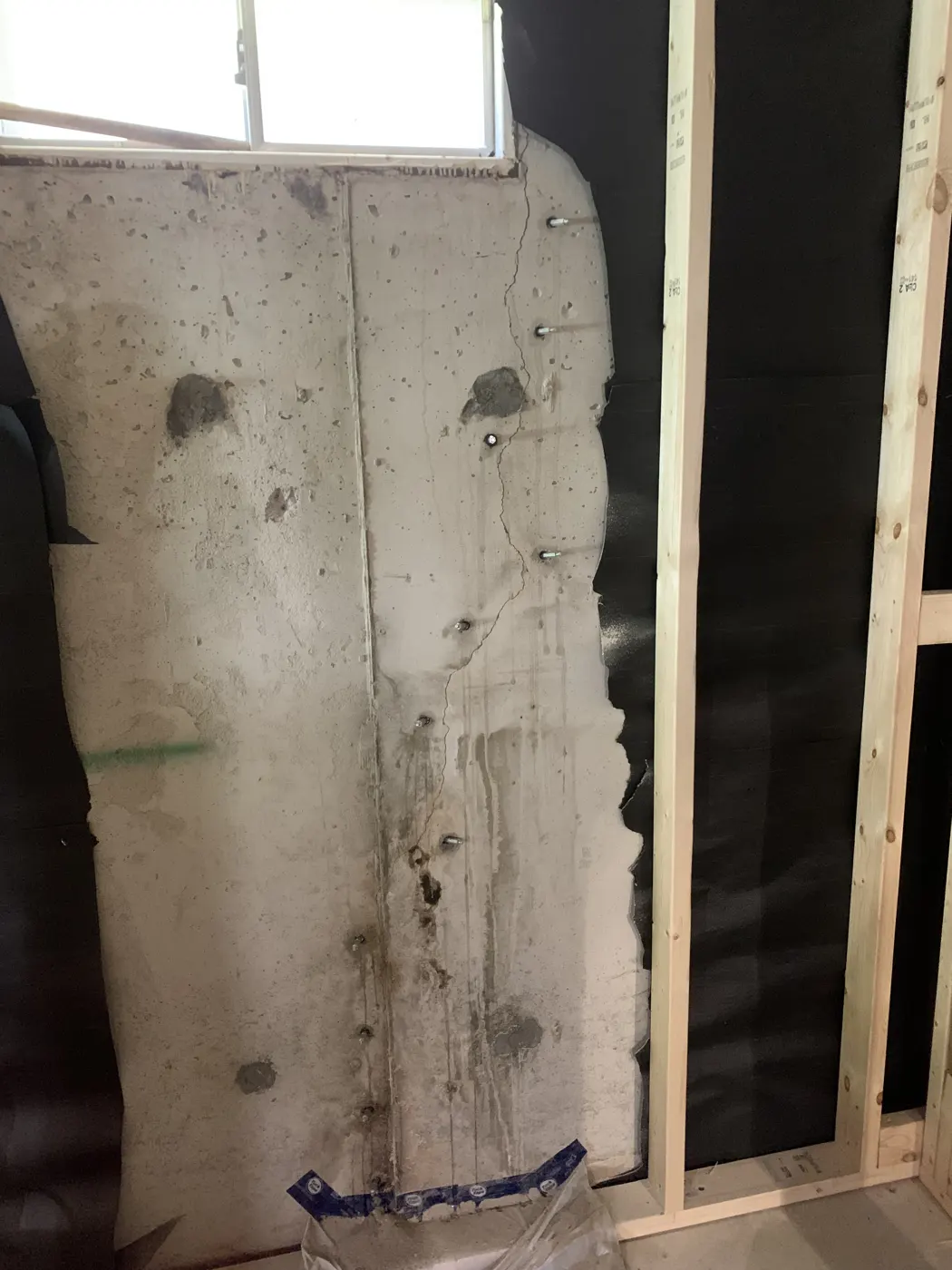
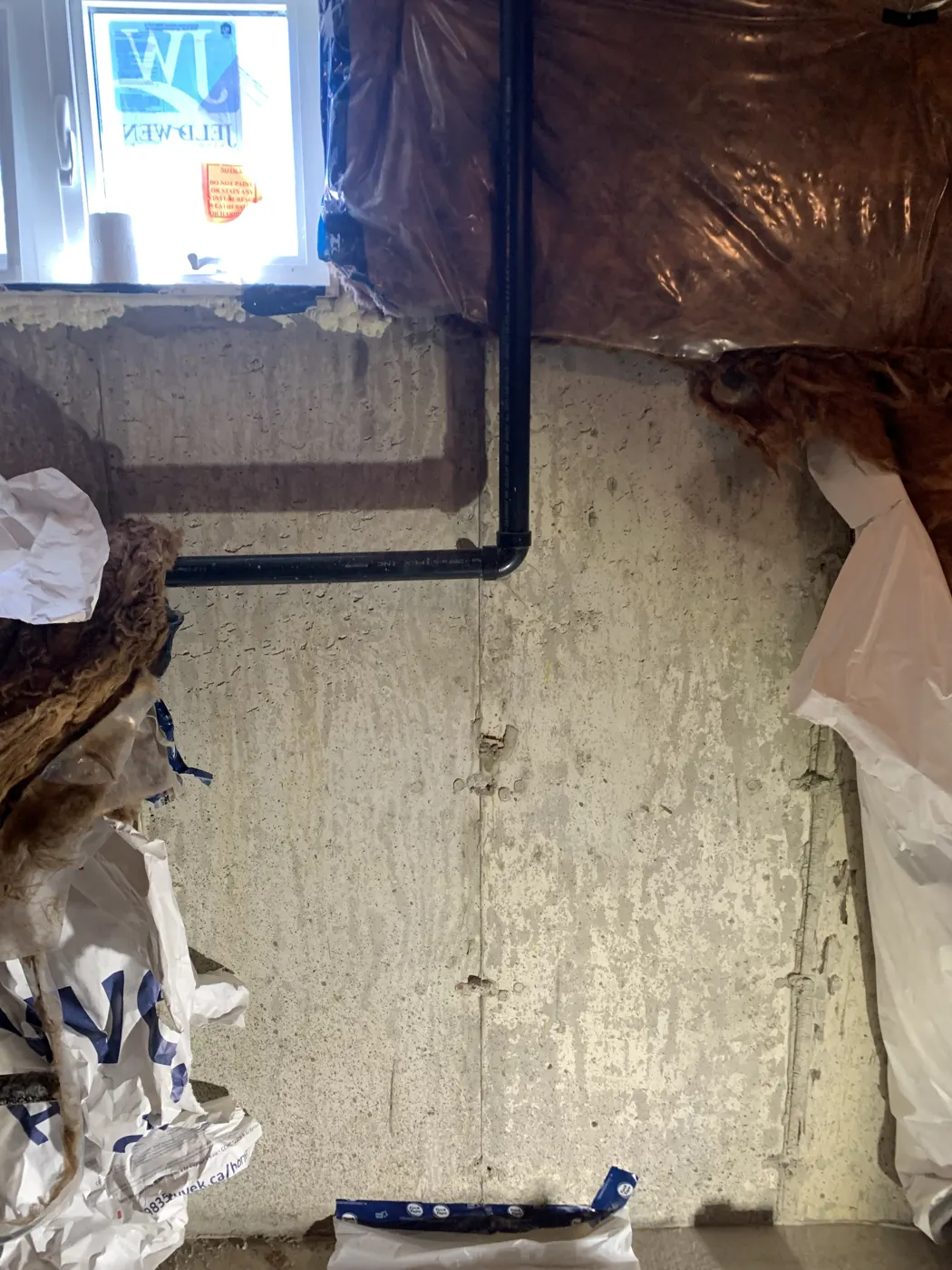
Sustained pressure and structural movement want different resins.
A crack under sustained hydrostatic pressure — the common case where groundwater sits near footing depth — gets hydrophobic polyurethane ($750–$1,000). It cures against live water and stays flexible. A crack that has grown across seasons, or one carrying structural load, gets epoxy injection that re-bonds the wall ($850–$1,500). Tie-rod leaks run $75–$150, extra cracks are 5% off each, and the complete method guide, the polyurethane page, the epoxy page and the open price sheet hold nothing back. Not sure which pattern you are looking at? Our guide to the five types of foundation crack explains what each orientation indicates, and why width alone tells you very little.
The best permit wording we have found anywhere.
Photo quotes come back the same day; the on-site assessment is free either way. A typical crack takes 60–90 minutes from the basement side — no excavation through Aurora landscaping, no seasonal blackout. On permits, Aurora is in a class of its own for clarity. Its published exemption list states, word for word, that no permit is required for the “repair of leaking foundations where there is no structural work involved.” No other municipality we serve names the job that precisely. Also exempt: finishing basements where there is no structural alteration, same-size window and door replacement, re-roofing with similar materials, HVAC replacement and plumbing fixture repair. Permits are required for new buildings, additions, alterations, plumbing and drain work, pool enclosures and demolition. The Building Division is on (365) 500-2081, building@aurora.ca, at 100 John West Way; inspections on (905) 726-4778.
The honest variables inside the published ranges.
Walls sitting close to the water table need patient multi-port injection because water keeps arriving during the work — with stabilized readings as shallow as 2.5 metres in parts of town, that is not unusual here. Long full-height cracks use more resin than hairlines, and finished basements add access care. Heritage foundations in Northeast Old Aurora are a genuine variable: the district’s buildings run from the 1860s through the 1930s, which straddles the arrival of poured concrete, and the district notably includes “a compact grouping constructed of decorative concrete block.” Injection is engineered for poured walls, where a crack is a discrete plane through a monolithic pour; mortared block has no such plane for resin to seal against. We assess before quoting. Every crack after the first is 5% off, and all of it is on the published cost breakdown before we ever ring your doorbell.
Town Park to Bayview Northeast, plus rural Aurora.
The historic downtown and Town Park area, Aurora Village, Aurora Highlands, Bayview Wellington, Aurora Estates, Bayview Northeast and rural Aurora. Where the Town documents an era we use it: the Northeast Old Aurora Heritage Conservation District, designated following Ontario Municipal Board approval on 9 November 2006, covers Catherine, Centre, Fleury, Maple, Mark, Spruce and Wellington Streets plus Yonge — 173 properties in the study area, 117 of them listed on the Town’s heritage inventory — and its development “was a lengthy process, running from the 1860s through the 1930s,” spanning “Ontario Victorian Vernacular through Craftsman Bungalows.” Aurora’s heaviest heritage concentrations sit along Yonge, Wellington East, Temperance, Catherine, Spruce, Centre and Mosley. For the newer neighbourhoods we do not publish build decades, because no municipal or census source supports them. Our Newmarket guide covers the town north, our Richmond Hill guide the city south, and the full service-area index lists every city we publish for.
The numbers behind the warranty.
A quarter-century of GTA basements kept dry.
Injection repairs warrantied for life — and the warranty moves with the house when you sell.
Full commercial coverage on every job, every crew, every home.
Eligible contractor for City of Toronto, Peel & Halton basement-flooding subsidy programs.
Inspection, honest diagnosis, and an exact per-crack quote — free, no pressure.
Your price is confirmed in writing before any work starts — no hourly surprises.
Every review below is a real, verifiable Google review of Concrete Crack Repair Pros. Nothing is paraphrased, and nothing is borrowed from a sister company.
Are these reviews genuine? Every review shown above is pulled live from the Concrete Crack Repair Pros Google Business Profile at 64 Millwick Dr, North York — not from a parent or sister brand’s listing. The rating and the count update automatically as new reviews arrive, so what you see here is what is on Google right now.
The same name, address and phone number we publish everywhere, so you can check us before you call.
No — and Aurora states it more clearly than any other municipality we work in. Its published list of exempt work includes, word for word, the “repair of leaking foundations where there is no structural work involved.” Finishing a basement with no structural alteration is also exempt. Permits are required for new buildings, additions, alterations, plumbing and drain work, pool enclosures and demolition. If your job stays non-structural and involves no plumbing, you are exempt. Building Division: (365) 500-2081.
You should take it seriously, though the comparison is ours rather than the report’s. A geotechnical investigation commissioned by the Town at 162 St. John’s Sideroad recorded stabilized groundwater “at depths of 2.5 to 7.2 m below the prevailing ground surface in 7 of the 8 wells” in September 2020 — with individual readings of 2.5, 2.7, 2.8 and 3.2 metres. A standard full-height basement floor sits at roughly 2.1 to 2.4 metres. So in parts of Aurora the water table sits within centimetres of footing elevation, and it fluctuates seasonally on top of that. It is why the Town’s own consultants required perimeter subdrains and dampproofing.
No. Aurora’s Basement Flooding page does list “repair any cracks or holes in the basement walls or floors” among the steps homeowners should take — but no municipal subsidy, rebate or grant exists to support it. Nor does York Region run a regional program; it points instead to schemes in individual municipalities, naming Richmond Hill’s backwater valve subsidy and Vaughan’s downspout disconnection. Aurora operates neither. For comparison, Toronto pays up to $6,650 and Halton up to $6,500 per measure — but not for crack repair either.
It depends on the house, and we assess before quoting. The district’s development ran “from the 1860s through the 1930s” — a span that straddles the arrival of poured concrete, so some properties will inject perfectly and others will not. The district also contains a notable grouping built of decorative concrete block, including an early concrete-block apartment on Yonge described as “an early and innovative example of workers housing from the early 20th Century.” Injection needs a monolithic poured wall where the crack is a single plane; mortared block moves water through joints and voids instead, and resin has nothing to seal against.
The Town’s Climate Change Adaptation Plan projects that “extreme precipitation for the 1 in 100-year storm event is projected to increase by 17.5%,” and notes that flooding here has already affected stream integrity, parking lots and roads, with severe storms overwhelming stormwater systems. For a foundation the honest read is that events which currently find an existing crack will find it more often and load it harder. It is not a reason to panic about a stable hairline; it is a reason not to leave an actively leaking wall for another three seasons.
Because of what is in the ground. The Town’s geotechnical consultants found a bearing layer of varved silty clay carrying silt seams and layers, over loosely placed fill containing organic inclusions, with groundwater near footing depth. Varved clay with seams passes water sideways along the seams while resisting it everywhere else — so a wall can take water from well outside your own lot. That is why the report required “perimeter subdrains and dampproofing of the foundation walls” and a floor subdrain where seepage shows during excavation. If your subdrain has silted or failed, sealing one crack treats a symptom, and we will tell you so.
Method, resins and money — documented before you commit.
Walls sitting near the water table are our daily work: free assessment, flat published pricing, one-visit repair, lifetime transferable warranty — and no permit required, in the Town’s own words.