
Home › Service Areas › Richmond Hill
Moraine sand up north, clay till and a shallow water table down south — either way, a cracked poured wall leaks. Flat pricing from $750, one visit, transferable lifetime warranty.
Coverage: We service Toronto, the GTA and Southern Ontario, and Richmond Hill sits mid-map between our Vaughan and Markham routes — York Region is weekly territory for our crews, and travel is included in the flat pricing. Free assessment first; most cracks are injected the same visit.
Foundation crack repair in Richmond Hill runs a flat $750–$1,000 per crack for polyurethane and $850–$1,500 for structural epoxy, each additional crack 5% off. The City’s only flood-money program is a backwater valve subsidy of up to $1,500 — it never covers crack repair. York Region’s own advice to homeowners includes fixing foundation cracks to keep water out, and that is precisely the repair we finish in one visit, warrantied for life.
Why the same crack behaves differently at Lake Wilcox than it does at Bayview and Weldrick.
The northern half of Richmond Hill sits on the Oak Ridges Moraine — in the City’s own words, the thickest piece of glacial material anywhere in Ontario, a ridge of sand and gravel that filters rainfall downward and stores a very large volume of groundwater. Kettle lakes pock its surface here: Lake Wilcox is the largest kettle lake on the entire moraine, with Bond, Swan and Phillips nearby. Sand this permeable moves storm water fast, so Oak Ridges and Jefferson basements tend to leak in bursts — a surge of hydrostatic pressure a day after big rain or the March melt, then quiet.
South of Major Mackenzie the ground changes to Halton Till — slow-draining clay — capped in places by old lakebed silt. Groundwater mapping for the City marks much of southern Richmond Hill with a water table within about 5 metres of the surface, which means plenty of basements around Bayview and Weldrick sit close to standing groundwater year-round. Cracks there rarely gush; they seep, stubbornly, for days after weather.
Layer the housing stock over the soils and the pattern completes: the old village core along Yonge carries the oldest walls; Mill Pond, Crosby and Beverley Acres are largely 1950s–60s subdivisions with poured and block foundations entering their seventh decade; Bayview Hill went up mostly in the 1990s; Jefferson, Westbrook, Rouge Woods and much of Oak Ridges are 2000s-era concrete still working through shrinkage cracks. We inject all of it, every week.
Water behaviour picks the product — not the salesperson.
Moraine-side surge leaks and south-end persistent seepers both point to flexible polyurethane injection ($750–$1,000): it reacts with water, fills the full wall thickness and keeps sealing as the wall breathes through freeze-thaw. A crack that is widening or stepping through the blocks calls for an epoxy structural repair ($850–$1,500) that restores the wall’s original strength. Tie-rod holes are $75–$150, every additional crack is 5% off, and the injection guide plus our published cost breakdown explain every number before anyone visits your basement. Not sure which pattern you are looking at? Our guide to the five types of foundation crack explains what each orientation indicates, and why width alone tells you very little.
From our crews — the stages your repair goes through.
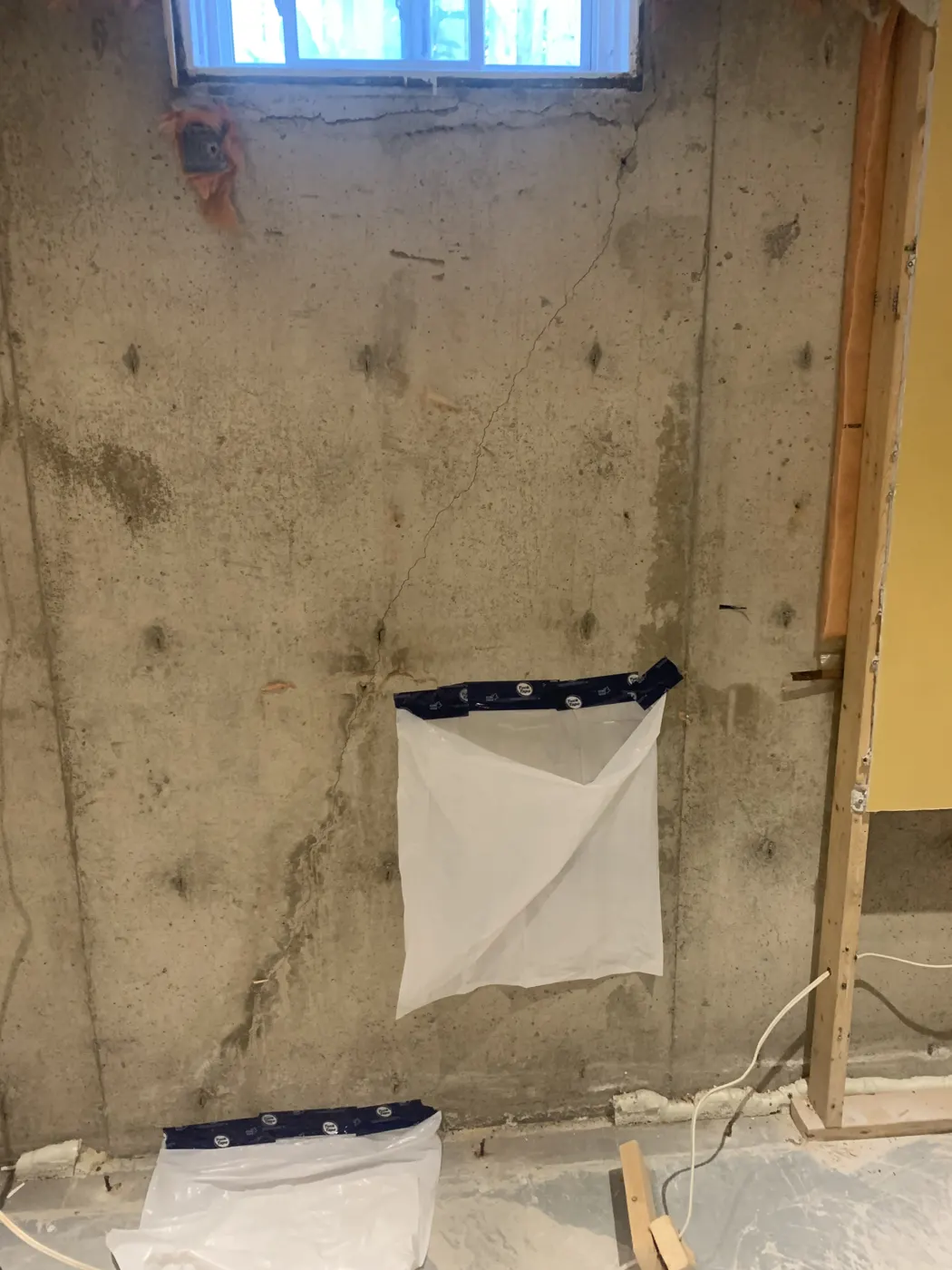
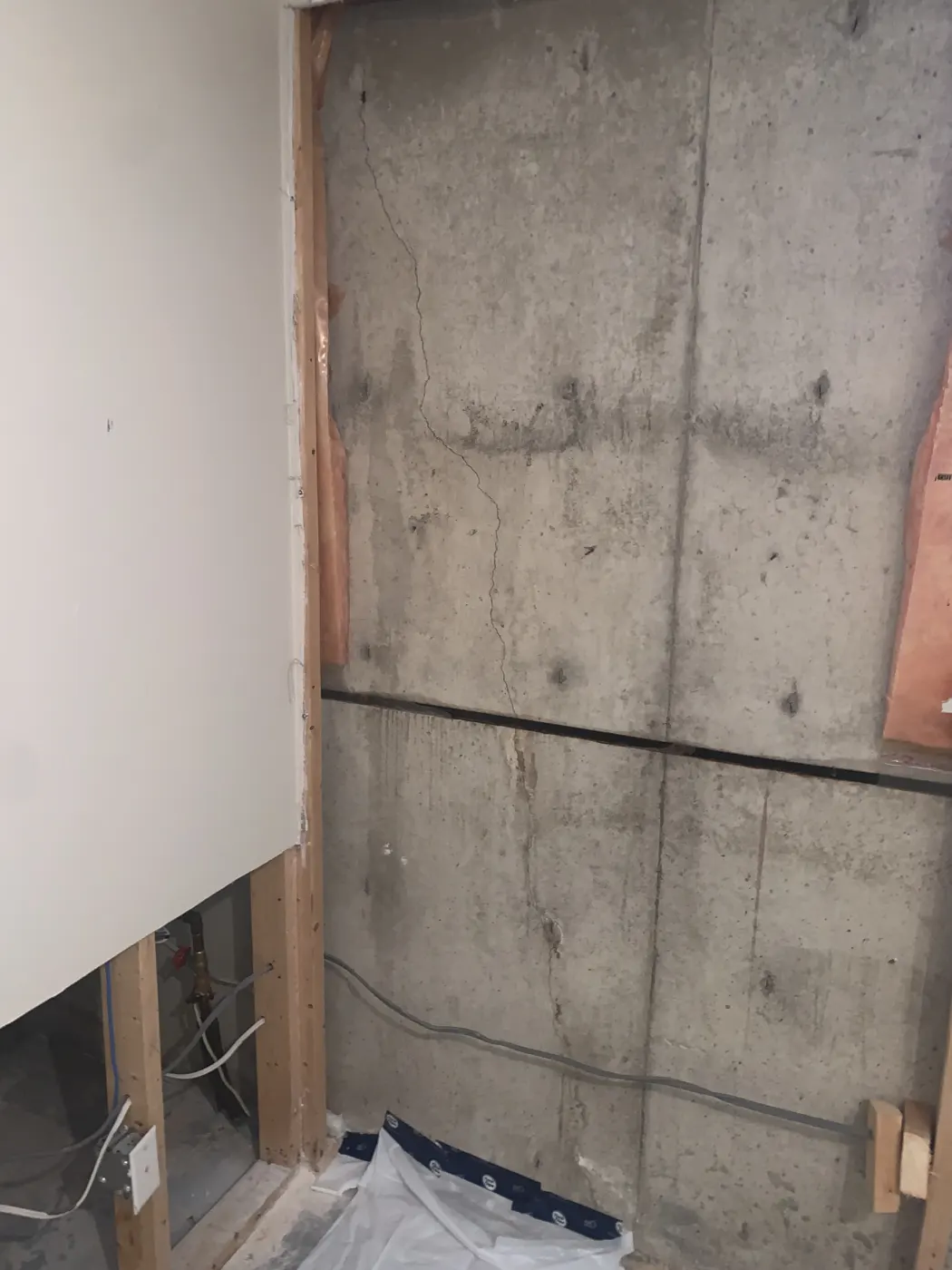
Real program, real limits, and a sentence worth reading twice.
| Program | What it offers | Crack repair covered? |
|---|---|---|
| Richmond Hill Backwater Valve Subsidy | Up to $1,500 toward a backwater valve: licensed plumber, building permit before installation, apply within 6 months after, once per property, existing homes only | No — valve costs only |
| York Region rebate | None — the Region runs no homeowner subsidy and points residents to local programs | No |
| Any program, anywhere | — | No: crack injection is never subsidized; it is flat-priced from $750 |
The subsidy is genuinely useful if sewer backup is part of your risk — and it is genuinely narrow: valve only, plumber only, permit first, new construction ineligible. We are not plumbers and do not touch that work. What we do is the other half of York Region’s own flood advice — the Region’s inflow-and-infiltration guidance tells residents to “fix cracks in your foundation” to keep groundwater out of the system. Book the valve with a licensed plumber, book the wall with us, and both halves of the official checklist are closed inside a week.
Four questions, instant range — polyurethane or epoxy, multi-crack discount included, no obligation.
Permit-free for the typical crack, scheduled around the melt.
Send photos for a same-day quote or book the free assessment straight away. A standard injection takes 60–90 minutes per crack from inside the basement — no excavation, no landscaping casualties, winter included. Richmond Hill’s permit FAQ exempts basement damp-proofing and minor repairs, so the typical injection involves zero City paperwork; a structural repair on an altered wall is the rare exception worth a call to the Building Division first. Moraine neighbourhoods book heaviest during snowmelt — if your crack leaks each March, beat the rush in February.
The variables inside the flat ranges.
A south-end seeper near the water table often needs patient, slower injection to chase saturated hairlines — more time, same range. A 1990s Bayview Hill shrinkage crack is usually the cleanest job on the sheet. Sixty-year-old Crosby walls sometimes want epoxy and prep at the top of the range, and finished basements add access work rather than a surcharge. Every crack after the first is 5% off; the cost page and calculator show the whole equation.
Kettle lakes to the Langstaff towers.
Oak Ridges, Lake Wilcox, Jefferson, Westbrook, Mill Pond, Crosby, Beverley Acres, Bayview Hill, Rouge Woods, Doncrest, Langstaff, Harding, North Richvale, South Richvale and the Observatory district — every corner of town. Next door, see the Vaughan guide for Tarion-era new builds and the Markham guide for rebate-country conditions, or browse every city we publish for.
The numbers behind the warranty.
Backed by the DryShield family — a quarter-century of GTA basements kept dry.
Injection repairs warrantied for life — and the warranty moves with the house when you sell.
Full commercial coverage on every job, every crew, every home.
Eligible contractor for City of Toronto, Peel & Halton basement-flooding subsidy programs.
Inspection, honest diagnosis, and an exact per-crack quote — free, no pressure.
Your price is confirmed in writing before any work starts — no hourly surprises.
Every review below is a real, verifiable Google review of Concrete Crack Repair Pros. Nothing is paraphrased, and nothing is borrowed from a sister company.
6 Google reviews · Concrete Crack Repair Pros
Verified on our Google Business Profile at 64 Millwick Dr, North York — read every review on Google.
Is Concrete Crack Repair Pros well reviewed? Yes. Concrete Crack Repair Pros holds a 5.0-star rating from 6 Google reviews as of August 2026, with no rating below five stars. Reviewers most often name polyurethane crack injection, epoxy repair of floor cracks, leaking foundation walls sealed on the first visit, and an on-site assessment carried out before any price is quoted. The reviews sit on the company’s own Google Business Profile in North York, not on a parent or sister brand’s listing.
“Highly recommend for polyurethane crack injections. They also mentioned epoxy crack repair for floor cracks that worked really well.”
Giles McMahon · Google review, August 2026
“Highly recommend this company. John came out and assessed my issues. Repaired my foundation by making sure the cracks do not leak anymore.”
Kiera · Google review, August 2026
“I got the crack injection service. My basement foundation was leaking and these injections sealed things up.”
Trina · Google review, August 2026
“Great service. They came out and fixed the cracks in my foundation right away. Thank you”
Randy · Google review, August 2026
“Great job filling the cracks in my concrete foundation”
Rapp · Google review, August 2026
“Highly recommend this Team for foundation crack repairs. I hope to not need these guys again, but if I do, I won’t call any one else.”
Joel Williams · Google review, July 2026
The same name, address and phone number we publish everywhere, so you can check us before you call.
No. The City’s only flood-related program is the Backwater Valve Subsidy — up to $1,500, once per property, installed by a licensed plumber with a building permit, claimed within 6 months of the work. It pays for the valve, never the wall. Crack injection is flat-priced instead: $750–$1,000 polyurethane, $850–$1,500 epoxy, free assessment first.
For a typical non-structural injection, no — the City’s own permit FAQ lists basement damp-proofing and minor repairs among work that does not require a permit. Structural alterations are a different category, so if a wall is being rebuilt or underpinned, check with the Building Division at 905-771-8810 first. We flag any crack that crosses that line at the free assessment.
Because moraine sand drains fast and deep. The Oak Ridges Moraine stores a huge volume of groundwater, and after heavy rain or snowmelt the infiltration front loads your foundation for a day or two — a pressure surge that finds any crack, then subsides. The leak disappearing does not mean the crack healed; injection closes the path before the next surge.
Groundwater mapping for the City shows the water table within about 5 metres of the surface across much of southern Richmond Hill, and the clay till there drains slowly. Your basement likely sits close to saturated ground, so a crack wicks moisture long after the sky clears. Polyurethane injection is built for exactly this — it cures in the presence of water and seals the full wall thickness.
Usually they are settled, stable and injectable — but sixty-plus years earns a proper look. The free assessment separates old, quiet cracks from ones showing fresh movement; stable leakers get polyurethane, moving cracks get structural epoxy, and anything beyond injection gets an honest referral rather than a forced fix. The warranty is identical either way: lifetime, transferable.
Very normal. Poured concrete shrinks as it cures, and neighbourhoods built in the 2000s and 2010s are at prime shrinkage-crack age. Most are vertical, tight and one-visit repairs. Seal them before finishing the basement — a $750 injection now beats opening finished drywall later, and the transferable warranty becomes a selling point when you list.
Every claim on this page, shown with its work.
Moraine surge or south-end seep, the fix is one visit: flat pricing, free assessment, lifetime transferable warranty.