
See the full foundation crack repair cost guide for every range and the discount math.
Guelph, Ontario
Leaking foundation cracks sealed from inside by polyurethane injection — one visit, no excavation, transferable lifetime warranty. Same crews and the same published prices we charge in Toronto.
Quick Answer
Why did my Guelph basement start leaking after years of being dry? Because Guelph sits on shallow, fractured dolostone, and water in fractured rock does not spread out evenly the way it does in soil — it travels along specific pathways. A wet spring, a new fracture connection, or a change in drainage upslope can put water against a wall that has been dry for a decade. If that wall is poured concrete, the crack it finds can be sealed permanently from the inside, in an afternoon, without digging anything up.
Guelph is built over shallow limestone and dolostone bedrock. Water moves through fractures, which is why leaks here appear suddenly rather than gradually.
A wall that leaked for the first time this spring is usually a shrinkage crack that finally met water, not a failing foundation.
Injection is a poured-wall repair. Stone and block foundations in the older core need a different approach and we will say so.
Guelph is the largest Canadian city living almost entirely on groundwater. The water pressing on your foundation is the same resource.
We could find no City of Guelph grant for this work. Budget the full amount and check guelph.ca before assuming otherwise.
Guelph is quoted from the same published per-crack ranges as our Toronto jobs. No travel surcharge.
Guelph’s geology is unusual enough that advice written for Toronto clay is close to useless here.
Guelph sits above two aquifers held in limestone and dolomite bedrock — the same rock system that runs across southern Ontario between the Bruce Peninsula and Niagara Falls. The city draws its drinking water from 21 operational groundwater wells plus the Glen Collector System at the Arkell Spring Grounds in Puslinch, a network of perforated underground pipes that gathers shallow groundwater. Between April and November, water from the Eramosa River is pumped into engineered infiltration areas there to recharge what the city takes out.
The City puts it plainly: Guelph is the largest Canadian city to rely almost exclusively on groundwater for its drinking water. There is no lake intake. Everything comes up through rock.
That has a direct and under-appreciated consequence for basements. In soil — clay, sand, till — water distributes through the mass more or less evenly, and a foundation either sits in a wet zone or it does not. In fractured rock it behaves completely differently. Water travels along joints and bedding planes, which means it concentrates into specific pathways and ignores everything in between. Two neighbouring houses on the same street can sit on ground that is functionally wet and functionally dry, because one is over a fracture that carries water and the other is not.
It also explains the single most common thing Guelph homeowners say to us: “It has never done this before.” A crack that has been quietly dry for fifteen years does not change. What changes is whether water is being delivered to it. One heavy spring, a new drainage pattern from a development upslope, or a seasonal shift in the water table, and a pathway that never reached your wall now does. The crack did not fail. The plumbing of the rock changed.
How water moves through fractured rock to a Guelph basement
Why one house leaks and the house next door does not: in fractured rock, water concentrates into pathways instead of spreading out.
A second Guelph-specific mechanism, and the one most often mistaken for a failing foundation.
When bedrock sits close to the surface, a basement has to be excavated into it — hammered, cut or blasted out. What gets put back around the finished walls is not the rock that came out. It is loose backfill: granular fill, or the broken spoil from the excavation.
That creates a situation worth picturing clearly. You have a relatively permeable envelope of loose material, sitting inside a relatively impermeable box of solid rock, wrapped around your foundation wall. Water that gets into that envelope — from roof runoff, from a downspout discharging too close, from surface grading that has settled toward the house over twenty years — has nowhere efficient to drain away, because the rock around it will not accept water except through its fractures.
The backfill holds it. Hydrostatic pressure builds in the zone immediately against your wall, and it presses on every crack, tie-rod hole and cold joint in that section. Contractors call it the bathtub effect, and it is why the cheapest genuinely useful things you can do in Guelph are unglamorous: get the downspouts discharging well away from the house, and re-establish positive grade so the ground slopes away from the wall. We will tell you that on site before we quote you anything, because sometimes it is the whole answer.
When it is not the whole answer — when water is still finding its way through a crack in a poured wall — injection seals that path permanently, from the inside, without disturbing any of the rock or the backfill.
The bathtub effect around a rock-cut basement
Water enters the loose backfill and cannot drain away through the rock, so it sits against the wall and presses on whatever path it can find.
Two of the six below are not injection work, and we will tell you that before quoting.
| What you are looking at | Usual cause | Is it injectable? |
|---|---|---|
| Vertical or near-vertical, hairline to a few millimetres | Shrinkage as the wall cured, usually within the first year or two | Yes. Most Guelph calls are this. |
| Diagonal from a window or door corner | Stress concentrating at an opening | Yes, once movement has stopped. |
| Horizontal along the wall | Lateral pressure pushing the wall inward | No, not alone. Structural question first. |
| A straight line where two pours met | A cold joint — not a crack | Yes, and it seals reliably. |
| Small round holes in a grid | Tie-rod holes from the original forms | Yes. Quick and cheap to seal. |
| Stair-stepping through mortar joints | A block or stone wall moving at the joints | No. Not an injection candidate. |
Given how the bathtub effect works here, these are worth an hour of your time first.
If they discharge within a metre of the wall, they are filling the backfill envelope every time it rains. Extend them well clear before anything else.
Grade settles over decades. If the soil now tilts toward the house, it is feeding the same envelope. Re-grading is cheap compared to waterproofing.
Water at the base of a wall may have come up through the slab joint or back up a floor drain. Different problem, different trade.
If all three check out and the wall is still wet at a crack, that is exactly what injection is for — and it is a permanent repair rather than a management strategy.
The same method we use across the GTA. In most Guelph homes it is an afternoon.
We confirm the wall is poured concrete, establish where water is genuinely entering, and rule out the slab joint and floor drain first.
Downspouts and grade get looked at before we quote. If the fix is out there, we would rather say so than sell you an injection.
Drilled on alternating sides of the crack and angled to meet it near the middle of the wall, spaced to the wall’s thickness.
A surface seal bridges the crack so resin travels into the wall under pressure. We inject from the bottom port up, moving on as resin shows above.
Polyurethane reacts with the water already in the crack and cures flexible. Ports come off, the seal is trimmed, and the wall can be closed up.
Photographs from our own jobs, start to finish. The same method and materials we bring to Guelph.
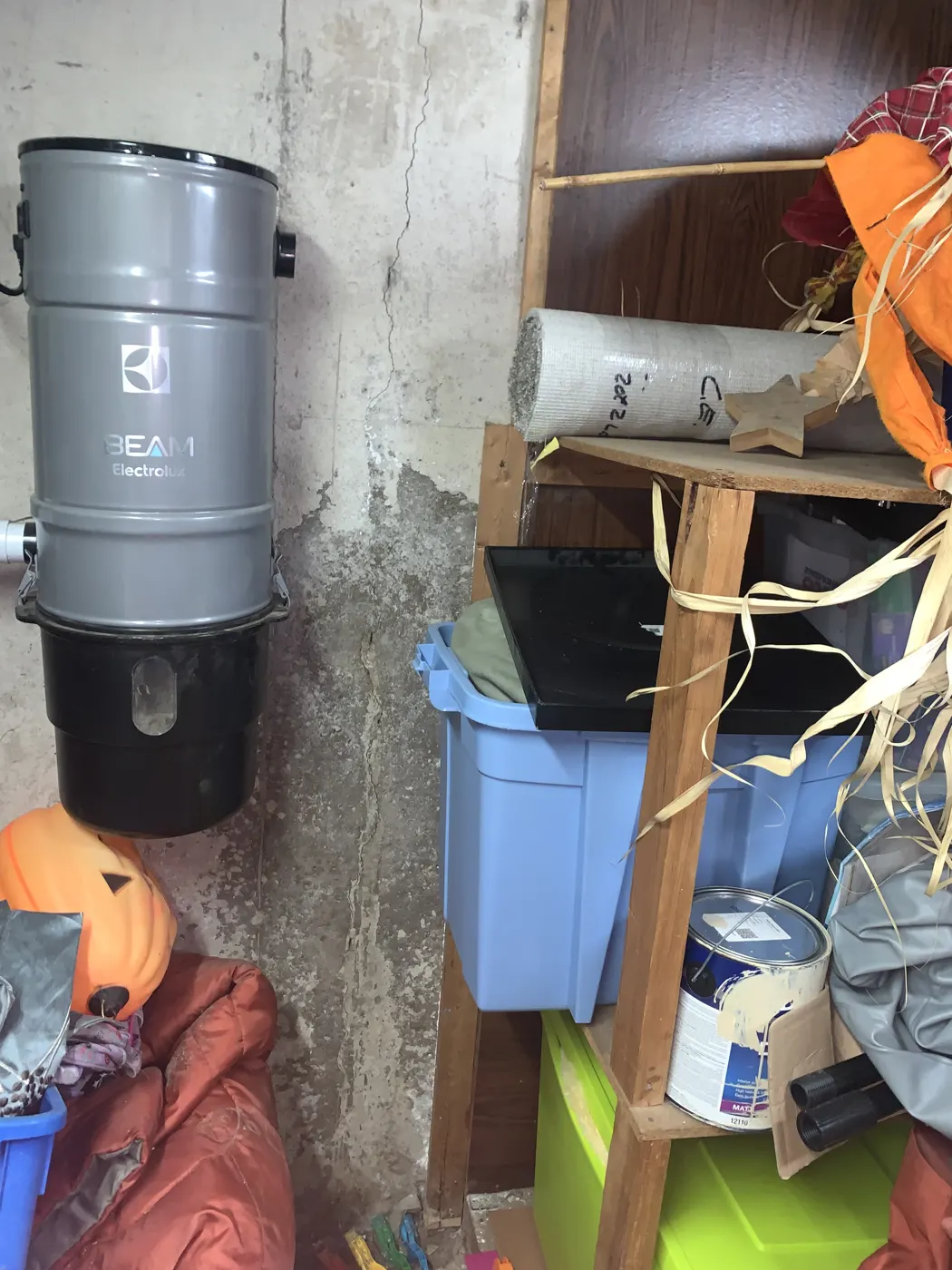
Before — a full-height crack under pressure. The staining spreading either side of the line is water arriving through the wall, not condensation on it.
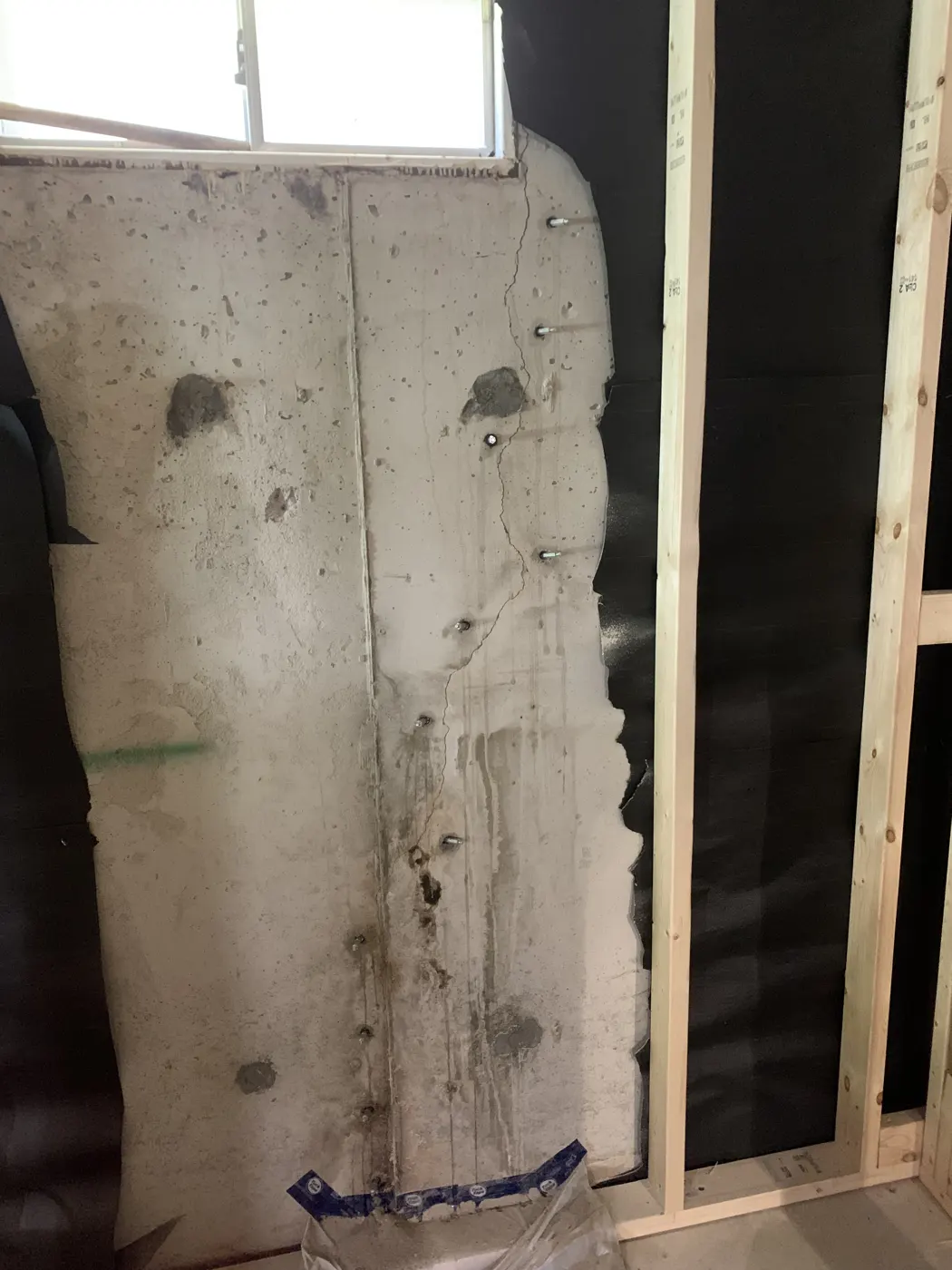
Ports set and spaced. Alternating sides, angled to intersect the crack at depth. Spacing follows wall thickness rather than a fixed rule.
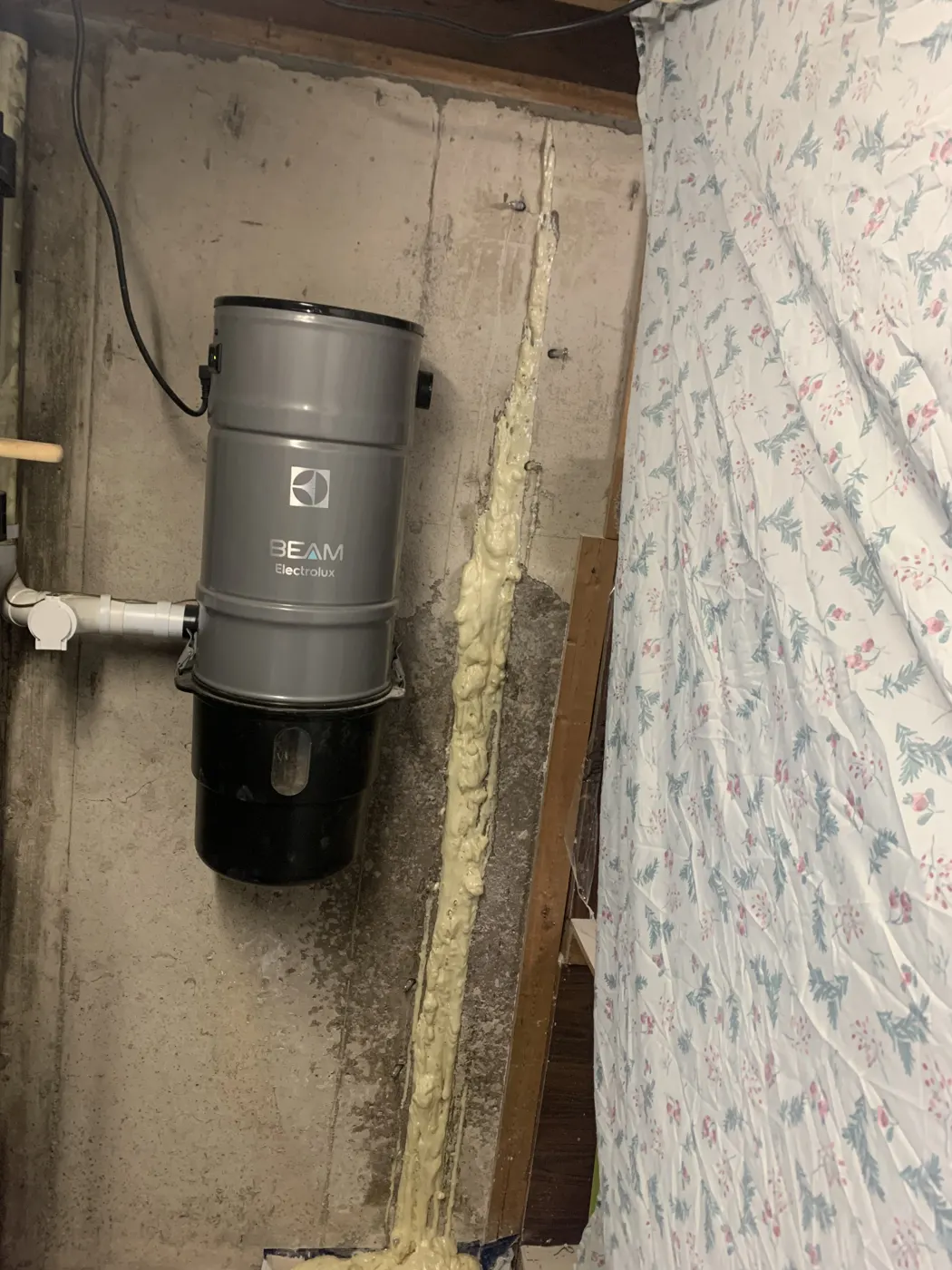
During — resin arriving. Foam at the surface means that section is full. It reacts with the water already in the crack, so a damp crack injects better than a dry one.
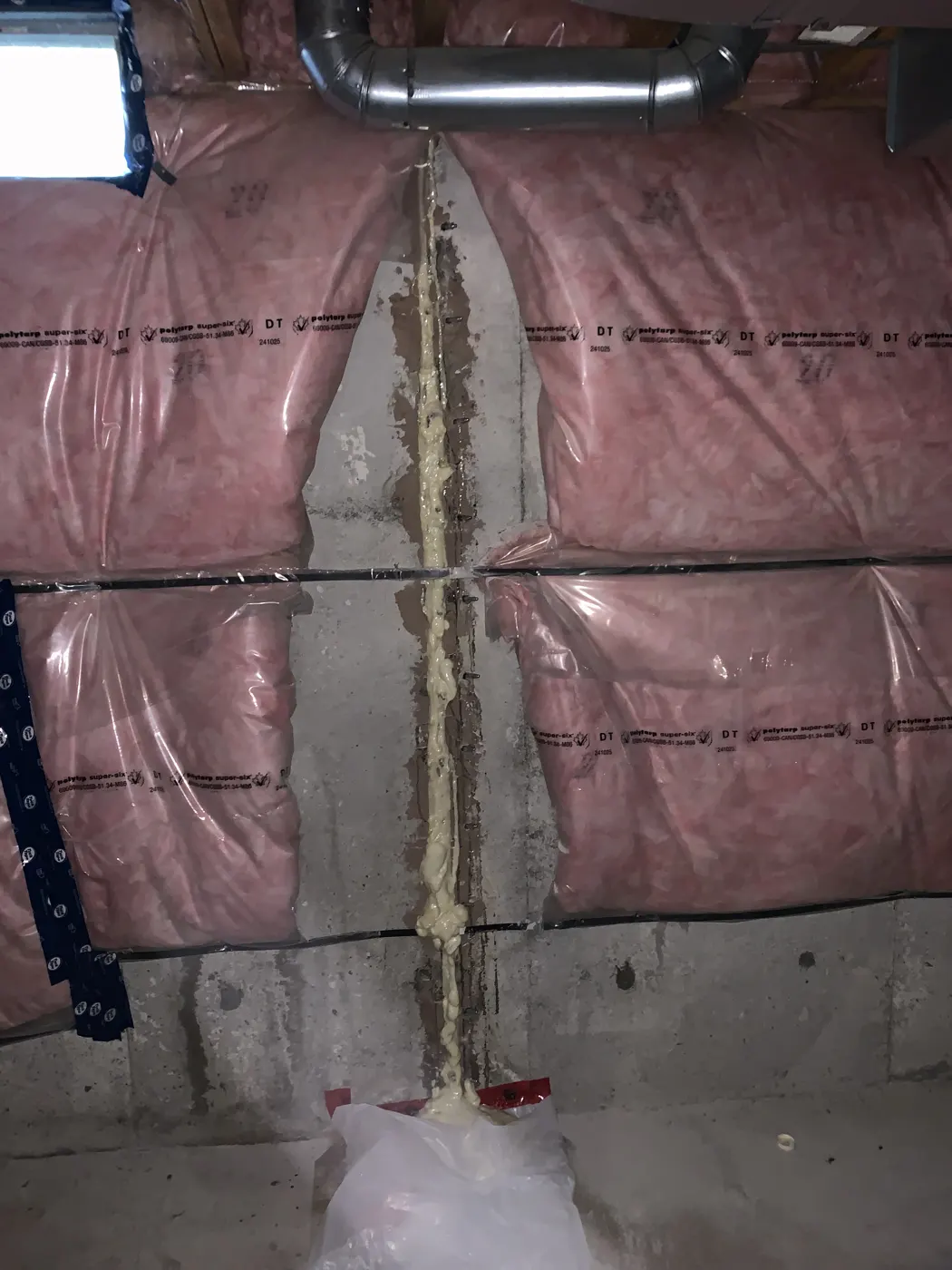
After — sealed front to back. A flexible seal through the full thickness of the wall, not a skim over the visible line.
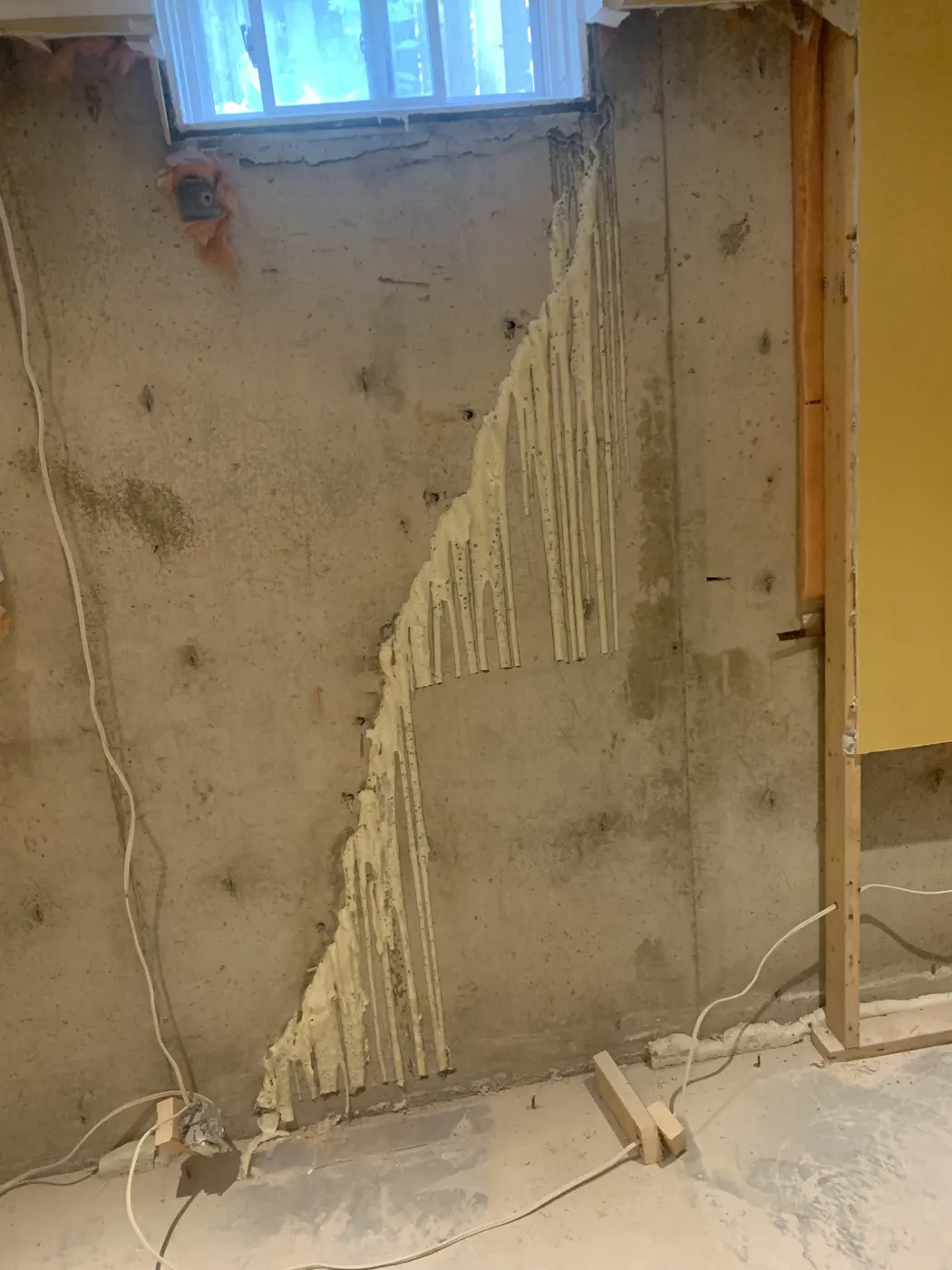
Cured and ready to trim. What the wall looks like before the surface is tidied and the space is closed back up.
Per crack, in writing, before anything starts. No hourly billing and no travel surcharge.
| Factor | Effect | Why |
|---|---|---|
| Number of cracks | Largest single factor | Each crack is its own set-up: ports, surface seal, resin, cure. |
| Height of the crack | Moderate | Full height takes more ports and more material than a metre near the floor. |
| Wall thickness | Moderate | Thicker walls need deeper ports and more resin to fill front to back. |
| Finished vs bare wall | Can be significant | Insulation and board have to come off to reach concrete, and go back after. |
| Tie-rod holes | Small | Cheap to seal individually, and worth doing while we are there. |
| Travel to Guelph | None | Quoted from the same published ranges as our Toronto work. |
Ranges are published on our crack injection cost page rather than held back for a sales call. Book multiple cracks on one visit — the second and third cost meaningfully less than the first.
All of Guelph, and the age of the housing changes what we find.
Almost always because the water changed, not the wall. Guelph sits on fractured limestone and dolostone, and water in fractured rock travels along specific joints and bedding planes rather than spreading evenly through the ground. A wet spring, a shift in the seasonal water table, or new drainage from construction upslope can connect a pathway that never previously reached your foundation. The crack was probably there for years doing nothing. What arrived is the water.
Almost entirely. The City describes Guelph as the largest Canadian city relying almost exclusively on groundwater for drinking water, drawn from 21 operational wells plus the Glen Collector System at the Arkell Spring Grounds in Puslinch. There is no lake intake. Between April and November, Eramosa River water is pumped into engineered infiltration areas at Arkell to recharge the supply. The relevance to your basement is that the same rock aquifer under pressure is what presses against your foundation wall.
Not for interior injection, no. We work from inside the wall, so what is outside it does not affect the method. Shallow rock does matter for the alternatives — exterior excavation on a rock-cut lot is considerably more expensive and disruptive than on a soil lot, which is one more reason to establish whether the interior repair will do the job first.
When bedrock is shallow, the basement is cut into rock and then backfilled with loose granular material or excavation spoil. That loose envelope sits inside an effectively impermeable rock box, so water entering it cannot drain away easily and instead builds pressure against the foundation wall. You probably have some version of it if your lot is on shallow rock. The practical tests are simple: check where your downspouts discharge, and check whether the ground slopes toward the house. Fixing those two things sometimes solves the problem outright.
We could not find one. Toronto, Peel and Halton run basement flooding subsidy programs; we found no City of Guelph equivalent. Note too that where such programs exist they fund plumbing measures — backwater valves, sump pumps, weeping tile disconnection — and crack injection would not usually qualify in any case. Budget the full cost, and check guelph.ca yourself rather than taking our word for it.
Yes, regularly. We work out of North York and Guelph is about an hour down the 401. There is no travel surcharge — the per-crack ranges are the same published ones we quote in Toronto. Practical advice: get everything you want assessed onto one visit rather than calling us back for a second crack later.
No. Injection needs a continuous mass for the resin to travel through. Stone and rubble walls have voids and mortar joints that let resin escape in every direction, and block walls are hollow with continuous mortar joints. In the Ward, downtown and the older streets this genuinely comes up. If that is your wall, the honest options are exterior excavation with membrane and drainage, or an interior drainage system with a sump — neither of which is what we do. We will tell you so rather than take the job.
For a leaking crack, polyurethane almost always. It reacts with the water already present, foams to fill irregular voids, and cures flexible so ordinary seasonal movement does not break the seal. Epoxy is rigid and far stronger in tension, which makes it correct when the goal is to structurally rebond a crack, usually under engineering direction. Epoxy in a wet crack frequently will not bond properly in the first place.
Most single-crack jobs take a few hours in a single visit. The resin cures quickly and there is no waiting period before you can use the space. Multiple cracks, or a finished wall that has to be opened first, will stretch it, but it is usually still the same day.
The repair carries a transferable lifetime warranty. Polyurethane stays flexible, so the normal seasonal movement of an Ontario foundation does not break the seal. What we cannot warrant is a new crack elsewhere on the wall, or water arriving by a route the injection was never meant to block — through the slab, over the top of the wall, or up a floor drain.
Usually not, and we will tell you so for free. A hairline vertical crack that has never been wet and is not widening is doing no harm. Mark each end with a pencil and the date, photograph it, and look again after a wet spring. If it has moved or wept, call us. If it has not, leave it alone.
Not an injection job on its own. A horizontal crack usually means lateral pressure — soil, backfill or ice pushing the wall inward — and that is a structural question before it is a waterproofing one. Sealing it conceals the symptom while the cause continues. We will look, tell you what we think, and point you to an engineer if that is what the wall needs.
Tie-rod holes, left by the steel rods that held the forms apart when the wall was poured. They are normal, they appear in a regular grid, and they are a common and easily overlooked leak path once the original plugs degrade. They are quick and cheap to seal, and worth doing while we are on site for something else.
Not for an ordinary vertical or diagonal crack in a poured wall. You do when the wall is bowing or moving, when a crack is measurably widening over months, or when a lender, insurer or buyer wants a professional opinion in writing. In Ontario that report comes from a professional engineer, and we will tell you when we think you have reached that point rather than guessing at it.
Live Google reviews for Concrete Crack Repair Pros, straight from our own Google Business Profile.
What this page is built on, so you can check us rather than trust us.
Free written assessment. An exact per-crack price before anything starts — and an honest answer if the fix is your downspouts rather than your foundation.