
See the full foundation crack repair cost guide for every range and the discount math.
#eef2f7}}
Home › Service Areas › Halton Hills
The Town’s own flooding page still lists the old subsidy amounts. The Region pays considerably more. We will show you both, then flat-price your crack from $750 — one visit, lifetime transferable warranty.
Coverage: We service Toronto, the GTA and Southern Ontario, and Halton Hills sits on our Halton route alongside Milton and Oakville — regular ground for our crews, travel folded into the flat pricing. The assessment is free, and most Georgetown and Acton cracks are injected in the same visit.
Foundation crack repair in Halton Hills costs a flat $750–$1,000 per crack for polyurethane injection and $850–$1,500 for structural epoxy, with every additional crack 5% off. Halton Region’s subsidy pays up to $6,500 on five measures, none of which is crack repair — and note that the Town of Halton Hills website still shows the pre-July-2024 amounts, which are materially lower than what the Region actually pays now. On permits, two Town documents contradict each other, so we call Building Services before we start.
Halton Hills does not behave like the clay towns south of it.
The surficial soil across the Georgetown area is Halton Till, which Halton Region’s own hydrogeological assessment for the Trafalgar Road corridor describes as “red-brown” with a “silty-clay texture,” varying “in thickness from approximately 2 m to 15 m within the vicinity of the Lindsay Court and Princess Anne Wellfields.” Sand and gravel lenses run through it, forming “minor aquifers that support private domestic water supplies.” Beneath sits the Queenston Formation — “reddish brown and thinly bedded shale with frequent hard grey limestone layers with occasional siltstone and some clay seams,” and critically, “the upper portion of the Queenston formation is highly weathered.”
Note that carefully, because it corrects a common assumption: the rock under Georgetown is shale, not the dolostone that caps the Niagara Escarpment a few kilometres west. Deeper still lie buried bedrock valleys filled with “sands and gravels” that act as “major regional groundwater aquifers” — the source of the town’s drinking water.
Physiographically the town straddles two regions: the Peel Plain to the southeast, “flat to undulating terrain… with a very gentle slope to the southeast, towards Lake Ontario,” and the South Slope to the northwest, “undulating terrain (drumlinized to bevelled till plains).” Toward the Escarpment the character changes sharply. The Credit Valley source protection assessment describes the Middle Zone — the escarpment belt between Inglewood and Norval/Georgetown — as “characterized by steep slopes, significant rock outcrops and thin overburden soil conditions.” Thin soil over weathered rock is the real hydrostatic story here: water cannot drain vertically, so it perches and moves laterally until it meets something solid, which is often a foundation wall.
Both settlements are 100% well-supplied — and that tells you something about the water table.
Halton Region’s water master plan is unambiguous: “presently, Georgetown relies entirely on groundwater supply, derived from seven wells at three municipal well fields” — Lindsay Court at about 6,545 cubic metres a day, Princess Anne at 6,800, and Cedarvale at 4,500. Acton draws on “groundwater, extracted from five wells at three well fields: Prospect Park, Davison and Fourth Line,” with a combined actual maximum daily supply of 5.5 million litres against a projected 8.34 million by 2031. Under municipal pumping, water table elevations near the Georgetown wellfields have been recorded at roughly 270 metres above sea level near Lindsay Court and 254 near Princess Anne.
What that means for a homeowner is simple enough. This is a place where groundwater is close, plentiful and actively managed — the Region maintains a network of at least 60 sentry wells to watch it. A basement here is not sitting in dry ground waiting for a storm; it is sitting in a working aquifer system. That is why so many Halton Hills leaks are slow, persistent seeps rather than dramatic storm events, and why flexible polyurethane rather than rigid epoxy is usually the right resin.
This is worth checking before you spend anything.
| Measure | Region pays now | Still shown on the Town site |
|---|---|---|
| Backwater valve installation | $1,600 (50%) | $675 |
| Weeping tile disconnection + sump pump | $6,500 (100%) | $5,000 |
| Downspout disconnection | $900 (100%) | $500 |
| Exterior storm drain disconnection | $6,500 (100%) | — |
| Sanitary lateral lining or repair | $4,000 (50%) | $2,000 |
| Foundation crack injection | Not eligible under either version — flat-priced from $750 instead | |
The dividing date is 15 July 2024. Work completed after it qualifies for the higher caps; work completed on or before it gets the old ones. The Town’s flooding page has not been updated, so a Halton Hills homeowner reading their own municipality’s website will underestimate what they can claim by thousands of dollars. Use halton.ca.
Two eligibility rules bite hard here. Every measure requires the property to be “connected to Halton Region’s municipal wastewater (sewer) system (homes on septic systems are not eligible)” — and the Town has confirmed on its own engagement site that there are no plans to retrofit older Glen Williams properties away from private septic. A Glen Williams homeowner is therefore categorically ineligible for all five subsidies, however badly their basement floods. Second, each subsidy is available once per property, forever, “even if ownership has changed.” Halton Hills take-up between July 2024 and the end of 2025 ran to 49 lateral repairs, 32 backwater valves, 18 weeping tile disconnections and 7 downspout disconnections.
Four questions, instant range — polyurethane or epoxy, multi-crack discount included, no obligation.
What actually flooded here, and what the Region says caused it.
In July 2024 the Mayor’s own message recorded “Conservation Halton reporting upwards of 75 mm and Credit Valley Conservation reporting up to 118 mm” — described as “more than a month’s worth of rain in one weather event.” Over 80 people from Halton Hills called the Region about basement flooding and property damage. Some Norval roads became rivers, parts of Georgetown were threatened, a Trafalgar Road culvert failed, and Town Hall itself flooded and closed.
The fuller picture came at a public meeting in June 2025 on basement flooding in the Delrex and Prince Charles area: across the July 2024 and April 2025 storms, approximately 140 residences in Halton Hills experienced flooding, with the majority in Ward 3. The stated cause was “unusually high volumes of stormwater entering the wastewater system and overwhelming its capacity during extreme rainfall events.”
That matches the Region’s own 2026 diagnosis, which attributes basement flooding to “excessive stormwater inflow and infiltration, primarily from private side sources, such as weeping tile, downspouts and exterior storm drain connections.” Foundation cracks are not on the Region’s list of causes. So if your Delrex basement took water in one of those two storms and is dry the rest of the year, injection is quite possibly not your answer — a drainage survey and a subsidised weeping tile disconnection may be. We will tell you that at the free assessment rather than sell you a repair that fixes nothing.
Two frames from our crews’ recent work.
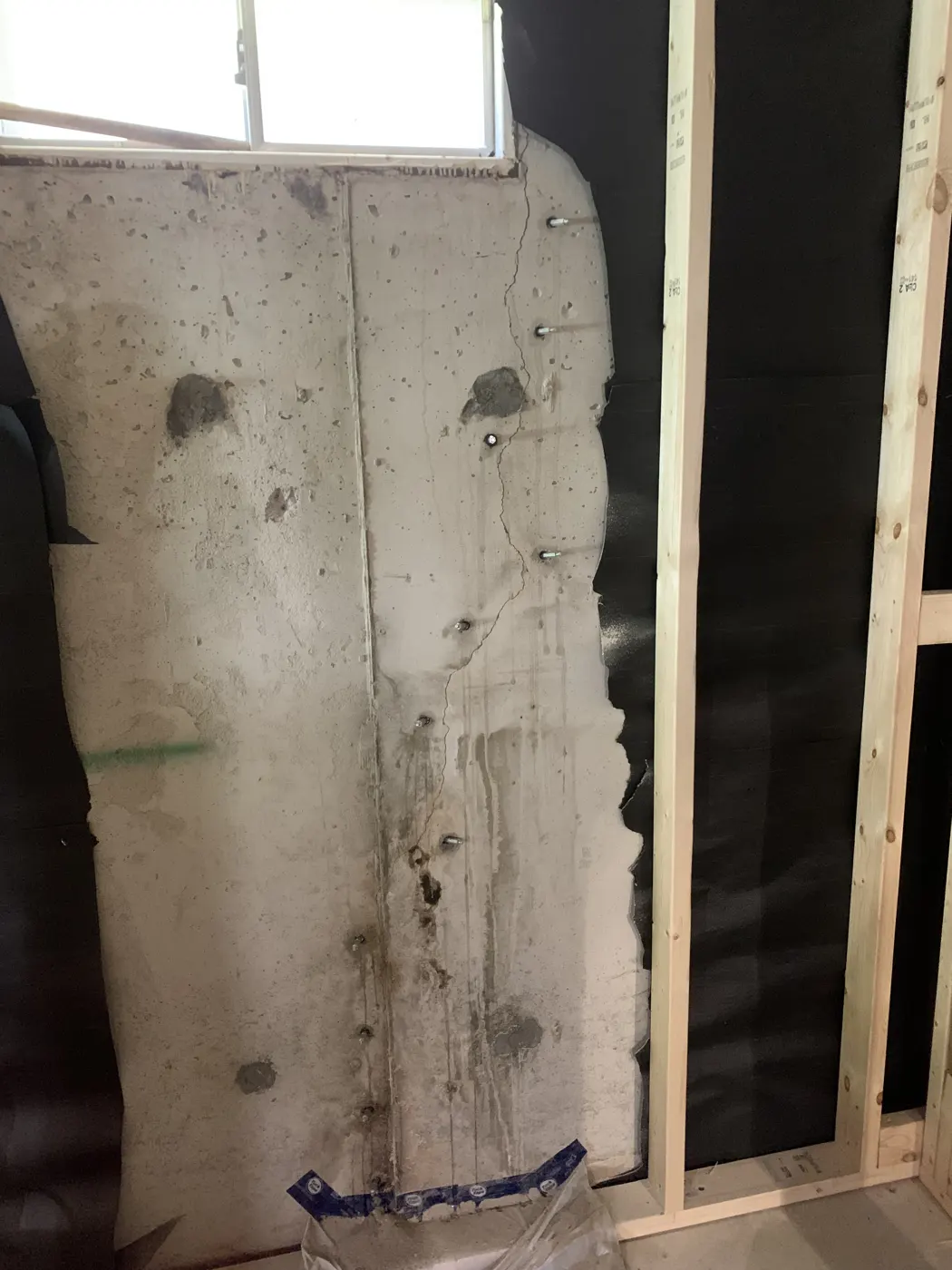
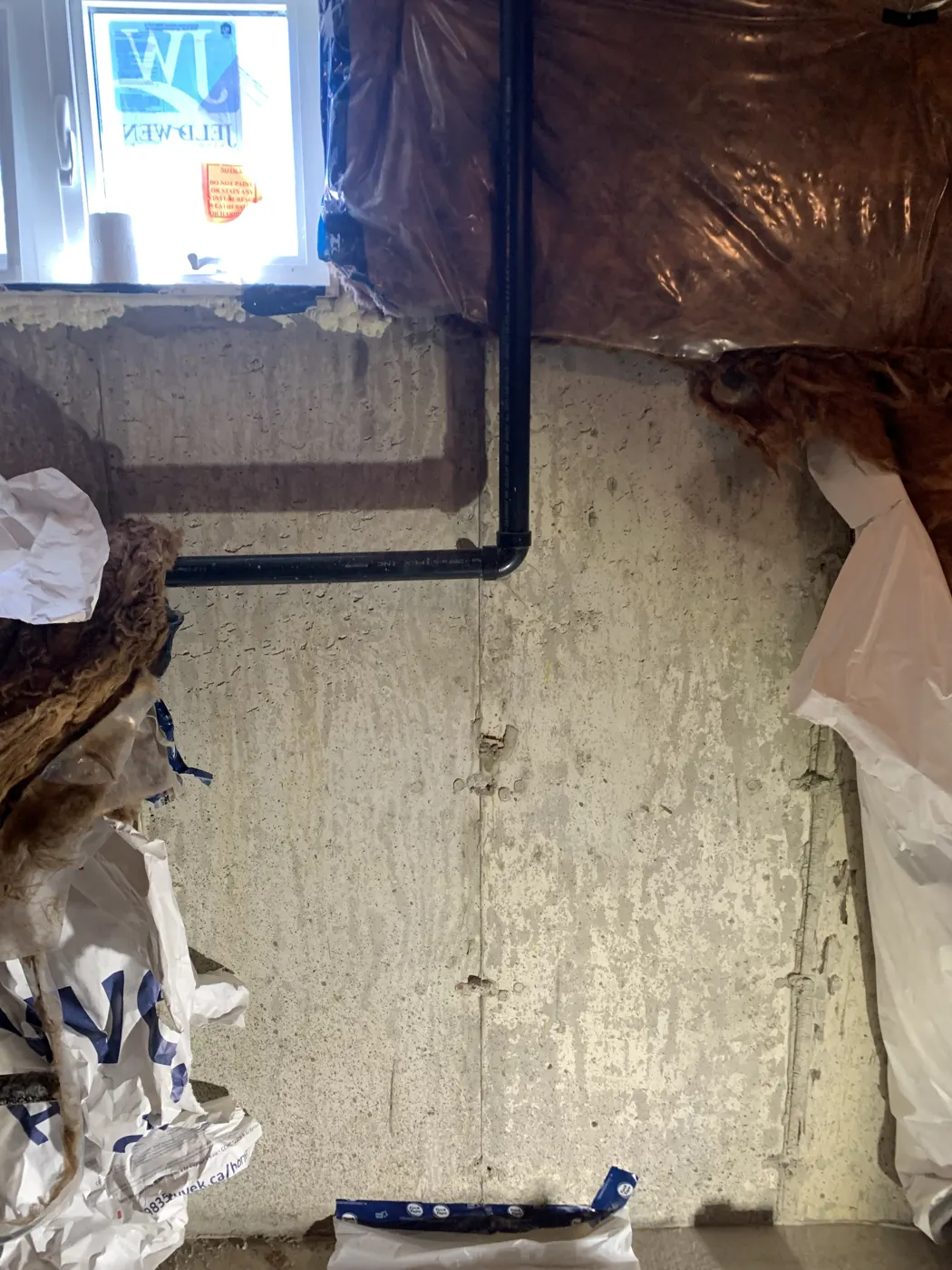
Persistent seepage and structural movement want different resins.
The characteristic Halton Hills crack is a slow, persistent seep rather than a storm event — groundwater working through thin overburden or perched on red shale till. That gets hydrophobic polyurethane ($750–$1,000), which cures against live water and stays flexible. A crack that has grown across seasons, or one carrying structural load, gets epoxy injection that re-bonds the wall ($850–$1,500). Tie-rod leaks run $75–$150, extra cracks are 5% off each, and the complete method guide, the polyurethane page, the epoxy page and the open price sheet hold nothing back. Not sure which pattern you are looking at? Our guide to the five types of foundation crack explains what each orientation indicates, and why width alone tells you very little.
One visit — and a permit question the Town answers two different ways.
Photo quotes come back the same day; the on-site assessment is free either way. A typical crack takes 60–90 minutes from the basement side — no excavation through Georgetown landscaping, no seasonal blackout. On permits we have to be straight with you: the Town’s current Building Permits page lists “replacement/repair of dampproofing and foundation drainage system” as work that requires a permit, while its 2020 Building Permit Application Guide lists “damp-proofing basements” under work that does not. Neither document names interior crack injection. The newer page governs, and it appears aimed at exterior dampproofing and drainage replacement rather than an interior injection — but we do not guess on your behalf. We call Halton Hills Building Services on 905-873-2600 (1 Halton Hills Drive; extension 2216 is the current Building line) before we start.
The honest variables inside the published ranges.
Properties near the Escarpment, on thin overburden over weathered rock, can need patient multi-port injection because water keeps arriving during the work. Long full-height cracks use more resin than hairlines, and finished basements add access care. Heritage foundations are the big variable here: Georgetown’s core dates to 1821 and Acton’s to 1825, and the Town’s heritage register covers properties across Georgetown, Acton, Norval, Glen Williams, Limehouse and Stewarttown. Injection is engineered for poured concrete, where a crack is a discrete plane through a monolithic pour — rubble, fieldstone and mortared block have no such plane, so water moves through joints and voids across the whole assembly and there is nothing for resin to seal against. We tell you that at the assessment rather than force the wrong fix. Every crack after the first is 5% off, and all of it is on the published cost breakdown before we ever ring your doorbell.
Georgetown and Acton, plus every hamlet in Esquesing.
Georgetown — the historic downtown, Delrex, Moore Park, Georgetown South, Stewart’s Mills and Arbour Glen — and Acton, downtown and the newer subdivisions, plus Glen Williams, Norval, Limehouse, Terra Cotta, Ballinafad, Stewarttown and rural Esquesing. Where dates are documented we use them: Georgetown was founded in 1821 around George Kennedy’s mills in the Silver Creek valley, reaching about 700 people by 1846; Delrex was built through the 1950s and 1960s by developer Rex Heslop, its name combining his and his wife Delma’s; Moore Park followed as a second subdivision in 1962; and Georgetown South began in 1989 on farmland south of Silver Creek. Acton was settled in 1825, took its present name in 1844, and grew around the Grand Trunk Railway’s arrival in 1856. Our Milton guide covers the town south, our Brampton guide the city east, and the full service-area index lists every city we publish for.
The numbers behind the warranty.
A quarter-century of GTA basements kept dry.
Injection repairs warrantied for life — and the warranty moves with the house when you sell.
Full commercial coverage on every job, every crew, every home.
Eligible contractor for City of Toronto, Peel & Halton basement-flooding subsidy programs.
Inspection, honest diagnosis, and an exact per-crack quote — free, no pressure.
Your price is confirmed in writing before any work starts — no hourly surprises.
Every review below is a real, verifiable Google review of Concrete Crack Repair Pros. Nothing is paraphrased, and nothing is borrowed from a sister company.
Are these reviews genuine? Every review shown above is pulled live from the Concrete Crack Repair Pros Google Business Profile at 64 Millwick Dr, North York — not from a parent or sister brand’s listing. The rating and the count update automatically as new reviews arrive, so what you see here is what is on Google right now.
The same name, address and phone number we publish everywhere, so you can check us before you call.
The Region’s. haltonhills.ca still publishes the pre-July-2024 figures — $500 for downspout disconnection, $5,000 for weeping tile, $675 for a backwater valve and $2,000 for lateral repair. Halton Region’s current amounts for work completed after 15 July 2024 are $900, $6,500, $1,600 and $4,000 respectively, plus $6,500 for exterior storm drain disconnection. A homeowner working from the Town’s page will underestimate their claim by thousands. Always check halton.ca, and note that foundation crack injection is not eligible under either version.
Indirectly, but usefully. Georgetown draws from seven municipal wells across three wellfields and Acton from five across three — this is a town built on a working aquifer, with the Region monitoring water levels through a network of at least 60 sentry wells. Groundwater here is close and plentiful rather than distant and seasonal. In practice that means Halton Hills leaks tend to be slow persistent seeps rather than sudden storm events, and flexible polyurethane usually suits them better than rigid epoxy.
The Town says two different things, and we would rather show you that than pick the convenient one. Its current Building Permits page lists “replacement/repair of dampproofing and foundation drainage system” as requiring a permit. Its 2020 Building Permit Application Guide lists “damp-proofing basements” as not requiring one. Neither names interior crack injection. The newer page governs and appears aimed at exterior work, but the ambiguity is real. We call Building Services on 905-873-2600 before starting. Anyone who gives you a flat yes or no is guessing.
No. Across the July 2024 and April 2025 storms roughly 140 Halton Hills residences flooded, the majority in Ward 3 — Delrex and Prince Charles. The stated cause was “unusually high volumes of stormwater entering the wastewater system and overwhelming its capacity,” and Halton Region’s own 2026 report blames “excessive stormwater inflow and infiltration, primarily from private side sources, such as weeping tile, downspouts and exterior storm drain connections.” Foundation cracks are not on the Region’s causes list at all. If your basement floods only in extreme storms, a drainage survey will serve you better than an injection.
Delrex was built through the 1950s and 1960s by developer Rex Heslop — the name combines his with his wife Delma’s — and in that era the area was referred to as Georgetown East. So expect poured or block walls now roughly 60 to 75 years old, well past their shrinkage phase. That usually means mature, stable cracks rather than active ones, which are straightforward to inject. It is also, as above, the part of town that took the brunt of the 2024 and 2025 flooding, so we always check drainage before quoting a wall repair here.
Shale — and the distinction matters because the Escarpment nearby leads people to assume otherwise. Halton Region’s hydrogeological assessment identifies the uppermost bedrock beneath the Georgetown area as the Queenston Formation: “reddish brown and thinly bedded shale with frequent hard grey limestone layers with occasional siltstone and some clay seams,” with the upper portion “highly weathered.” The dolostone is the Escarpment cap rock further west, not what sits under Georgetown. The red-brown, silty-clay Halton Till above it is weathered Queenston shale, which is why the local soil has that colour.
Method, resins and money — documented before you commit.
Slow seeps through red shale till are our daily work: free assessment, flat published pricing, one-visit repair, lifetime transferable warranty — and the current subsidy numbers, not the ones still on the Town’s website.