
The full foundation crack repair cost breakdown shows every range we publish.
#eef2f7}}
Home › Service Areas › North York
Twenty of Toronto’s 67 basement flooding study areas sit in North York — more than any other district. None of that work crosses your property line. Flat pricing from $750, one visit, lifetime transferable warranty.
Coverage: We service Toronto, the GTA and Southern Ontario, and North York is home ground — routes run daily from Weston to Willowdale, travel folded into the flat pricing. The assessment is free, and most North York cracks are injected in the same visit.
Foundation crack repair in North York costs a flat $750–$1,000 per crack for polyurethane injection and $850–$1,500 for structural epoxy, with every additional crack 5% off. Toronto’s Basement Flooding Protection Subsidy reaches a combined $6,650 per property, but crack repair is not one of its five eligible measures. No building permit is needed for interior injection, and none for a sump pump — though a backwater valve does require one.
A common local-SEO error, corrected.
You will find pages claiming North York sits on glacial Lake Iroquois beach sand. It does not, and the sources are unambiguous. TRCA places the Iroquois shoreline at the 135-metre contour, and City of Toronto Planning states plainly that “its shoreline in Toronto was roughly five kilometres north of the current waterfront,” marked today by “a substantial bluff that remains a defining topographical feature” — the Davenport Road escarpment. That is in the old City of Toronto. North York’s southern boundary is well north of it. The Iroquois sand condition belongs to downtown and the Danforth, not here.
What is actually under North York is the South Slope — described by TRCA as lying “south of the ORM and largely consisting of till deposits at surface” — and the till in question is Halton Till: “sandy silt to clayey silt till interbedded with silt, clay, sand and gravel,” typically 3 to 6 metres thick but locally reaching about 40 metres. Critically, it functions as an aquitard — a low-permeability confining layer. Beneath it lies Newmarket Till, “sandy silt to silty sand with limestone clasts,” a dense over-consolidated unit laid down 18,000 to 20,000 years ago, containing fractures, joints and thin 2 to 5 centimetre interbeds of sand and silt.
The practical consequence follows from the permeability, and we will label it as reasoning rather than dress it up as a citation: a clayey-silt till that does not drain freely means water working down through the looser backfill beside your foundation has nowhere to dissipate into. It accumulates against the wall instead. That is the ordinary mechanism behind most North York seepage — not dramatic, not unusual, and exactly what injection is designed to stop. North York’s ravines make it worse in places: the Don’s East and West branches, German Mills Creek and Black Creek all cut deeply through this district, and TRCA records interbasin groundwater flowing from the Humber watershed into the Upper West Don, Upper East Don and German Mills Creek subwatersheds.
The most heavily studied district in Toronto — with a genuinely encouraging number attached.
North York carries twenty of Toronto’s 67 basement flooding study areas: Glenfield–Jane Heights, Black Creek at Finch West, Oakdale–Beverly Heights, Black Creek at Highway 401 and Dufferin, Highway 401 and Bathurst, Clanton Park, Don Mills/York Mills, Victoria Village, the Don Valley Parkway and York Mills, Bathurst at Finch West, Lansing–Westgate, Willowdale Park, Bayview Village, Finch Avenue from Bathurst to Bayview, west of Highway 404 between the 401 and Steeles East, Bayview and York Mills, Black Creek, Steeles West at Weston Road, Finch Avenue from Allen Road to Keele, and Keele/Sheppard West/Allen Road.
The programme behind them is large: $2.15 billion in the 2025–2034 Toronto Water budget, with roughly $1.15 billion already spent on 167 completed projects by the end of 2024, work the City says has “mitigated basement flooding risks for more than 31,000 benefitting properties.” And the results are worth quoting because they are unusually clear. Toronto logged 3,600 basement flooding complaints after the August 2005 storm and over 4,700 after July 2013. In the July and August 2024 storms, areas where the upgrades were complete reported “one or two basement flooding incidents.”
That is a genuine, City-published success, and we would rather you knew it than not. If your street’s sewer upgrade is done and your basement still takes water, the cause is very unlikely to be municipal surcharge — which makes a foundation or drainage problem far more probable, and that is where we can actually help. If the work has not reached you yet, a backwater valve claimed under the subsidy may do more for you this year than anything we sell.
Worth claiming. Just not for your wall.
| Eligible measure | City pays | Maximum |
|---|---|---|
| Home plumbing assessment | 80% of invoice | $500 |
| Backwater valve | 80% of invoice | $1,600 per device, up to 2 |
| Sump pump | 80% of invoice | $2,250 |
| Sump pump battery backup | 80% of invoice | $300 |
| Severing and capping the weeping tile connection | 80% of invoice | $400 |
| Combined maximum per property | $6,650 | |
| Foundation crack injection | Not among the eligible measures — flat-priced from $750 instead | |
Be precise about how crack repair is excluded, because it matters: there is no clause naming it as ineligible. The list of eligible measures is exhaustive and crack repair is simply not on it. Meanwhile the City’s own basement flooding page names “a crack or leak in your home’s foundation, basement walls, or basement windows or door” as a cause, and states that “if the flooding is a result of a private blocked drainpipe, leaking foundation walls or poor lot drainage on your property, you are responsible for repairs and any subsequent damage caused by flooding.” The City identifies the problem, assigns you the bill, and funds five other things. That is the honest position and it is better to know it going in.
Four questions, instant range — polyurethane or epoxy, multi-crack discount included, no obligation.
Two frames from our crews’ recent work.
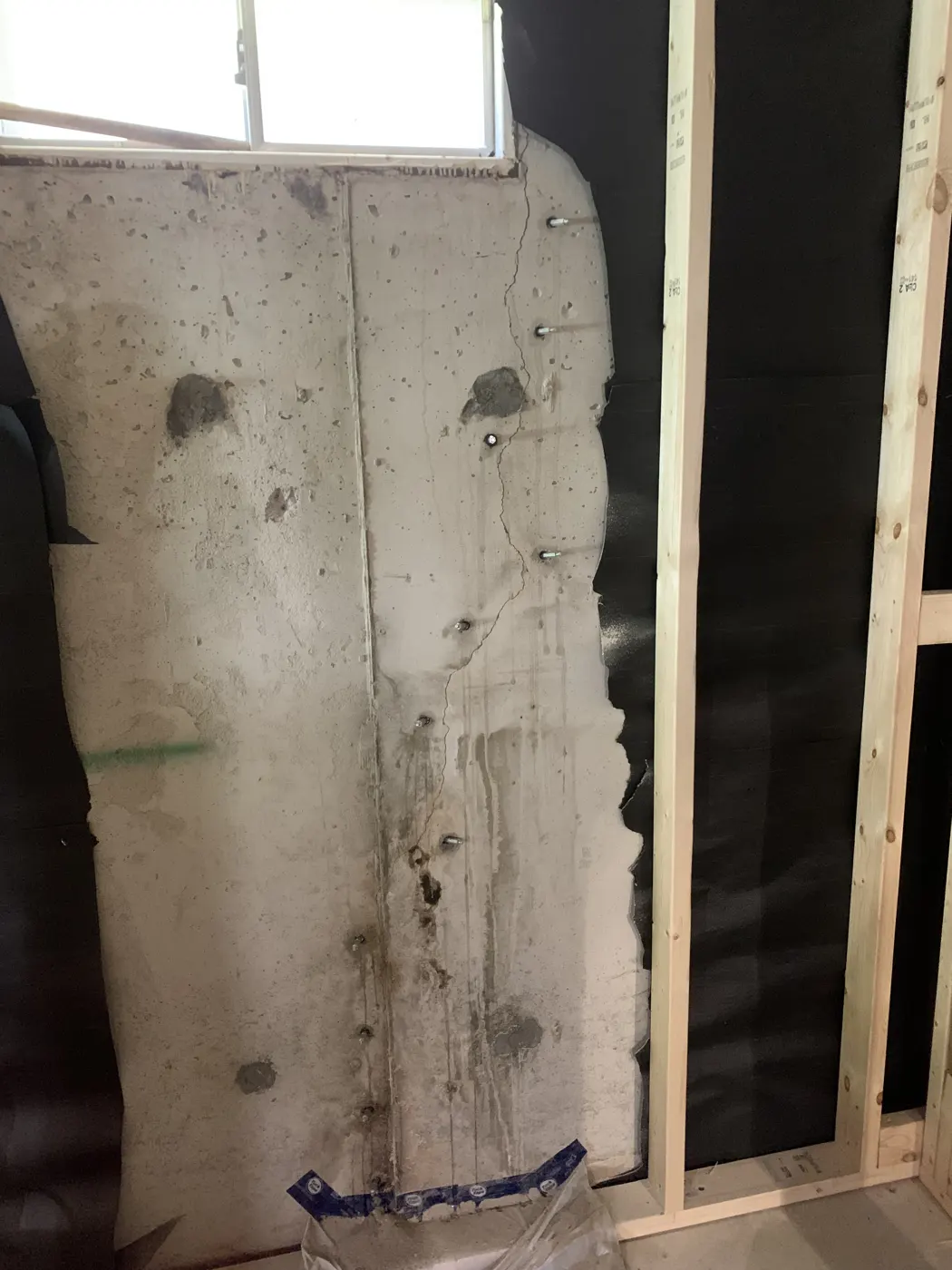
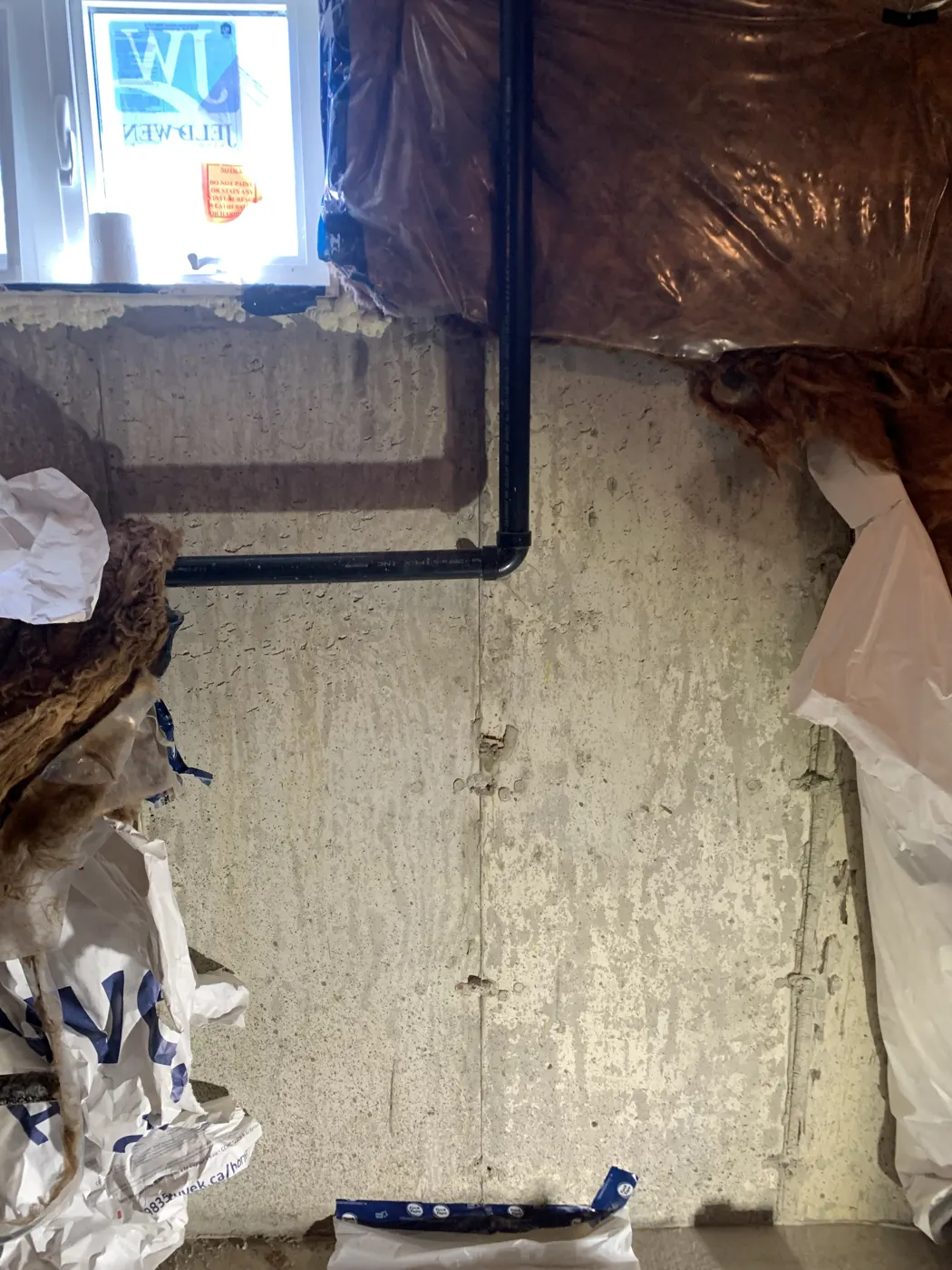
Perched water and structural movement want different resins.
A crack that weeps after heavy rain — water accumulating against the wall because the till beneath will not take it — gets hydrophobic polyurethane ($750–$1,000). It cures against live water and stays flexible. A crack that has grown across seasons, or one carrying structural load, gets epoxy injection that re-bonds the wall ($850–$1,500). Tie-rod leaks run $75–$150, extra cracks are 5% off each, and the complete method guide, the polyurethane page, the epoxy page and the open price sheet hold nothing back. Not sure which pattern you are looking at? Our guide to the five types of foundation crack explains what each orientation indicates, and why width alone tells you very little.
The storm that rewrote how Toronto treats its ravines.
On 15–16 October 1954 an estimated 210 millimetres of rain fell on the watersheds of the Don and Humber rivers. Eighty-one people died; damage was put at $25 million, roughly $147 million in 1998 dollars. The Humber took the worst of it — 35 lives on Raymore Drive in Weston, two more in Thistletown, five firefighters elsewhere — but the detail that stays with people is Black Creek. Environment and Climate Change Canada describes it in normal times as “one foot deep and so narrow that a person is able to jump across.” That night at Mount Dennis it covered Humber Boulevard, Porter Avenue and Cordella Avenue, and at Cynthia Avenue there was “10 feet of water” around homes.
Modern storms behave differently — the ravines are regulated now and the damage shows up as basement flooding rather than lost streets. In July 2013 close to 140 millimetres fell across western Toronto in a few hours, producing over 4,700 basement flooding complaints and $60.8 million in City costs. On 16 July 2024, Pearson recorded 97.8 millimetres and downtown 83.6, with over 100 millimetres in pockets; dozens of vehicles were stranded on the Don Valley Parkway leading to 12 water rescues, and insured damage across southern Ontario topped $940 million. Both those complaint figures are city-wide, not North York specific, and we will not pretend otherwise.
The one North York neighbourhood whose build history is fully documented.
In 1952, Don Mills Developments hired planner Macklin Hancock to design a complete neighbourhood north of the CPR corridor. E.P. Taylor had assembled 2,000 acres by that year, on land where, as City Planning records, “as late as 1950, there were only around 20 farms in the locale.” The result was organised into four quadrants around a shopping complex, the Don Mills Centre, combining “industrial, commercial, residential, educational, religious and recreational facilities, all in one compact development,” with single-family homes, semis, row housing and apartments all available. Taylor even agreed to finance and build the water and sewage infrastructure himself, with the former Township of North York repaying the loan over fifteen years.
That gives Don Mills something unusual: a documented, dated foundation cohort. Elsewhere in North York we deliberately do not publish build decades — the City’s per-neighbourhood construction data is not retrievable and the decades that circulate on property sites are unsourced. What is official is the district picture: of 261,830 dwellings, 62,165 date from 1960 or earlier and 86,190 from 1961 to 1980 — 56.6% built in 1980 or before, with nearly a quarter predating 1960.
One visit, no permit — with one exception worth knowing.
Photo quotes come back the same day; the on-site assessment is free either way. A typical crack takes 60–90 minutes from the basement side — no excavation through North York landscaping, no seasonal blackout. Toronto’s published list of work that does not require a building permit includes “undertaking waterproofing repairs to a basement,” and separately confirms that “a building permit is not required to install a sump pump.” Interior crack injection sits squarely in the first category. The exception that surprises people: installing a backwater valve does require a permit, even though a sump pump does not — and both are subsidy-eligible. A permit is also required for structural or material alterations, excavating or constructing foundations, basement underpinning and basement entrances. Toronto Building is on 416-397-5330, or 311 within the city.
The honest variables inside the published ranges.
Ravine lots along the Don and Black Creek carry concentrated runoff and can need patient multi-port injection. Long full-height cracks use more resin than hairlines. Finished basements add access care — very common in a district where 1950s and 60s houses have been renovated repeatedly. Block foundations appear in the older stock, and injection is engineered for poured concrete: a crack there is a discrete plane through a monolithic pour, whereas mortared block has no such plane for resin to seal against. We tell you at the assessment rather than inject a wall that will not hold it. Every crack after the first is 5% off, and all of it is on the published cost breakdown before we ever ring your doorbell.
Willowdale to Weston, Don Mills to Downsview.
Willowdale, Lansing-Westgate, Bayview Village, Don Mills, Banbury-Don Mills, Flemingdon Park, Victoria Village, Parkwoods-Donalda, Henry Farm, Pleasant View, Hillcrest Village, Newtonbrook, Bathurst Manor, Clanton Park, Downsview, York University Heights, Black Creek, Glenfield-Jane Heights, Humber Summit, Bridle Path-Sunnybrook-York Mills, St. Andrew-Windfields, Forest Hill North and Yorkdale-Glen Park. Our Vaughan guide covers the city north across Steeles, our Markham guide the region northeast, and the full service-area index lists every city we publish for.
The numbers behind the warranty.
A quarter-century of GTA basements kept dry.
Injection repairs warrantied for life — and the warranty moves with the house when you sell.
Full commercial coverage on every job, every crew, every home.
Eligible contractor for City of Toronto, Peel & Halton basement-flooding subsidy programs.
Inspection, honest diagnosis, and an exact per-crack quote — free, no pressure.
Your price is confirmed in writing before any work starts — no hourly surprises.
Every review below is a real, verifiable Google review of Concrete Crack Repair Pros. Nothing is paraphrased, and nothing is borrowed from a sister company.
Are these reviews genuine? Every review shown above is pulled live from the Concrete Crack Repair Pros Google Business Profile at 64 Millwick Dr, North York — not from a parent or sister brand’s listing. The rating and the count update automatically as new reviews arrive, so what you see here is what is on Google right now.
The same name, address and phone number we publish everywhere, so you can check us before you call.
No — this is a common error and it is worth correcting. TRCA places the Iroquois shoreline at the 135-metre contour, and City of Toronto Planning states its Toronto shoreline “was roughly five kilometres north of the current waterfront,” marked by the bluff along Davenport Road. That is in the old City of Toronto, well south of North York’s boundary. North York sits inland on the South Slope till plain — Halton Till at surface, which acts as a low-permeability aquitard. Sand drains; till does not. If a contractor tells you your North York basement leaks because of Iroquois sand, they have the geology backwards.
Worth checking, because the difference is dramatic. Toronto logged 3,600 basement flooding complaints after the August 2005 storm and over 4,700 after July 2013. In the 2024 storms, areas where the sewer upgrades were complete reported “one or two basement flooding incidents.” Roughly $1.15 billion has been spent on 167 completed projects, benefitting more than 31,000 properties. Twenty of the 67 study areas are in North York. Call 311 to ask about your street. If the work is done and you are still taking water, the cause is probably on your property — which is where we come in.
Different answers, which catches people out. Toronto states that “a building permit is not required to install a sump pump” — but installing a backwater valve does require one. Both are eligible for the City subsidy, so if you are claiming for a valve, budget for the permit and the inspection. Interior foundation crack injection needs no permit either: it falls under “undertaking waterproofing repairs to a basement” on the City’s no-permit list. Underpinning, foundation excavation, structural alterations and basement entrances all require permits.
Because a small creek in a hard-surfaced catchment can rise extraordinarily fast. Environment and Climate Change Canada describes Black Creek in normal conditions as “one foot deep and so narrow that a person is able to jump across.” During Hazel, with an estimated 210 millimetres falling on the Don and Humber watersheds, it covered Humber Boulevard, Porter Avenue and Cordella Avenue at Mount Dennis, and there was “10 feet of water” around homes at Cynthia Avenue. That is why the ravines are regulated the way they are now — and why modern North York flooding shows up as basements rather than lost streets.
It gives us a dated cohort, which helps. Don Mills was designed from 1952 by Macklin Hancock for E.P. Taylor, who had assembled 2,000 acres on land that held “only around 20 farms” as late as 1950 — Canada’s first fully planned community, laid out in four quadrants around the Don Mills Centre. So its poured walls are broadly 1950s to 1960s, now around 65 to 75 years old. Walls of that age finished shrinking generations ago, so their cracks are almost always mature and stable rather than actively growing — usually straightforward polyurethane work rather than structural epoxy.
Usually not directly, and it is fairer to say so. North York’s housing is unusual: only 26.3% of its 261,830 dwellings are single-detached, while 48.9% are apartments of five storeys or more and another 11.8% are lower-rise apartments. If you are in a multi-unit building, the foundation is common element and the repair is a decision for your condo corporation or landlord, not an individual owner — we do work with property managers and boards on that basis. If you own a house, a semi or a townhouse, that is straightforward and we can quote it directly.
Method, resins and money — documented before you commit.
Post-war walls on aquitard till are our daily work: free assessment, flat published pricing, one-visit repair, lifetime transferable warranty — and an honest answer when the City’s sewer programme has already solved your problem.