
For the complete picture, read what foundation crack repair costs in the GTA.
#eef2f7}}
Home › Service Areas › Milton
Roughly three in four Milton homes did not exist in 2001 — and young concrete shrinks. Flat pricing from $750, one visit, a lifetime transferable warranty, and an honest word about your Tarion window before you pay us anything.
Coverage: We service Toronto, the GTA and Southern Ontario, and Milton sits on our Halton route alongside Oakville and Burlington — regular ground for our crews, travel folded into the flat pricing. The assessment is free, and most Milton cracks are injected in the same visit.
Foundation crack repair in Milton costs a flat $750–$1,000 per crack for polyurethane injection and $850–$1,500 for structural epoxy, with every additional crack 5% off. But check your possession date first: if your home is under two years old and water is actively coming through the wall, that is a Tarion warranty claim, not a bill you should be paying. Halton Region’s subsidy program covers five measures and crack injection is not one of them.
The Town’s own filed reports describe the ground your foundation sits in.
Milton sits below the Niagara Escarpment, and Conservation Halton’s 2024 Watershed Characterization Report is direct about what that means: above the escarpment “most of the area is covered by loam and sandy loam which are usually permeable and well drained,” but below it “clay loam soils are predominant,” and “most of the surface materials, such as clays and silts, have low permeability and hence low infiltration.” Every Milton subdivision is on the low-permeability side of that line.
A hydrogeological investigation filed with the Town for a site on Bronte Street North puts numbers to it. The borehole log runs fill to 1.5 metres, then clayey silt till from 1.5 to 4.6 metres, sandy silt till below that, and weathered shale by 9.4 metres — with Queenston bedrock as shallow as about five metres on part of the site. The till is Halton Till, described in that report as “reddish in color as it is composed primarily of glacially reworked Queenston shales,” and the regional soils as “heavier clay loams.” Measured hydraulic conductivity ran between 1.62 × 10⁻⁶ and 3.45 × 10⁻⁷ metres per second — low permeability, in plain terms: water does not drain away, it sits.
The number that matters most to a homeowner is the water table. That same June 2018 investigation measured groundwater at 1.55 to 2.63 metres below ground surface. A standard Ontario full-height basement floor sits roughly 2.1 to 2.4 metres down. For part of the year, in that part of Milton, groundwater is at or above the slab. That is not a crack problem or a builder problem — it is a hydrostatic pressure problem, and it is why a hairline shrinkage crack that would stay dry in a drier town weeps here. Sixteen Mile Creek, at about 360 square kilometres the largest watershed in Conservation Halton’s jurisdiction, runs straight through Milton in a ravine cut down into the underlying shale, and the Milton flood channel was built through the town between 1975 and 1979 for exactly these reasons.
The single most useful thing a Boyne Survey homeowner can understand.
Concrete shrinks as it dries. The National Research Council’s building digest on volume change puts typical drying shrinkage between 0.04% and 0.085% depending on the water-cement ratio, rising past 0.10% at 50% relative humidity, and identifies water content as “probably the largest single factor influencing the shrinkage of paste and concrete.” Shrinkage alone is harmless. What cracks a wall is restraint: the footing below and the reinforcing within hold the wall while it tries to contract, tension builds, and the wall relieves it — usually as a vertical crack at the weakest section, which is why they so often appear at window openings, form-tie lines and service penetrations.
That process is progressive over months, not instant, which is why a two-year-old house in the Boyne Survey can look perfect at closing and show a full-height hairline by its second winter. It is not settlement, it is not a bad builder, and on its own it is not a defect. It becomes your problem the day it starts letting water through — and in Milton, with groundwater sitting where it does, that day tends to come.
The honest conversation most contractors skip.
| Condition | Tarion standard | Coverage |
|---|---|---|
| Cast-in-place foundation wall is cracked | Shrinkage cracks acceptable; cracks over 6 mm wide are not | One year (shrinkage excluded) |
| Concrete block foundation wall is cracked | Cracks over 2 mm wide are not acceptable | One year (shrinkage excluded) |
| Basement floor is cracked | Cracks over 4 mm wide are not acceptable | One year (shrinkage excluded) |
| Foundation wall leaks | “Foundation walls shall allow no water penetration” | Two years — basement water penetration |
| Basement wall or floor is damp | Dampness from capillary transport or condensation may occur | None |
Read that table before you call anyone, including us. If your home is under two years from possession and water is actively coming through the wall, that is a warranted two-year item and you should claim it. If the wall is merely damp, or the crack is a dry hairline under 6 mm, Tarion treats that as normal and it is yours to deal with. Given how much of Milton was built after 2015, a real share of the cracks we get called about are still inside that window — and we would rather tell you to file the claim than take the job. Once you are outside it, our price sheet is published and the crack costs what it says.
Two frames from our crews’ recent work.
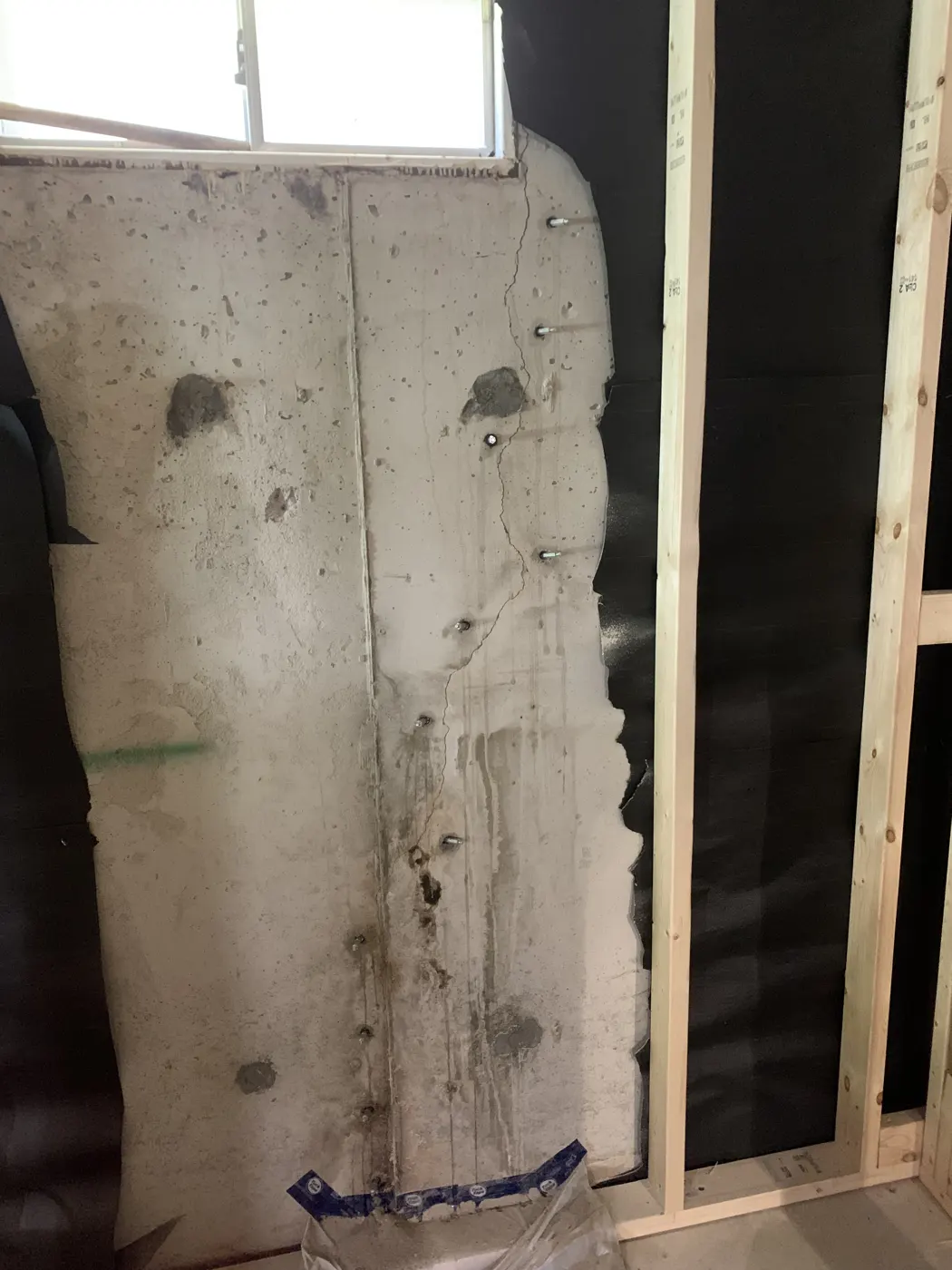
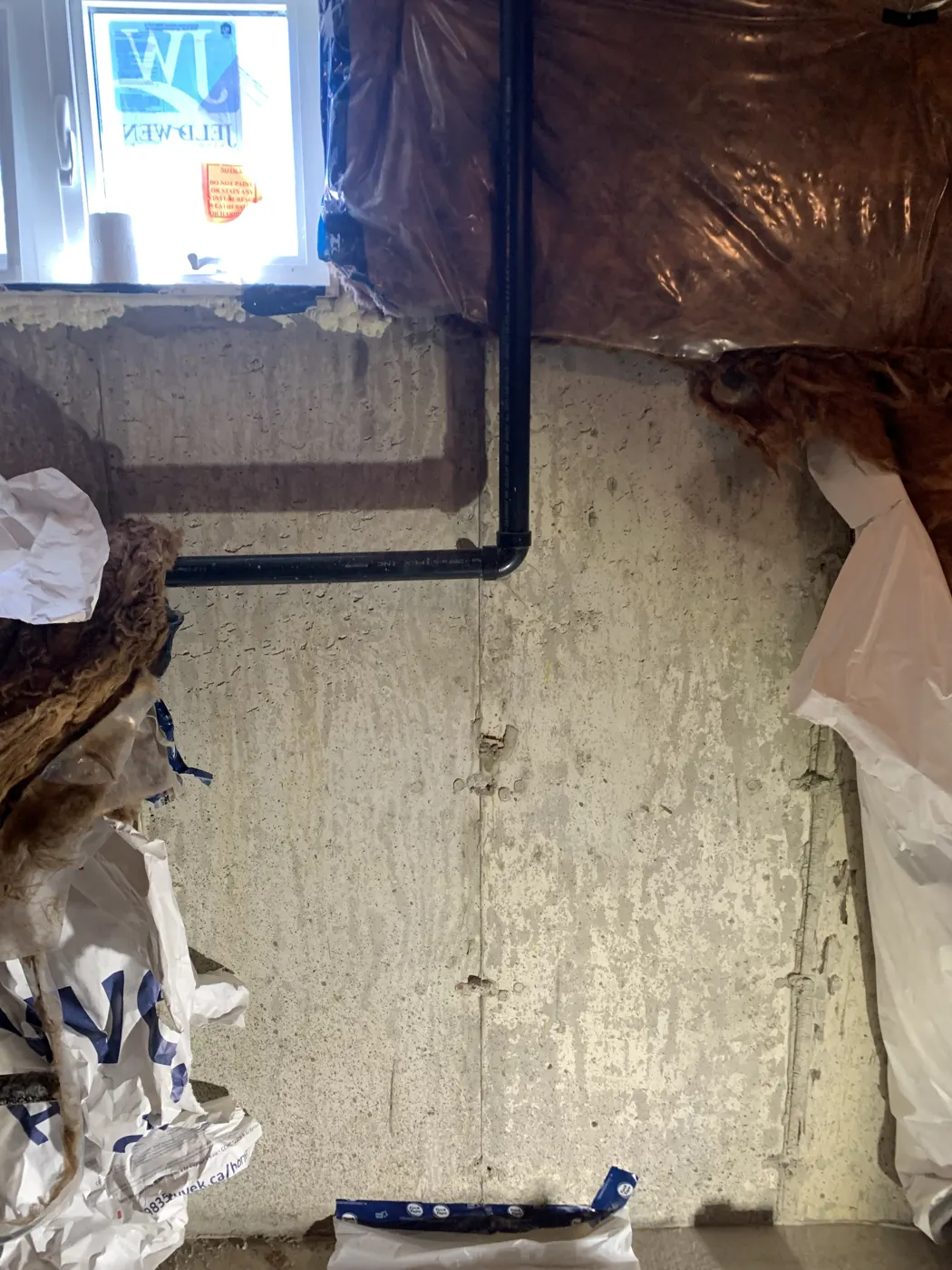
A live shrinkage crack and a structural crack want different resins.
The typical Milton crack — a full-height shrinkage crack in a young poured wall, weeping under hydrostatic pressure — gets hydrophobic polyurethane ($750–$1,000). It cures against live water and stays flexible, which matters when the wall is still finishing its drying shrinkage. A crack that is carrying structural load, or one that has grown measurably across seasons, gets epoxy injection that re-bonds the wall ($850–$1,500). Tie-rod leaks run $75–$150, extra cracks are 5% off each, and the complete method guide, the polyurethane page, the epoxy page and the open price sheet hold nothing back. Not sure which pattern you are looking at? Our guide to the five types of foundation crack explains what each orientation indicates, and why width alone tells you very little.
Every current measure, every dollar cap, and who does not qualify.
| Subsidized measure | Halton pays | Maximum |
|---|---|---|
| Backwater valve installation | 50% of materials & labour | $1,600 |
| Weeping tile disconnection + sump pump | 100% of materials & labour | $6,500 |
| Downspout disconnection | 100% of materials & labour | $900 |
| Exterior storm drain disconnection | 100% of materials & labour | $6,500 |
| Sanitary lateral lining or repair | 50% of materials & labour | $4,000 |
| Foundation crack injection | Not among the five eligible measures — flat-priced from $750 instead | |
Two eligibility rules catch Milton homeowners out. The first: the property must be connected to Halton Region’s municipal wastewater system, and homes on septic are excluded outright — which rules out Campbellville, Brookville, Moffat and rural Milton generally, no matter how badly a basement floods. The second: each measure is available once per property, forever, “even if ownership has changed.” If a previous owner claimed the backwater valve subsidy, you cannot. Applications go in within one year of finished work, the backwater valve must be installed inside the home, and water-powered backup sump pumps became ineligible in 2026. Milton’s take-up has been modest next to Burlington’s — 24 weeping tile disconnections, 21 backwater valves, 7 lateral repairs and 5 downspout disconnections between July 2024 and the end of 2025.
None of it touches the wall. The plumbing and drainage measures belong to a licensed plumber or qualified drainage contractor; we are injection specialists, not plumbers. Where your flood plan pairs a wall repair with qualifying drainage work, we time our visit around it and hand you a documented, itemized record for the wall side of the file.
Four questions, instant range — polyurethane or epoxy, multi-crack discount included, no obligation.
One visit — and one call we make before we start.
Photo quotes come back the same day; the on-site assessment is free either way. A typical crack takes 60–90 minutes from the basement side — no excavation through Milton landscaping, no seasonal blackout. On permits we will give you the accurate answer rather than the convenient one: the Town of Milton publishes no list of permit-exempt work at all, and interior crack injection is not named either way in its published material. We call Milton Building Services at 905-878-7252 (permit inquiries extension 2397, 150 Mary Street) before we start rather than assume. Any contractor who tells you flatly that no permit is required in Milton is telling you something the Town has not published.
The honest variables inside the published ranges.
Long full-height cracks in newer builds use more resin than hairlines — and in a town of newer builds, that is the common case. Walls under sustained hydrostatic pressure need patient multi-port injection rather than a fast pass. Finished basements, which a great many Boyne and Hawthorne Village homes have, add access care. Heritage foundations in Old Milton are a different conversation entirely and we flag them at the assessment. Every crack after the first is 5% off, and all of it is on the published cost breakdown before we ever ring your doorbell.
The 1850s core, the post-2015 south end, and the hamlets in between.
Old Milton and the downtown core, Bronte Meadows, Dorset Park, Timberlea, Clarke, Beaty, Coates, Hawthorne Village, Willmott, Harrison, Scott, Ford, Walker and Cobban — plus the hamlets of Campbellville, Brookville and Moffat. Two sourced anchors are worth knowing. Milton was settled in 1820 around Jasper Martin’s mill on Sixteen Mile Creek, and the downtown’s heritage buildings run from the 1850s and 1860s through the Edwardian era — foundations from well before poured concrete. At the other end, the Boyne Survey covers roughly 930 hectares south of Louis St. Laurent Avenue, was planned for 50,000 residents, and had its official plan amendment passed in August 2015. It is the newest concrete in Halton, and it behaves accordingly. Our Oakville guide and Burlington guide cover the lakeshore towns south, and the full service-area index lists every city we publish for.
The numbers behind the warranty.
A quarter-century of GTA basements kept dry.
Injection repairs warrantied for life — and the warranty moves with the house when you sell.
Full commercial coverage on every job, every crew, every home.
Eligible contractor for City of Toronto, Peel & Halton basement-flooding subsidy programs.
Inspection, honest diagnosis, and an exact per-crack quote — free, no pressure.
Your price is confirmed in writing before any work starts — no hourly surprises.
Every review below is a real, verifiable Google review of Concrete Crack Repair Pros. Nothing is paraphrased, and nothing is borrowed from a sister company.
Are these reviews genuine? Every review shown above is pulled live from the Concrete Crack Repair Pros Google Business Profile at 64 Millwick Dr, North York — not from a parent or sister brand’s listing. The rating and the count update automatically as new reviews arrive, so what you see here is what is on Google right now.
The same name, address and phone number we publish everywhere, so you can check us before you call.
Yes. Poured concrete shrinks as it dries — typically 0.04% to 0.085% depending on the mix — and the footing and rebar restrain that contraction until the wall relieves the tension by cracking. It is a material property of concrete, not settlement and not a defect. Given how much of Milton was built after 2015, this is the most common thing we see here. It matters only when it starts letting water through.
It depends on two things: your possession date and whether water is actually coming through. Tarion’s two-year warranty says “foundation walls shall allow no water penetration,” so an actively leaking wall inside two years of possession is a claimable item. But a dry shrinkage crack under 6 mm is treated as normal and excluded, and dampness or condensation is not a warranted condition at all. Check your possession date before you pay anyone — including us.
No — and this is the question we get most often in Milton. Drying shrinkage is progressive over months rather than instant, so a young wall genuinely is still moving. But waiting does not make the crack close, and every wet season it stays open is another season of water against a wall with groundwater sitting at 1.55 to 2.63 metres below grade nearby. The answer is the resin, not the timing: hydrophobic polyurethane stays flexible after it cures, so it accommodates the wall’s remaining movement instead of fighting it. Rigid epoxy is the wrong choice on a young shrinkage crack for exactly that reason, and we will say so if someone has quoted you one.
Almost certainly not. Every measure requires the property to be connected to Halton Region’s municipal wastewater system, and homes on septic are excluded outright. That takes in Campbellville, Brookville, Moffat and rural Milton generally. Confirm your servicing with the Region at 311 or 905-825-6000 before planning around the program.
The honest answer is that the Town does not say. Unlike some neighbouring municipalities, Milton publishes no list of permit-exempt work, and foundation repair, waterproofing and crack injection are not named on any Milton permit page either way. We call Milton Building Services at 905-878-7252 before starting rather than guess. Treat any contractor who states flatly that no permit is needed as guessing too.
Groundwater in Milton sits close to basement depth — a hydrogeological study filed with the Town measured it at 1.55 to 2.63 metres below grade on a Bronte Street North site, against a typical basement floor at 2.1 to 2.4 metres. A metre of difference in lot grade, backfill, or downspout discharge decides whether a wall sees standing water. Two identical houses on the same street genuinely can behave differently.
Method, resins and money — documented before you commit.
Young concrete and a shallow water table are our daily work here: free assessment, flat published pricing, one-visit repair, lifetime transferable warranty — and we will tell you to claim Tarion instead if that is the right answer.