
For the complete picture, read what foundation crack repair costs in the GTA.
#eef2f7}}
Home › Service Areas › Pickering
Toronto homeowners get up to $6,650 toward basement flooding. Durham homeowners get a $3,000 loan for two plumbing devices — and nothing at all for the wall. Flat pricing from $750, one visit, lifetime transferable warranty.
Coverage: We service Toronto, the GTA and Southern Ontario, and Pickering sits on our eastern lakeshore route alongside Ajax and Whitby — regular ground for our crews, travel folded into the flat pricing. The assessment is free, and most Pickering cracks are injected in the same visit.
Foundation crack repair in Pickering costs a flat $750–$1,000 per crack for polyurethane injection and $850–$1,500 for structural epoxy, with every additional crack 5% off. Unlike Toronto and Halton, Durham Region offers no subsidy — only a $3,000 interest-free loan covering a backwater valve and sump pump, and only if you have already had a sanitary sewer backup. Crack repair is not covered by anyone. The good news: Pickering explicitly lists basement waterproofing repairs as work that needs no building permit.
Pickering runs across the whole glacial sequence, and your address decides your failure mode.
Pickering’s own Official Plan tells the story: two ice sheets, a moraine formed between them, and then “a much larger lake, known as Lake Iroquois” whose “remnants of the shoreline can still be seen today across central Pickering.” The Oak Ridges Moraine “lies at Pickering’s northern boundary, and is the source of many of the City’s streams.” Follow Duffins Creek south and you cross the lot: headwaters rising on the moraine, then, in TRCA’s words, the creek “winds its way across the Halton Till Plain,” then the Lake Iroquois Shoreline, then the Lake Iroquois Plain to the lake.
Those four bands behave differently against a basement wall. Moraine and shoreline deposits are granular and free-draining — TRCA notes that recharge to surficial till runs about 50 to 150 millimetres a year and is higher in sandy and gravelly areas, and that in the Petticoat Creek watershed “higher-permeability beach and nearshore sands along the glacial shoreline support increased recharge.” Water gets to the wall quickly there. On the till plain and the fine-grained lakeplain, the opposite: water perches rather than drains, and the wall carries the load.
A hydrogeological review filed with the City for a Dunbarton Road property puts hard numbers on how sharply this changes. Across a single 8,550-square-metre site, the borehole log runs fill to 0.8 metres at a hydraulic conductivity of 1.0 × 10⁻⁵ m/s, silt and sand from 0.8 to 4.6 metres at 5.0 × 10⁻⁷, and clayey silt from 4.6 to 8.2 metres at 7.21 × 10⁻⁹ — three orders of magnitude of difference stacked vertically. Groundwater in the three boreholes ranged from 93.1 to 98.7 metres above sea level: a spread of more than five metres within one property line. The report’s own foundation guidance is that structures with basements below the water table need either drained foundations with sump systems or watertight construction “designed to resist hydrostatic pressure and uplift forces.” That is the honest reason your basement can behave nothing like your neighbour’s.
A loan, not a grant. Two devices, not the wall.
| Region | What you get | Maximum |
|---|---|---|
| Durham (Pickering) | Interest-free loan, repaid on your water bill over up to 3 years — backwater valve and sump pump only | $3,000 |
| City of Toronto | Subsidy — 80% of invoice across five measures | $6,650 combined |
| Halton Region | Subsidy — up to 100% across five measures | $6,500 per measure |
| Foundation crack injection | Not covered by Durham, Toronto or Halton — flat-priced from $750 instead | |
The Durham program’s terms are narrow and worth knowing before you plan around it. It is a loan, not a grant — repaid in equal amounts added to your quarterly water and sewer bill. It covers only “the installation of an approved backwater valve and the installation of a sump pump,” with the valve specified as a Mainline Fullport model. It is available only to existing homes on residentially zoned property, only to owners who have already experienced basement flooding from a sanitary sewer backup, only once per property, and it requires municipal plumbing inspector approval. The Region’s Finance Department administers it on 905-668-7711 extension 2264. Because the program document dates from 2009, we would call and confirm the terms are unchanged before counting on the number.
The City of Pickering runs no program of its own. What Pickering does publish is a basement flooding brochure listing the causes, and “a leak in your building’s foundation, basement walls, windows or doors” is first on the list — along with advice to drain downspouts at least 1.2 metres from basement walls. So the City names the problem and no level of government pays to fix it. That is the honest position, and anyone advertising a Pickering “crack repair rebate” is describing something that does not exist.
Four questions, instant range — polyurethane or epoxy, multi-crack discount included, no obligation.
Two frames from our crews’ recent work.
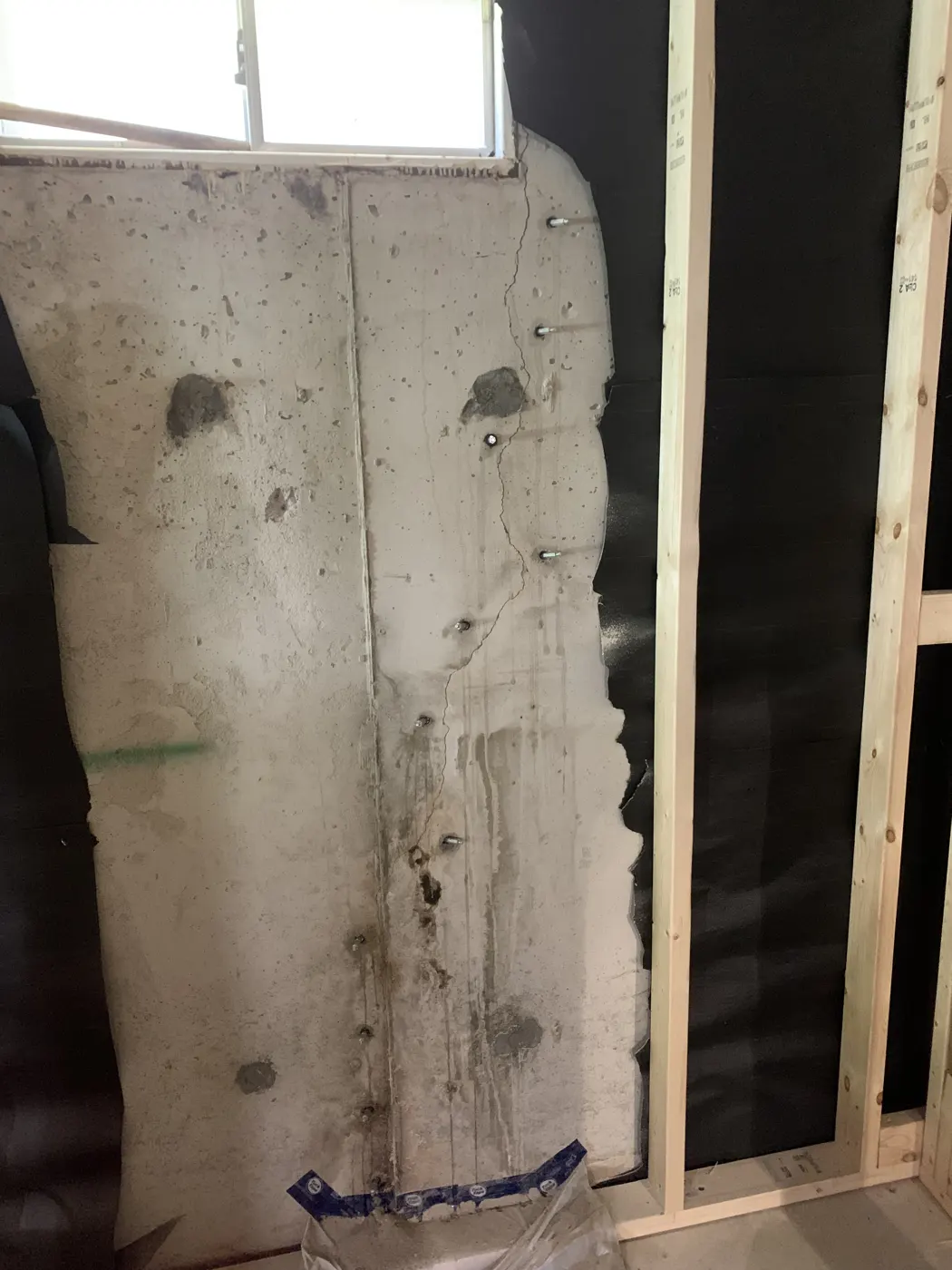
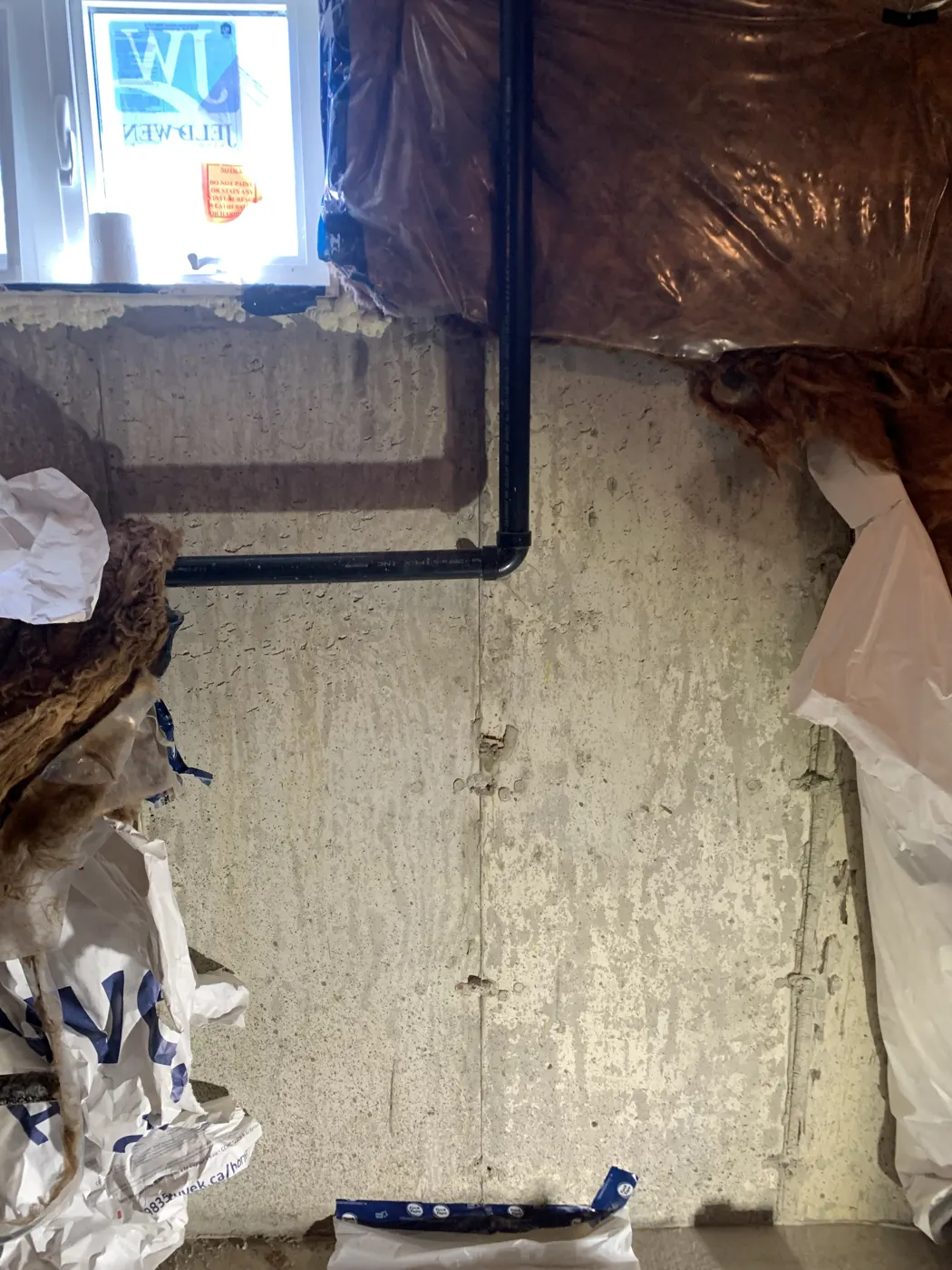
Hydrostatic pressure and structural movement want different resins.
A crack under sustained water pressure — the common case where groundwater sits near slab level — gets hydrophobic polyurethane ($750–$1,000). It cures against live water and stays flexible. A crack that has grown across seasons, or one carrying structural load, gets epoxy injection that re-bonds the wall ($850–$1,500). Tie-rod leaks run $75–$150, extra cracks are 5% off each, and the complete method guide, the polyurethane page, the epoxy page and the open price sheet hold nothing back. Not sure which pattern you are looking at? Our guide to the five types of foundation crack explains what each orientation indicates, and why width alone tells you very little.
The peak decade is the 1980s — which changes what we expect to find.
| Period built | Dwellings | Share |
|---|---|---|
| 1960 or before | 2,070 | 6.2% |
| 1961–1980 | 8,350 | 25.0% |
| 1981–1990 | 8,955 | 26.8% |
| 1991–2000 | 6,540 | 19.6% |
| 2001–2010 | 2,995 | 8.9% |
| 2011–2021 | 4,520 | 13.5% |
Most GTA municipalities peak in the post-war boom. Pickering does not — its single biggest decade is 1981 to 1990, and the City’s own assessment states that “77.5% of the dwellings in Pickering were built prior to 2000, while 22.5% of dwellings have been built since 2001.” It also records 1,205 units, 3.6% of households, as requiring major repair. For foundations that matters: a wall poured in the mid-1980s is now around forty years old, well past its shrinkage phase, and any crack in it is almost certainly mature and stable rather than actively moving. That is usually good news for the repair, and it is why we quote most Pickering work as straightforward polyurethane rather than structural epoxy.
The permit answer here is unusually clear — and it is in your favour.
Photo quotes come back the same day; the on-site assessment is free either way. A typical crack takes 60–90 minutes from the basement side — no excavation through Pickering landscaping, no seasonal blackout. On permits, Pickering is one of the few municipalities in the GTA that publishes both lists plainly, and “waterproofing repairs to a basement” and “basement waterproofing repairs” both appear on the work that does not require a building permit, alongside sump pumps. What does require one: basement underpinning, structural or material alterations, finishing a basement, a retaining wall over one metre, and installing a backwater valve. Note also that the Ontario Building Code 2024 has applied to all new Pickering permit applications since April 1, 2025. Building Services is on 905.420.4631 and we confirm scope with them before we start.
The honest variables inside the published ranges.
Lots in the granular shoreline and moraine bands can need patient multi-port injection because water keeps arriving during the work — the Dunbarton data shows how sharply that changes street to street. Long full-height cracks use more resin than hairlines. Finished basements add access care. Heritage foundations in Whitevale, Brougham and Greenwood are a different conversation entirely: injection is engineered for poured concrete walls, and rubble or fieldstone has no single crack plane for resin to seal against — we say so at the assessment rather than force the wrong fix. Every crack after the first is 5% off, and all of it is on the published cost breakdown before we ever ring your doorbell.
Bay Ridges to Seaton, and the hamlets in between.
Rosebank, West Shore, Bay Ridges, Rougemount, Woodlands, Dunbarton, City Centre, Village East, Highbush, Amberlea, Liverpool, Brock Ridge, Rouge Park and Duffin Heights, plus the Seaton neighbourhoods — Lamoreaux, Brock-Taunton, Mount Pleasant, Wilson Meadows and Thompson’s Corners — and the hamlets of Claremont, Brougham, Greenwood, Whitevale and Kinsale. Where the City publishes build eras we use them: West Shore saw initial development between 1900 and 1940 followed by subdivisions in the 1960s; Village East began in the late 1940s to mid-1950s along Guild, Royal and Southview; Liverpool is mostly since the 1970s and Brock Ridge since the 1980s. Duffin Heights follows guidelines Council adopted in May 2009, and Seaton flows from the province’s Central Pickering Development Plan approved in 2006 — over 7,000 acres planned for around 61,000 residents. Whitevale is Pickering’s only Heritage Conservation District, designated in June 1993. Our Oshawa guide covers Durham east and the full service-area index lists every city we publish for.
The numbers behind the warranty.
A quarter-century of GTA basements kept dry.
Injection repairs warrantied for life — and the warranty moves with the house when you sell.
Full commercial coverage on every job, every crew, every home.
Eligible contractor for City of Toronto, Peel & Halton basement-flooding subsidy programs.
Inspection, honest diagnosis, and an exact per-crack quote — free, no pressure.
Your price is confirmed in writing before any work starts — no hourly surprises.
Every review below is a real, verifiable Google review of Concrete Crack Repair Pros. Nothing is paraphrased, and nothing is borrowed from a sister company.
Are these reviews genuine? Every review shown above is pulled live from the Concrete Crack Repair Pros Google Business Profile at 64 Millwick Dr, North York — not from a parent or sister brand’s listing. The rating and the count update automatically as new reviews arrive, so what you see here is what is on Google right now.
The same name, address and phone number we publish everywhere, so you can check us before you call.
No, and the gap is stark. Toronto pays a subsidy of up to $6,650 per property and Halton up to $6,500 per measure. Durham Region offers an interest-free loan of up to $3,000, repaid in instalments on your quarterly water and sewer bill, covering only a backwater valve and a sump pump — and only if you have already suffered a sanitary sewer backup. The City of Pickering runs no program of its own. Foundation crack repair is covered by none of them. The program dates from 2009, so confirm current terms with the Region at 905-668-7711 ext. 2264.
No. Pickering is one of the clearer municipalities on this — it publishes a list of work that does not require a building permit, and “waterproofing repairs to a basement” and “basement waterproofing repairs” both appear on it, as do sump pumps. Interior crack injection falls squarely in that category. A permit is required for basement underpinning, structural or material alterations, finishing a basement, retaining walls over one metre, and installing a backwater valve. Confirm your specific scope with Building Services on 905.420.4631.
It is normal in Pickering and it explains a lot of local frustration. A hydrogeological review filed with the City for a Dunbarton Road site recorded groundwater between 93.1 and 98.7 metres above sea level across three boreholes on one 8,550-square-metre property. The ground is layered — fill, then silt and sand, then clayey silt, with hydraulic conductivity varying by three orders of magnitude between them. Water perches on the low-permeability layers and moves along them. That is why your basement can be wet while the identical house next door stays dry.
It is the most common era here — 1981 to 1990 is Pickering’s single biggest building decade at 26.8% of the housing stock, more than the post-war years — but no, it is not a bad one. A wall poured forty years ago finished its drying shrinkage decades back, so cracks from that era are typically mature and stable rather than actively growing. That usually makes them straightforward polyurethane jobs rather than structural epoxy. We measure and tell you which you have.
Some, and they are usually normal. Seaton flows from the province’s Central Pickering Development Plan approved in 2006, planned for around 61,000 residents across roughly 7,000 acres — so its concrete is new, and new poured walls shrink as they dry and relieve the tension by cracking. That is a material property, not a defect. What matters is whether water comes through. If your home is under two years from possession and a wall is actively leaking, that is a Tarion warranty item and you should claim it before you pay anyone, us included.
Partly, and not in the way people assume. The Pickering Dike was built in 1985, runs about 1,150 metres north of Kingston Road, and protects the Village East community, which sits in the Duffins Creek regulatory floodplain — TRCA counts 634 buildings susceptible to flooding in a Regional Storm event there. But TRCA also reports the dike now provides roughly 100-year protection against an original 500-year design, owing to settlement and updated hydraulic modelling. A dike defends against river flooding. It does nothing about groundwater against your foundation wall, which is a separate problem and the one we solve.
Method, resins and money — documented before you commit.
Durham gives you a loan and a list of causes. We give you a free assessment, flat published pricing, a one-visit repair and a lifetime transferable warranty — plus an honest answer when the wall is not your problem.