The full foundation crack repair cost breakdown shows every range we publish.
#eef2f7}}
Home › Service Areas › Burlington
Burlington took 85% of Halton’s basement flooding in 2024 — 1,620 homes out of 1,897 region-wide. When the wall is the problem: flat pricing from $750, one visit, and a lifetime transferable warranty.
Coverage: We service Toronto, the GTA and Southern Ontario, and Burlington anchors our western lakeshore route alongside Oakville — Halton is regular ground for our crews, travel folded into the flat pricing. The assessment is free, and most Burlington cracks are injected in the same visit.
Foundation crack repair in Burlington costs a flat $750–$1,000 per crack for polyurethane injection and $850–$1,500 for structural epoxy, with every additional crack 5% off. Halton Region’s Enhanced Basement Flooding Prevention Subsidy pays up to $6,500 for some measures — but none of the five eligible measures is crack repair. The program funds plumbing and drainage work. The wall is our job: injected in one visit, warrantied for life.
Conservation Halton’s own soil mapping explains why the cracks cluster where they do.
Burlington is cut in half by the Niagara Escarpment, and Conservation Halton’s 2024 Watershed Characterization Report draws the line bluntly. Above the escarpment — Kilbride, Lowville, the rural north — “most of the area is covered by loam and sandy loam which are usually permeable and well drained.” Below it, where almost every Burlington basement actually sits, “clay loam soils are predominant,” and the report explains why: “the soil reflects the underlying clayey and silty till and shale bedrock.”
That underlying rock is the Queenston Formation — roughly 150 metres of shale the same report calls “easily weathered,” inter-layered with siltstone, limestone and sandstone, and left with an irregular weathered upper surface. Fine clay over weathered shale does one awkward thing to a foundation: it drains slowly. Conservation Halton rates clay and clay loam lowest for infiltration and highest for surface runoff. Storm water that would sink away on a Kilbride lot stands against a Roseland wall long after the rain stops.
Then there is the fall line itself. The escarpment face drops 35 to 40 metres on average, and below it the land runs from roughly 330 metres above sea level down to 75 metres at the shoreline. Burlington is stitched with the creeks that carry that water down — Grindstone Creek alone drains about 100 square kilometres and supplies 14 percent of the flow into Hamilton Harbour, and between the big watersheds run eighteen smaller urban creeks that Conservation Halton describes as long, narrow strips draining straight to the lake. Tuck, Shoreacres, Appleby, Rambo, Hager, Roseland, Sheldon and Falcon are all in that group, and ravine-lot grading concentrates runoff exactly where basements are deepest.
Slow-drainage seepage and structural movement want different resins.
A crack that weeps after a heavy rain gets hydrophobic polyurethane ($750–$1,000) — it cures against live water and stays flexible while the ground around it keeps moving. A crack that grows across seasons, or one carrying structural load, gets epoxy injection that re-bonds the wall ($850–$1,500). Tie-rod leaks run $75–$150, extra cracks are 5% off each, and if you want the engineering before the invoice, the complete method guide, the polyurethane page, the epoxy page and the open price sheet hold nothing back. Not sure which pattern you are looking at? Our guide to the five types of foundation crack explains what each orientation indicates, and why width alone tells you very little.
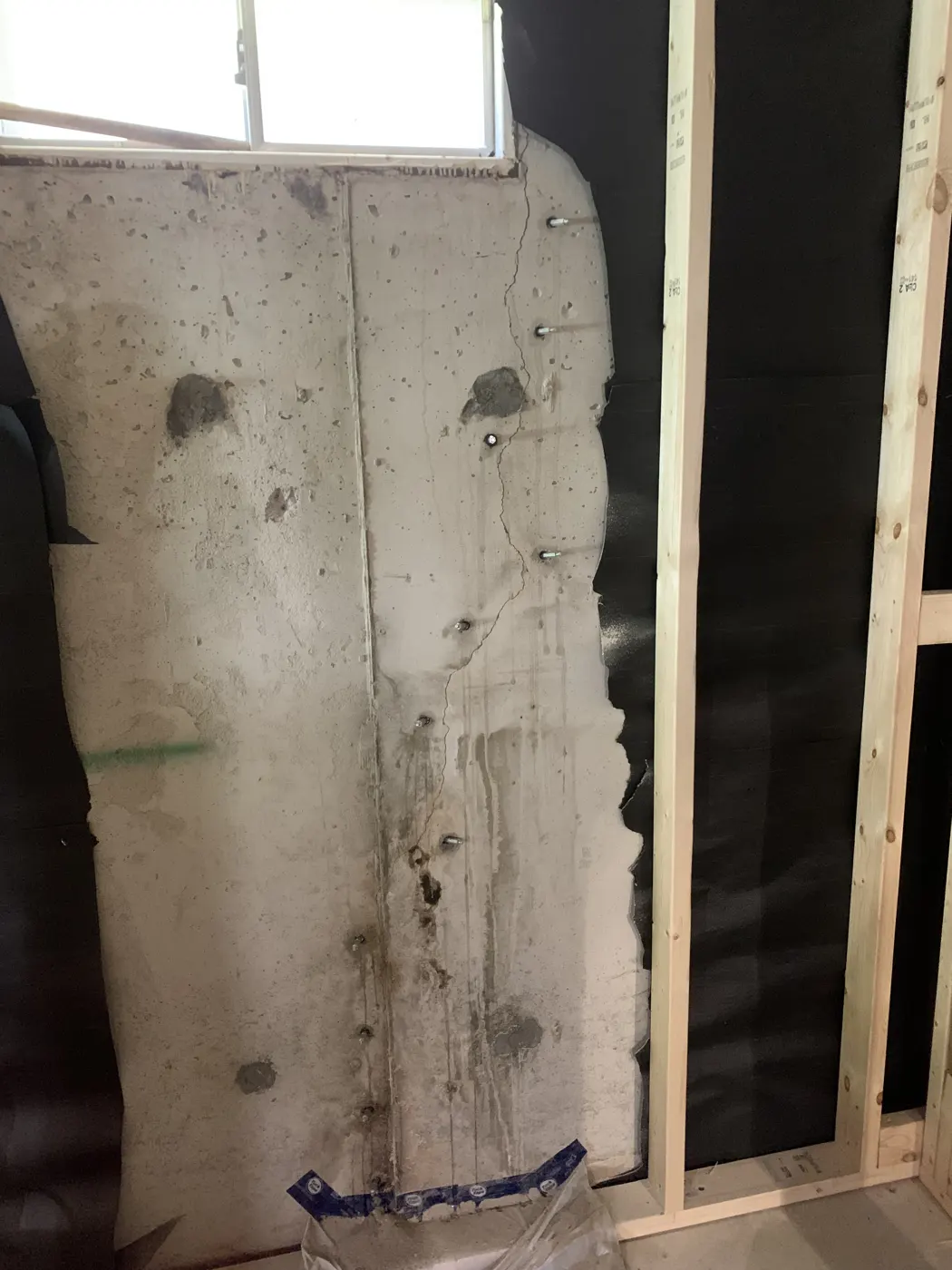
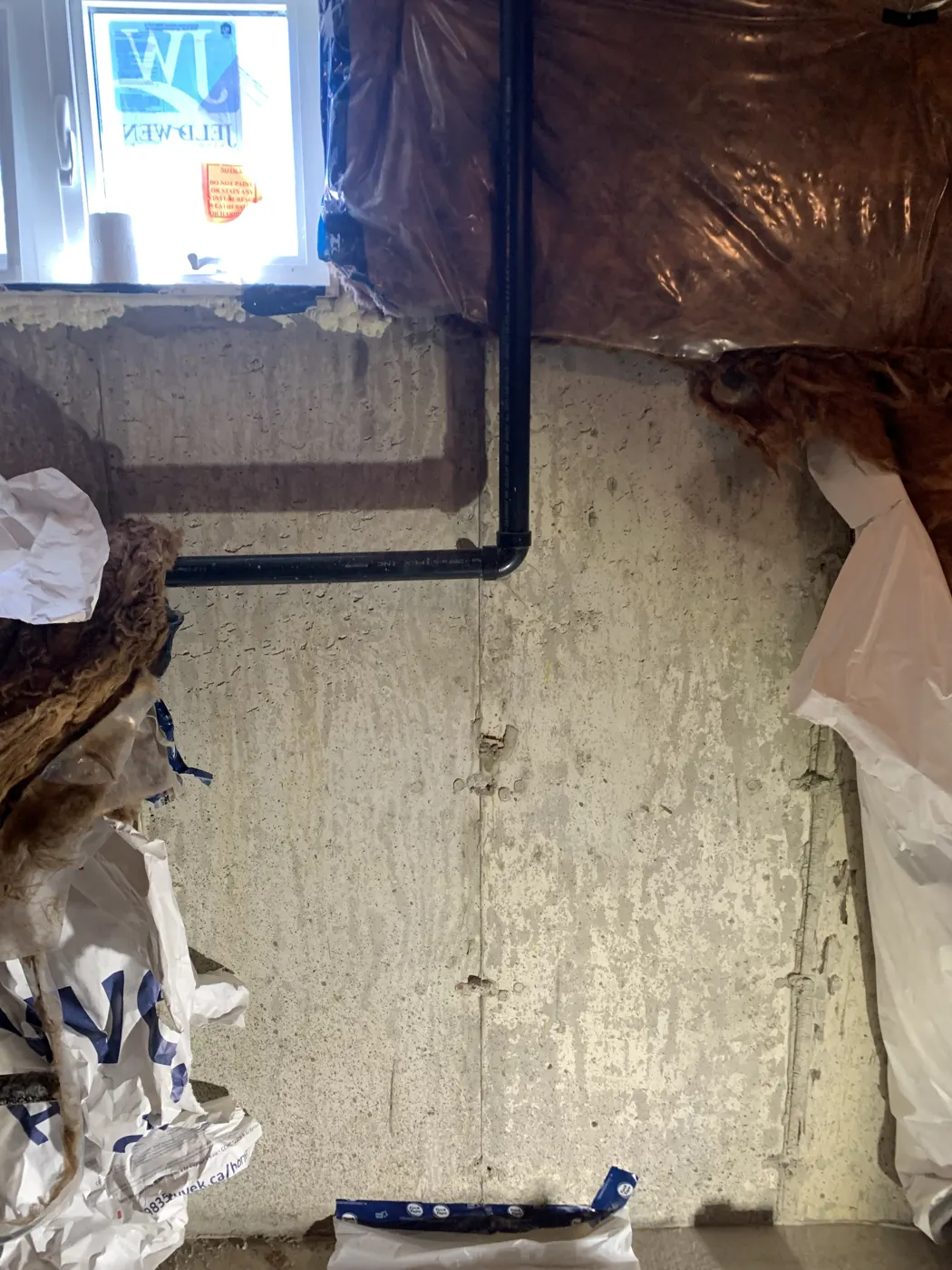
Two frames from our crews’ recent work.
Every current measure, every dollar cap — and the honest line about where injection fits.
| Subsidized measure | Halton pays | Maximum |
|---|---|---|
| Backwater valve installation | 50% of materials & labour | $1,600 |
| Weeping tile disconnection + sump pump | 100% of materials & labour | $6,500 |
| Downspout disconnection | 100% of materials & labour | $900 |
| Exterior storm drain disconnection | 100% of materials & labour | $6,500 |
| Sanitary lateral lining or repair | 50% of materials & labour | $4,000 |
| Foundation crack injection | Not among the five eligible measures — flat-priced from $750 instead | |
How the program really works: it is a reimbursement, claimed within one year of finished work, available once per property per measure — and once a property has claimed a measure it cannot claim it again, even after a sale. Your home must be connected to Halton’s municipal wastewater system; septic properties are excluded outright. Two things changed in 2026: the Region discontinued its authorized contractor list, and water-powered backup sump pumps became ineligible. Burlington homeowners have used the program hard — 186 backwater valves, 143 weeping tile disconnections, 53 lateral repairs and 46 downspout disconnections between July 2024 and the end of 2025, against a 2026 subsidy budget of $960,000 region-wide.
The plumbing and drainage measures belong to a licensed plumber or qualified drainage contractor, and we are injection specialists, not plumbers. Where your flood plan pairs a wall repair with qualifying drainage work, we time our visit around it and hand you a documented, itemized record for the wall side of the file. No inflated bundle, no rebate theatre — the crack costs what the price sheet says.
Four questions, instant range — polyurethane or epoxy, multi-crack discount included, no obligation.
Two storms, ten years apart, and the same lesson about where water goes.
On August 4, 2014, a stalled storm dropped up to 200 millimetres of rain on Burlington in about eight hours — one gauge on Palmer Avenue near Walker’s Line recorded 192 millimetres, while gauges up near Brant and Dundas caught 48 to 54. That is the whole story of Burlington rainfall in one comparison. The Region logged more than 6,000 flood-related calls, 3,500 of them reports of basement flooding, and Conservation Halton identified Tuck, Shoreacres and Appleby creeks as the watercourses most affected.
Ten years later, July 2024 did it again with less rain and worse results. Burlington took up to 74 millimetres on July 15 and accounted for 1,620 of the 1,897 basement flooding incidents recorded across Halton Region — against 124 in Halton Hills, 104 in Oakville and 49 in Milton. The City is now spending against it: $1,566,000 on Tuck Creek flood mitigation at Spruce Avenue through 2026–27, $200,000 on Rambo Creek watershed studies in 2026, and a $52.3 million capital levy for erosion control on Appleby, Falcon, Rambo, Sheldon, Shoreacres, Tuck and Roseland creeks between 2026 and 2035.
Here is the honest part. Halton Region’s own 2026 report attributes basement flooding primarily to excessive stormwater inflow and infiltration from private-side sources — weeping tile, downspouts and exterior storm drain connections. Foundation cracks are not on the Region’s list of causes. If your basement flooded in a storm and your wall is dry the rest of the year, injection may not be your answer, and we will tell you that at the free assessment rather than sell you a repair that fixes nothing.
One visit — and one question worth asking the City first.
Photo quotes come back the same day; the on-site assessment is free either way. A typical crack takes 60–90 minutes from the basement side — no excavation through Burlington landscaping, no seasonal blackout. On permits, we will not tell you what some contractors will: Burlington publishes an exemption list, not a permit-required list, and its stated default is that construction requires a permit unless specifically exempted. Interior crack injection is not named on either list. We call Burlington Building Services at 905-335-7731 on your behalf before we start, or you can reach Service Burlington at 905-335-7777 at 426 Brant Street. Note that the backwater valve and drainage subsidies do require a municipal permit and a signed-off final inspection — that is a different conversation from a crack.
The honest variables inside the published ranges.
Ravine-lot walls along the urban creeks carry concentrated runoff and can need patient multi-port injection. Older foundations in the downtown core and Aldershot sometimes rule out injection entirely — rubble and mortared-block walls have no single crack plane for resin to seal against, and we say so at the assessment, free, rather than force the wrong fix. Long full-height cracks in newer builds use more resin than hairlines, finished basements add access care, and every crack after the first is 5% off. All of it is on the published cost breakdown before we ever ring your doorbell.
Lakeshore to escarpment, Aldershot to Alton.
Aldershot, Downtown and the Village, Roseland, Shoreacres, Elizabeth Gardens, Pinedale, Longmoor, Dynes, Mountainside, Brant Hills, Tyandaga, Palmer, Headon Forest, Millcroft, The Orchard, Alton Village, Tansley Woods, Corporate and Uptown — plus rural Burlington north of Dundas, including Kilbride and Lowville. One sourced note worth having: Halton prioritises its free household drainage survey for properties with a documented flooding history or built between 1958 and 1978, because homes from that period are likelier to feed stormwater directly into the wastewater system. Surveys are otherwise focused on eleven designated priority areas where 90 percent of surcharge-related flooding occurred. Our Oakville guide covers the next town east, our Hamilton guide the escarpment west, and the full service-area index lists every city we publish for.
The numbers behind the warranty.
A quarter-century of GTA basements kept dry.
Injection repairs warrantied for life — and the warranty moves with the house when you sell.
Full commercial coverage on every job, every crew, every home.
Eligible contractor for City of Toronto, Peel & Halton basement-flooding subsidy programs.
Inspection, honest diagnosis, and an exact per-crack quote — free, no pressure.
Your price is confirmed in writing before any work starts — no hourly surprises.
Every review below is a real, verifiable Google review of Concrete Crack Repair Pros. Nothing is paraphrased, and nothing is borrowed from a sister company.
Are these reviews genuine? Every review shown above is pulled live from the Concrete Crack Repair Pros Google Business Profile at 64 Millwick Dr, North York — not from a parent or sister brand’s listing. The rating and the count update automatically as new reviews arrive, so what you see here is what is on Google right now.
The same name, address and phone number we publish everywhere, so you can check us before you call.
No, and Burlington’s own uptake numbers show why the confusion is common. Between July 2024 and the end of 2025 Burlington homeowners claimed 186 backwater valves, 143 weeping tile disconnections, 53 lateral repairs and 46 downspout disconnections — real money, and more of it than any other Halton municipality. But every one of those is a plumbing or drainage measure. The Enhanced Basement Flooding Prevention Subsidy has exactly five eligible measures and foundation crack repair is not among them, so the wall is flat-priced from $750 instead. If a contractor implies the Region will cover part of your injection, they are describing a subsidy that does not exist.
Burlington publishes a list of projects that are exempt from permits, not a list of projects that require them, and its stated default is that construction requires a permit unless specifically exempted. Interior crack injection appears on neither list. We call Building Services at 905-335-7731 before we start rather than guess. Drainage and backwater valve work under the Halton subsidy does require a permit and a signed-off final inspection.
Rainfall distribution and drainage capacity. Burlington recorded 1,620 of the 1,897 basement flooding incidents across Halton Region in July 2024 — about 85 percent — against 104 in Oakville. The 2014 storm showed the same pattern in miniature: 192 mm at a Palmer Avenue gauge while gauges near Brant and Dundas caught 48 to 54 mm. Burlington’s urban creeks are short, narrow and steep off the escarpment, which concentrates runoff fast.
Often not, and we would rather say so. Halton Region attributes basement flooding primarily to stormwater inflow and infiltration from private-side sources — weeping tile, downspouts and exterior storm drain connections. A wall that is dry between storms and floods only during a surcharge event usually has a drainage problem, not a crack problem. Our assessment is free and it is fine for us to leave without a sale.
No. Every measure requires the property to be connected to Halton Region’s municipal wastewater system, and homes on septic are excluded outright. Rural Burlington properties north of Dundas should confirm their servicing before planning around the program. The subsidy is also once per property forever — if a previous owner claimed a measure, you cannot claim it again.
Yes, with a caveat we give up front. Injection is engineered for poured concrete walls, where a crack is a discrete plane through a monolithic pour. Rubble, fieldstone and mortared-block foundations have no such plane — water moves through joints and voids across the whole assembly, so there is nothing for resin to seal against. If that is what we find in your basement, we tell you at the free assessment and point you to the right repair instead of injecting a wall that will not hold it.
Method, resins and money — documented before you commit.
Halton’s flooding epicentre is our daily work: free assessment, flat published pricing, one-visit repair, lifetime transferable warranty — and an honest answer when the crack is not your problem.