
Wondering about the bigger picture? Here’s how much foundation crack repair costs.
#eef2f7}}
Home › Service Areas › Newmarket
Newmarket drains north to Lake Simcoe, not south to Lake Ontario — and the Town explicitly exempts basement waterproofing repairs from needing a permit. Flat pricing from $750, one visit, lifetime transferable warranty.
Coverage: We service Toronto, the GTA and Southern Ontario, and Newmarket sits on our northern York route alongside Aurora and King — regular ground for our crews, travel folded into the flat pricing. The assessment is free, and most Newmarket cracks are injected in the same visit.
Foundation crack repair in Newmarket costs a flat $750–$1,000 per crack for polyurethane injection and $850–$1,500 for structural epoxy, with every additional crack 5% off. No building permit is required — Newmarket explicitly lists “waterproofing repairs to basement (no plumbing involved)” as exempt. York Region runs no basement flooding subsidy of its own, and the Town’s $500 backwater valve subsidy dates from 2018 with no live program page, so confirm availability before counting on it.
Newmarket sits on the north side of the divide, and it changes the whole water picture.
Every other municipality on this site drains south to Lake Ontario. Newmarket does not. It sits in the East Holland River subwatershed — 247 square kilometres spanning Aurora, King, Newmarket, East Gwillimbury, Georgina, Whitchurch-Stouffville and Uxbridge, over 99% of it within York Region — whose headwaters rise on the Oak Ridges Moraine and flow north to join the West Holland River and reach Lake Simcoe at Cook’s Bay. The moraine, as the subwatershed plan puts it, “divides subwatersheds draining south into Lake Ontario from the subwatersheds draining north to Lake Simcoe.” The Town states it plainly: “eventually all stormwater runoff in Newmarket makes its way back to Lake Simcoe.”
This matters because Newmarket is on the recharge side of that divide. The subwatershed contains 8,635 hectares of Oak Ridges Moraine, which the Lake Simcoe conservation authority describes as “a major groundwater recharge system,” with soil “that is porous and allows water to infiltrate into the ground.” Around 65% of people in the Lake Simcoe watershed rely at least partly on groundwater for drinking water. Newmarket Till is the named surficial unit.
A geotechnical investigation the Town commissioned at 16780 Yonge Street, at the northwest corner of Mulock and Yonge, shows what that means at footing depth. Five boreholes to about 6.6 metres found 25 to 43 centimetres of topsoil, then silt and sandy silt ranging loose to very dense, then silty clay laminated with sand and silt seams, stiff to very stiff. Those seams are the detail worth knowing: thin permeable layers running through otherwise low-permeability clay act as preferential pathways, delivering water sideways to a foundation wall from well beyond your own lot. Groundwater was recorded at 5.8 and 4.3 metres in two boreholes with three dry, and the report notes levels “will be subject to seasonal fluctuations.” Its foundation recommendation was direct: “perimeter subdrains and dampproofing of the foundation walls will be required,” with subdrains “encased in a fabric filter to protect them against blockage by silting.”
Thinner than Toronto or Halton, and patchier than either.
York Region runs no regional basement flooding subsidy. Its inflow and infiltration page offers homeowner advice only and points instead to programs run by individual municipalities — naming a backwater valve subsidy in Richmond Hill and downspout disconnection in Vaughan. So unlike Halton, where one regional program covers four municipalities, York homeowners get whatever their own town happens to offer.
Newmarket approved a backwater valve subsidy of up to $500 per single-family residential property in an information report dated 9 March 2018, covering eligible labour, materials, permit and taxes, excluding homeowner labour and interior or exterior restoration, funded with $10,000 through that year’s water and wastewater operating budget. We flag it because it is worth asking about — but there is no live program page, application form or post-2018 reference on newmarket.ca, and the Town’s current inflow and infiltration pages describe no rebate. Treat it as a question for the Town at 905-895-5193 rather than a number to budget against.
Foundation crack repair is covered by nothing at either level. It never has been. Anyone advertising a Newmarket crack repair rebate is describing something that does not exist.
Four questions, instant range — polyurethane or epoxy, multi-crack discount included, no obligation.
Two frames from our crews’ recent work.
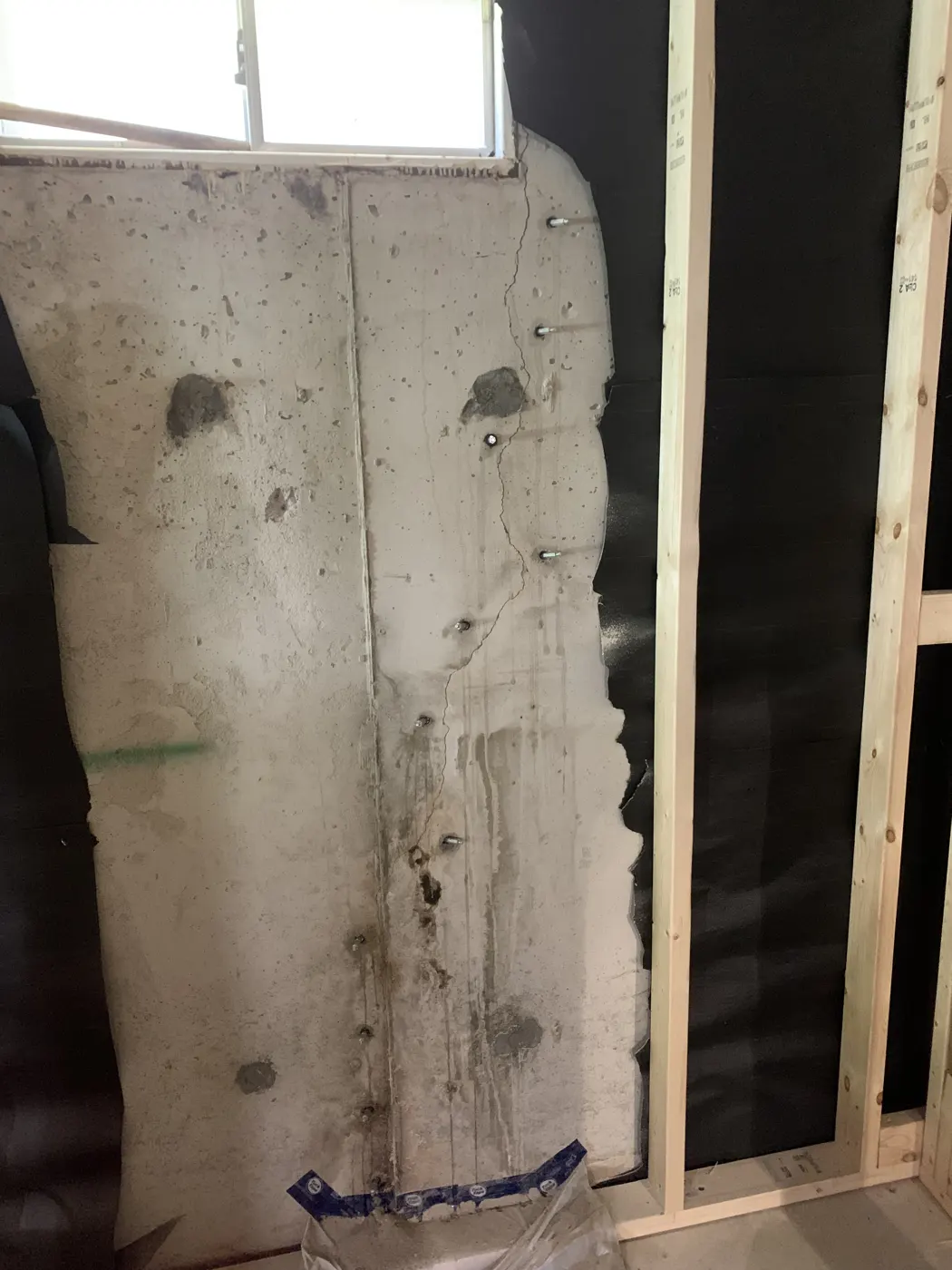
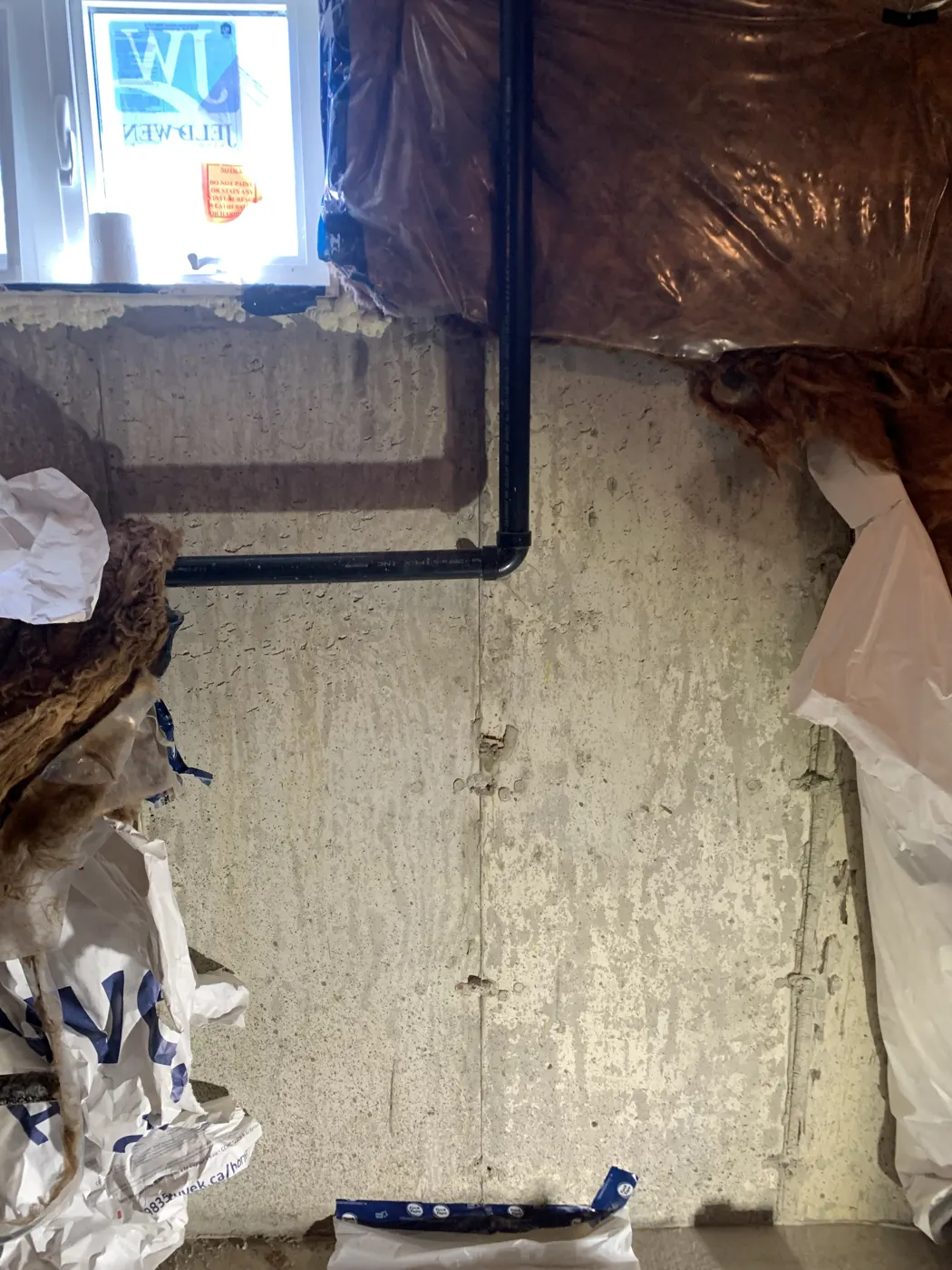
Seam-fed seepage and structural movement want different resins.
A crack fed by those sand and silt seams — water arriving laterally, often long after the rain has stopped — gets hydrophobic polyurethane ($750–$1,000). It cures against live water and stays flexible. A crack that has grown across seasons, or one carrying structural load, gets epoxy injection that re-bonds the wall ($850–$1,500). Tie-rod leaks run $75–$150, extra cracks are 5% off each, and the complete method guide, the polyurethane page, the epoxy page and the open price sheet hold nothing back. Not sure which pattern you are looking at? Our guide to the five types of foundation crack explains what each orientation indicates, and why width alone tells you very little.
One visit, and one of the clearest permit answers in the GTA.
Photo quotes come back the same day; the on-site assessment is free either way. A typical crack takes 60–90 minutes from the basement side — no excavation through Newmarket landscaping, no seasonal blackout. On permits, Newmarket is admirably direct: its published list of work that does not require a building permit includes “waterproofing repairs to basement (no plumbing involved),” alongside like-for-like door and window replacement, floor and ceiling finishes, and repairs to chimneys, porches, decks and roofs. Interior crack injection with no plumbing work sits squarely there. A permit is required for adding or removing walls, any structural alterations, finishing a basement, a below-grade entrance or walkout, new or enlarged window and door openings, retaining walls over one metre, and mechanical alterations. Building Services is on 905-953-5300 extension 2400, building.permits@newmarket.ca, 395 Mulock Drive.
The honest variables inside the published ranges.
Walls fed by laminated sand and silt seams can need patient multi-port injection because water keeps arriving during the work — a lot of Newmarket ground behaves this way. Long full-height cracks use more resin than hairlines, and finished basements add access care. Heritage foundations in the Historic Core and the Lower Main Street South district are a different conversation: injection is engineered for poured concrete, where a crack is a discrete plane through a monolithic pour, and stone or rubble has no such plane for resin to seal against. Where we find that, we say so at the assessment. Every crack after the first is 5% off, and all of it is on the published cost breakdown before we ever ring your doorbell.
Historic Core to Copper Hills — and the Town’s own way of sorting them.
The Historic Core and Main Street, Glenway, Stonehaven, Summerhill, Bristol-London, Huron Heights, Armitage, Woodland Hill, Copper Hills, and the estate areas at Kingdale Road, Old Bathurst Estates and Premier Place. Rather than assign decades that no municipal source supports, we use the Official Plan’s own character-area framework: the Historic Core was “developed prior to the 1940’s,” Traditional Suburban areas “between the 1940’s and 1990’s,” and Contemporary Suburban areas “following the 1990’s.” Newmarket was founded in 1801 as a Quaker settlement, became a town in 1880 with 2,000 people, and grew again after the electric railway to Toronto opened in 1902 — then “between 1950 and 1970 Newmarket’s population more than doubled, growing from 5,000 to 11,000.” The Lower Main Street South Heritage Conservation District covers 72 properties, with a further 93 individually designated. Our Aurora guide covers the town south, our Richmond Hill guide the city beyond it, and the full service-area index lists every city we publish for.
The numbers behind the warranty.
A quarter-century of GTA basements kept dry.
Injection repairs warrantied for life — and the warranty moves with the house when you sell.
Full commercial coverage on every job, every crew, every home.
Eligible contractor for City of Toronto, Peel & Halton basement-flooding subsidy programs.
Inspection, honest diagnosis, and an exact per-crack quote — free, no pressure.
Your price is confirmed in writing before any work starts — no hourly surprises.
Every review below is a real, verifiable Google review of Concrete Crack Repair Pros. Nothing is paraphrased, and nothing is borrowed from a sister company.
Are these reviews genuine? Every review shown above is pulled live from the Concrete Crack Repair Pros Google Business Profile at 64 Millwick Dr, North York — not from a parent or sister brand’s listing. The rating and the count update automatically as new reviews arrive, so what you see here is what is on Google right now.
The same name, address and phone number we publish everywhere, so you can check us before you call.
It changes the context more than the repair. Newmarket sits in the East Holland River subwatershed — 247 square kilometres draining north to Cook’s Bay on Lake Simcoe, with headwaters on the Oak Ridges Moraine, of which 8,635 hectares fall within the subwatershed. Being on the recharge side of the moraine divide means groundwater is a working part of the landscape rather than a distant thing: about 65% of people in the Lake Simcoe watershed rely at least partly on groundwater. Practically, Newmarket leaks tend to be persistent seeps rather than storm-driven, which favours flexible polyurethane over rigid epoxy.
No, and Newmarket is unusually clear about it. The Town publishes a list of work that does not require a building permit, and “waterproofing repairs to basement (no plumbing involved)” appears on it explicitly. Interior crack injection with no plumbing work falls squarely there. Permits are required for adding or removing walls, structural alterations, finishing a basement, below-grade entrances or walkouts, new or enlarged window and door openings, retaining walls over a metre, and mechanical alterations. Confirm your scope with Building Services on 905-953-5300 ext. 2400.
Honestly, we do not know — and we would rather say that than quote you a figure that has lapsed. The Town approved a subsidy of up to $500 per single-family property in a report dated 9 March 2018, funded with $10,000 for that year, covering eligible labour, materials, permit and taxes but excluding homeowner labour and any restoration work. There is no live program page, application form or post-2018 reference anywhere on newmarket.ca, and the current inflow and infiltration pages describe no rebate. Call the Town on 905-895-5193 and ask. York Region itself runs no regional program.
Not necessarily, and the same report explains why. At the Yonge and Mulock site, groundwater was recorded at 5.8 and 4.3 metres in two of five boreholes, with three dry — but the soil profile is silty clay “laminated with sand and silt seams.” Those seams carry water laterally through otherwise low-permeability clay, so water can reach a foundation wall from well beyond your own lot and well above the measured regional water table. The report also warns levels are “subject to seasonal fluctuations.” A deep water table is not the same as a dry backfill zone.
Because of what they found in the ground. The geotechnical investigation at 16780 Yonge Street concluded that where a basement is contemplated, “perimeter subdrains and dampproofing of the foundation walls will be required,” and specified that subdrains be “encased in a fabric filter to protect them against blockage by silting.” That last detail is the telling one — silt migration clogging drains is a known local failure mode. If your Newmarket home is leaking and the weeping tile has silted up, injecting a crack treats the symptom. We check the drainage before we quote the wall.
It is a formal Official Plan designation, and a useful one. Newmarket sorts its neighbourhoods into character areas by era: the Historic Core was “developed prior to the 1940’s,” Traditional Suburban areas “between the 1940’s and 1990’s,” and Contemporary Suburban areas “following the 1990’s.” For foundations that is the honest level of precision available — no municipal or census source assigns build decades to individual Newmarket neighbourhoods. Pre-1940s means a real chance of stone, rubble or early block rather than poured concrete, and injection only works on the latter. We assess before quoting.
Method, resins and money — documented before you commit.
Seam-fed seepage on the Lake Simcoe side of the divide is our daily work: free assessment, flat published pricing, one-visit repair, lifetime transferable warranty — and no permit required.