
ccnap b{background:#f8fafc;padding:13px 16px;font-size:12.5px;letter-spacing:.4px;text-transform:uppercase;color:#475569}.ccrp.ccnap span{padding:13px 16px;font-size:15px;color:#0f172a}@media(max-width:900px){.ccrp.ccrev{grid-template-columns:1fr}.ccrp.ccnap>div{grid-template-columns:1fr}.ccrp.ccnap b{border-bottom:1px solid #eef2f7}}
Home › Service Areas › King
In Schomberg the Township’s own geotechnical study puts the water table 1 to 2 metres below grade. That is above a standard basement floor. Flat pricing from $750, one visit, lifetime transferable warranty.
Coverage: We service Toronto, the GTA and Southern Ontario, and King sits on our northern York route alongside Aurora and Vaughan — regular ground for our crews, travel folded into the flat pricing. The assessment is free, and most King cracks are injected in the same visit.
Foundation crack repair in King costs a flat $750–$1,000 per crack for polyurethane injection and $850–$1,500 for structural epoxy, with every additional crack 5% off. Water tables here are the shallowest we work in — 1 to 2 metres in Schomberg, 1 to 6 metres in Nobleton with documented perched tables, 3 to 11 metres in King City. Neither the Township nor York Region offers any subsidy, and King publishes no permit exemption for foundation work, so we confirm with the Building Division first.
King’s own 2015 geotechnical desktop study is the most useful document on this page.
| Village | Ground conditions | Groundwater below surface |
|---|---|---|
| Schomberg | “Fine textured glaciolacustrine deposits (silt and clay, minor sand and gravel)”; firm to very stiff clayey silt beyond 8 m | 1–2 m |
| Nobleton | “Stiff to hard silty clay till overlying deposits of dense to very dense silt to very stiff to hard silty clay,” with localized sandy deposits | 1–6 m, perched tables expected in sandy soils |
| King City | “Interstratified layers stiff to hard silty clay till, compact to very dense silt and very stiff to hard silty clay” | 3–11 m, perched tables expected in sandy soils |
Read Schomberg’s line again. One to two metres below grade. A standard Ontario full-height basement floor sits at roughly 2.1 to 2.4 metres. For much of the year, in much of Schomberg, the regional water table is above the level of your basement slab. That is not a maintenance problem or a builder problem — it is a hydrostatic pressure problem, and it means a foundation there is holding back standing water rather than merely shedding rain. The comparison to basement depth is our engineering interpretation rather than the report’s own words, but the measured numbers are the Township’s.
Nobleton’s range is wider and the caveat is the important bit: 1 to 6 metres, with “perched tables expected in sandy soils.” A perched table is groundwater sitting on top of a low-permeability layer, well above the regional water table. It explains the single most common question we get in King — why one house floods and the identical house across the road stays dry. The answer is usually that a sand lens under one property carries water that the clay under the other does not. King City’s deeper 3 to 11 metre regional table with perched water above it produces exactly the same street-by-street variation.
The study adds a practical warning worth passing on: “contractors working in this area should be made aware of the potential presence of cobbles and/or boulders within the overburden soils,” with bedrock — shale, limestone, dolostone and siltstone — at elevations of 100 to 150 metres. The Township’s stormwater master plan describes local soil as “silt loam, clay loam, clay loam steep phase, and underlying sandy glacial moraine,” with “shale till mixed with lacustrine deposits and limestone.”
Two thirds of this township is a recharge feature, and that cuts both ways.
King Township’s own figures: “66% of King Township lies on the Oak Ridges Moraine” and “33% of King Township is located on the Greenbelt.” It is the largest municipality in York Region with the smallest population, nearly a quarter forested, holding over 20% of all forest cover in the region. The three villages sit differently against the landform — “Schomberg is located just north of the Oak Ridges Moraine, while Nobleton is located just south of it. King City is located on the Oak Ridges Moraine, and is designated a rural settlement.”
The moraine itself stretches 160 kilometres from the Trent River to the Niagara Escarpment across 190,000 hectares, and its statutory purpose includes “maintaining groundwater recharge.” The Lake Simcoe conservation authority describes it as “a major groundwater recharge system and a primary water source for many watercourses,” where “groundwater recharge areas contain soil that is porous and allows water to infiltrate into the ground,” and notes that about 65% of people in the Lake Simcoe watershed rely at least partly on groundwater.
Here is the nuance most pages get wrong. The moraine as a regional landform is a sand-and-gravel recharge feature — but King’s own geotechnical study shows the settled village cores sitting on clay-rich till and glaciolacustrine silt and clay. Both mechanisms operate: recharge-driven high water tables from the moraine, and water perching on clay till within the villages. That is why King has both persistent standing-water pressure and sharply localised differences. Hydrologically the township straddles two conservation authorities — LSRCA to the north via the Holland River system, and TRCA to the south via the Humber — not three.
The shortest section on this site, because there is nothing to report.
King Township offers no basement flooding subsidy, rebate, grant or loan. York Region offers no regional program either — its inflow and infiltration page gives advice and points to schemes run by individual municipalities, naming Richmond Hill’s backwater valve subsidy and Vaughan’s downspout disconnection. King operates neither. The Township’s guidance is responsibility-based: “as a homeowner, it is your responsibility to make sure that water continues to flow away from your foundation and does not impact neighbouring properties,” and residents are told to avoid raising or lowering the grade of their yard without a site alteration permit.
For context, a Halton homeowner can claim up to $6,500 per measure and a Toronto homeowner up to $6,650 combined — though neither covers crack repair either. In King, everything is out of pocket. And because much of rural King is on private wells and septic systems, even the regional programs that do exist elsewhere would not reach these properties on eligibility grounds. We would rather you knew that up front than discovered it after the work.
Four questions, instant range — polyurethane or epoxy, multi-crack discount included, no obligation.
Two frames from our crews’ recent work.
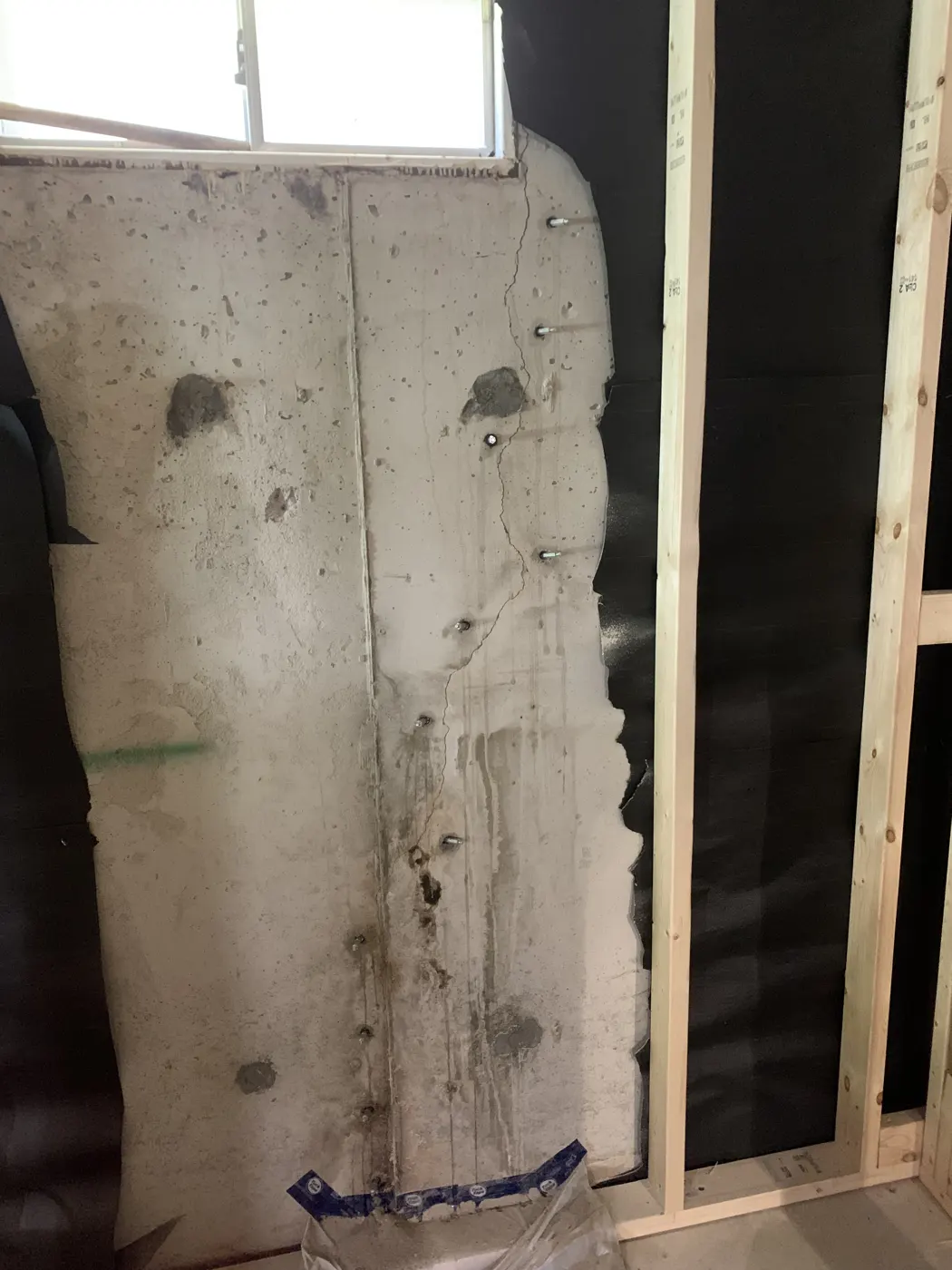
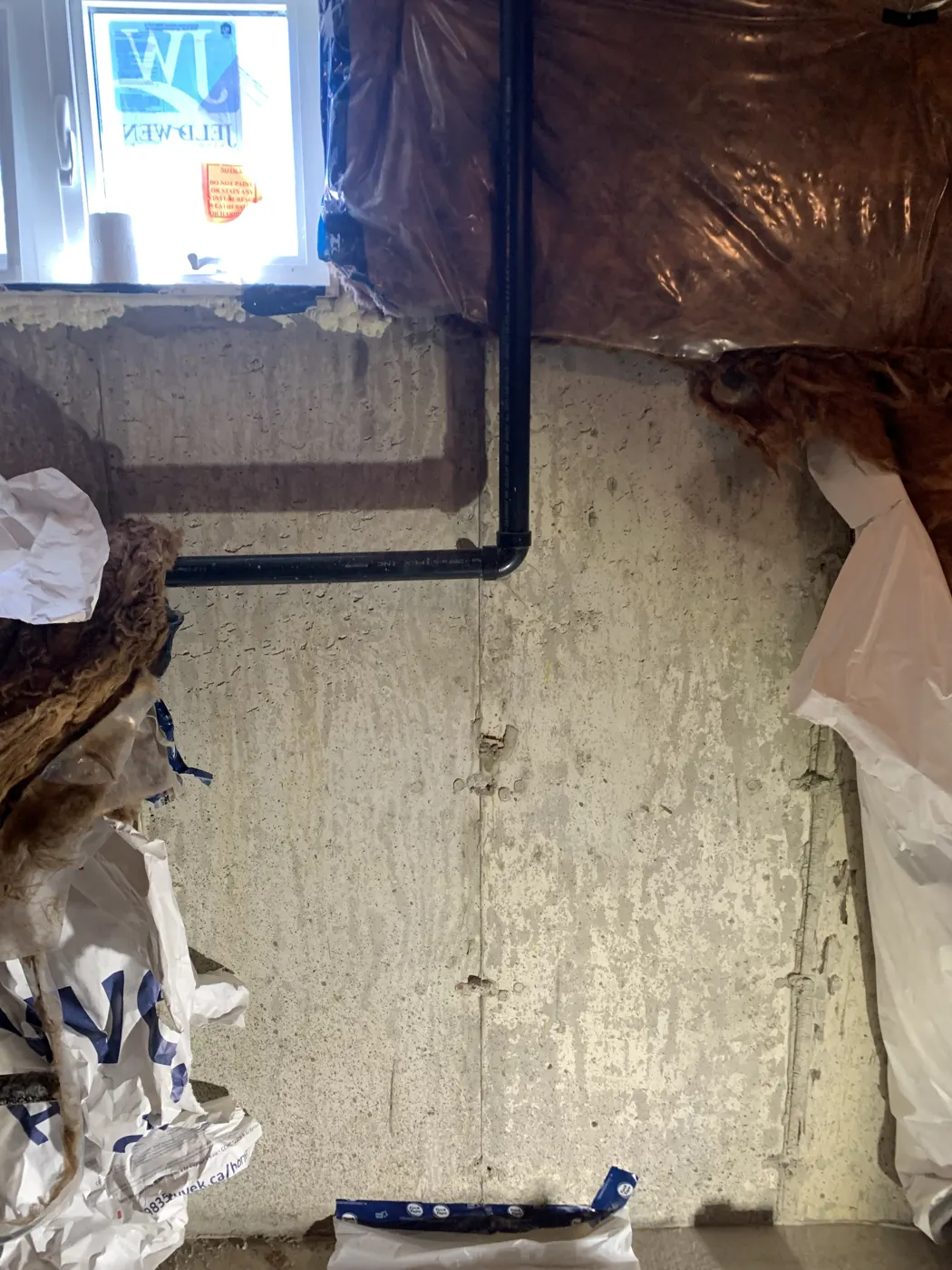
Standing-water pressure and structural movement want different resins.
The characteristic King crack is under sustained hydrostatic pressure rather than intermittent storm loading — particularly in Schomberg, where the water table can sit above slab level. That wants hydrophobic polyurethane ($750–$1,000), which cures against live water and stays flexible. A crack that has grown across seasons, or one carrying structural load, gets epoxy injection that re-bonds the wall ($850–$1,500). Tie-rod leaks run $75–$150, extra cracks are 5% off each, and the complete method guide, the polyurethane page, the epoxy page and the open price sheet hold nothing back. Not sure which pattern you are looking at? Our guide to the five types of foundation crack explains what each orientation indicates, and why width alone tells you very little.
One visit — and a permit question King does not answer.
Photo quotes come back the same day; the on-site assessment is free either way. A typical crack takes 60–90 minutes from the basement side — no excavation through King landscaping, no seasonal blackout. On permits, King is less helpful than its neighbours and we will not paper over it. Unlike Newmarket, which exempts basement waterproofing repairs by name, or Aurora, which exempts “repair of leaking foundations where there is no structural work involved,” King publishes no foundation or waterproofing exemption at all. Its permit-required list includes the broad phrase “repair a building or it’s plumbing system,” which could reasonably capture foundation repair, and its does-not-require list covers only fences, sidewalks, painting and general maintenance, roof shingles, replacement plumbing fixtures and hot water heaters, small sheds and small unattached decks. We call the King Building Division on 905-833-5321 (toll free 1-800-688-5013, 2585 King Road) before we start.
The honest variables inside the published ranges.
Walls holding back standing water need patient multi-port injection, and Schomberg properties are the clearest case of that anywhere we work. Cobbles and boulders in the overburden — which the Township’s own study warns contractors about — can complicate any exterior work, though they rarely affect interior injection. Long full-height cracks use more resin than hairlines, and finished basements add access care. Rural properties on private wells and septic sometimes have older or non-standard foundations, and injection is engineered for poured concrete: a crack there is a discrete plane through a monolithic pour, whereas stone, rubble or mortared block has no such plane for resin to seal against. We say so at the assessment. Every crack after the first is 5% off, and all of it is on the published cost breakdown before we ever ring your doorbell.
Three villages and the hamlets between them.
King City, Nobleton and Schomberg, plus Ansnorveldt, Kettleby, Pottageville, Laskay and Snowball, and rural King throughout. We do not publish build decades for King communities because no municipal or census source assigns them — what the Township does document is where each village sits against the Oak Ridges Moraine, and that turns out to be the more useful fact for a foundation. King’s housing mix is distinctive too: of 8,970 dwellings, 7,835 — 87% — are single-detached, the highest share in York Region, against 60% in both Newmarket and Aurora. Almost every home here has a basement, and most sit in ground with a shallow or perched water table. Our Aurora guide covers the town east, our Vaughan guide the city south, and the full service-area index lists every city we publish for.
The numbers behind the warranty.
A quarter-century of GTA basements kept dry.
Injection repairs warrantied for life — and the warranty moves with the house when you sell.
Full commercial coverage on every job, every crew, every home.
Eligible contractor for City of Toronto, Peel & Halton basement-flooding subsidy programs.
Inspection, honest diagnosis, and an exact per-crack quote — free, no pressure.
Your price is confirmed in writing before any work starts — no hourly surprises.
Every review below is a real, verifiable Google review of Concrete Crack Repair Pros. Nothing is paraphrased, and nothing is borrowed from a sister company.
Are these reviews genuine? Every review shown above is pulled live from the Concrete Crack Repair Pros Google Business Profile at 64 Millwick Dr, North York — not from a parent or sister brand’s listing. The rating and the count update automatically as new reviews arrive, so what you see here is what is on Google right now.
The same name, address and phone number we publish everywhere, so you can check us before you call.
Often, yes — and it is the single most important thing to understand about foundations in Schomberg. King Township’s own geotechnical desktop study records groundwater there at 1 to 2 metres below ground surface, in “fine textured glaciolacustrine deposits (silt and clay, minor sand and gravel).” A standard Ontario full-height basement floor sits at roughly 2.1 to 2.4 metres. So for much of the year the regional water table is above slab level. That comparison is our interpretation, but the depths are the Township’s own figures. It means a Schomberg foundation is holding back standing water, not just shedding rain — which is exactly what flexible polyurethane injection is designed for.
Both, and the nuance matters. The moraine is a major groundwater recharge feature — porous soil that lets water infiltrate, feeding the aquifers most of King depends on. Good for water supply, less good for basements, because recharge means a live, well-fed groundwater system rather than a dry one. But the villages themselves are not sitting on clean sand: the Township’s study describes clay-rich till and glaciolacustrine silt and clay under King City, Nobleton and Schomberg. So you get moraine-driven water arriving, and clay layers stopping it from draining away. That combination is the local signature.
Almost always perched water. King’s geotechnical study records Nobleton groundwater anywhere from 1 to 6 metres, and specifically notes “perched tables expected in sandy soils.” A perched table is water sitting on top of a low-permeability layer, well above the regional water table — so a sand lens under your property can carry water that the clay under your neighbour’s simply does not. Identical houses, identical age, entirely different basements. It is not bad luck and it is not poor maintenance; it is what is under the slab.
King does not say, and that is the honest answer. Unlike Newmarket, which exempts “waterproofing repairs to basement,” or Aurora, which exempts “repair of leaking foundations where there is no structural work involved,” King publishes no foundation or waterproofing exemption at all. Its permit-required list includes the broad “repair a building or it’s plumbing system,” and its exemption list covers only fences, sidewalks, painting, roof shingles, replacement fixtures and small sheds and decks. We call the Building Division on 905-833-5321 before starting. Treat a flat “no permit needed” from any contractor as an assumption.
No, at any level. King Township runs no basement flooding subsidy, rebate, grant or loan, and York Region has no regional program — it points instead to schemes in Richmond Hill and Vaughan, neither of which applies here. On top of that, regional programs elsewhere in the GTA typically require connection to a municipal wastewater system, which excludes septic properties by design. So rural King homeowners are doubly outside the system. Everything is out of pocket, which is why our pricing is published rather than quoted on the doorstep.
Rarely for interior injection, but it is worth knowing. King’s geotechnical study advises that “contractors working in this area should be made aware of the potential presence of cobbles and/or boulders within the overburden soils,” with bedrock — shale, limestone, dolostone and siltstone — at 100 to 150 metres elevation. Cobbles and boulders matter enormously for excavation, exterior waterproofing and drainage work, where they slow everything down and raise costs. Interior crack injection works from inside the basement and does not touch the surrounding soil at all, which is one of the reasons it is usually the cheaper route here.
Method, resins and money — documented before you commit.
Walls holding back standing water are our daily work: free assessment, flat published pricing, one-visit repair, lifetime transferable warranty — and an honest word about what no subsidy will cover here.