
The full foundation crack repair cost breakdown shows every range we publish.
Waterloo, Ontario
Leaking foundation cracks sealed from the inside by polyurethane injection — one visit, no excavation, transferable lifetime warranty. Same crews, same published prices we charge in Toronto.
Quick Answer
Can a leaking foundation crack in Waterloo be fixed from inside? In a poured concrete wall, almost always yes. Polyurethane resin is injected through ports drilled into the crack, travels the full thickness of the wall under pressure, and cures into a flexible seal that runs from the soil face to the interior face. No digging, no landscaping damage, one visit in most cases. Where it does not apply is block, stone or rubble foundations, and walls that are moving rather than simply cracked — we will tell you that on site rather than inject something that will fail.
Injection is a poured-wall repair. Waterloo’s post-war and newer subdivisions are overwhelmingly poured, which is why most Waterloo calls are straightforward.
Moraine ground drains fast, then dumps. Waterloo leaks tend to arrive in sharp bursts hours after heavy rain rather than as a slow weep.
A licensed rental unit with a wet wall is a habitability problem under the Residential Tenancies Act, whatever your licence says.
Unlike Toronto, Peel and Halton, we could find no Waterloo or Region of Waterloo grant for this work. Budget the full amount.
If it has never been wet and is not widening, monitor it. We will say so and charge you nothing for the visit.
Waterloo work is quoted from the same published per-crack ranges as our Toronto jobs. There is no travel surcharge.
Most Ontario foundation advice is written for Toronto clay. Waterloo sits on something materially different, and it changes how water reaches your wall.
The Waterloo Moraine is an interlobate moraine — sediment squeezed between three retreating lobes of the Laurentide ice sheet — and it is built mainly of sand and gravel rather than the heavy clay that dominates the Peel and Halton plains. It covers roughly 400 square kilometres, the largest of fourteen moraines in the region, and the glacial sediment beneath you runs from about 30 metres thick to well over 100 metres in places.
That matters to a homeowner for a reason that has nothing to do with geology trivia. Clay is slow. Water arriving at a clay lot ponds, saturates, and presses against a wall steadily for days — which is why Toronto basements often weep gradually and keep weeping. Sand and gravel are fast. Rain infiltrates quickly, moves down until it meets a less permeable layer, then turns sideways and travels along that layer until it hits something. If your foundation wall is what it hits, you get water at the wall in a concentrated pulse, often several hours after the rain has already stopped.
Homeowners routinely misread this. The basement is dry during the storm, so the storm gets ruled out. Then water appears at nine in the evening and the theory becomes a burst pipe, a failed sump, or condensation. In moraine ground the delay is normal, and it is one of the more reliable tells that you are looking at a crack rather than a plumbing fault.
The same geology is why the region drinks its own groundwater. The moraine supplies roughly three quarters of the potable water for the Region of Waterloo — drinking water for well over 300,000 people — drawn from well fields rather than a lake. Recharge is concentrated: a large share of it happens on a relatively small footprint out toward Wilmot and Wellesley, and the water moves broadly west to east through the aquifer system toward the regional wells. You are living on top of a working aquifer, not beside one.
How water reaches a Waterloo foundation wall
Why a Waterloo basement is often dry during the storm and wet that evening: fast infiltration through sand and gravel, then lateral travel along a denser layer until it reaches the wall.
If your address sits in the Laurel/Clair corridor, the rules around your house are genuinely different from the rest of the city.
Waterloo has a single provincially approved Special Policy Area, designated in 1990, covering part of the Laurel Creek and Clair Creek corridor. It runs from the Clair Creek and Laurel Creek crossing of University Avenue West through to roughly 475 metres downstream of the Laurel Creek crossing of University Avenue East. A Special Policy Area is what a province creates when a community has historically been built inside a flood plain and simply removing it is not realistic — site-specific policies let existing buildings carry on under conditions that would otherwise be refused.
The City has been updating its flood plain mapping, because the existing lines were produced with mid-1980s methods and the modelling available now is considerably better. Worth being precise about what that means, because it gets misreported: updating the mapping does not create flood plain. The water was always going where the water goes. The maps are being re-measured, not redrawn to punish anyone.
What this has to do with a crack in your wall is straightforward. A house inside or near that corridor sits closer to a seasonally high water table, and a crack in that setting is under load far more often than the same crack in Vista Hills or Columbia Forest. It is not a reason to panic and it is not a reason to excavate. It is a reason not to leave a known wet crack through a second spring, and a reason to keep the paperwork from any repair you do, because it comes up at sale.
What we will not tell you: that injection solves flooding. It does not. Injection seals a crack. If water is coming up through the floor slab, backing up through a floor drain, or arriving over the top of the foundation wall, the crack is not your problem and sealing it will change nothing. Those are drainage, grading, and plumbing problems, and we will say so on site rather than sell you the repair we happen to perform.
Waterloo is one of the few Ontario cities with a full residential rental licensing regime. It is worth understanding what it actually inspects.
If you rent out a low-rise unit in Waterloo — including a basement apartment — you almost certainly need a licence. The classes run roughly as follows: Class A for non-owner-occupied low-rise units of up to five bedrooms, Class B where the owner lives in the building and rents up to five bedrooms, Class C for lodging houses, Class D for units grandfathered from the earlier regime, and Class S for short-term rentals in apartment buildings. Purpose-built apartment buildings, post-secondary residences, bed and breakfasts and group homes sit outside it.
| Requirement | Who signs it | What it actually covers |
|---|---|---|
| Electrical inspection Form D, within 12 months |
Licensed electrician | The electrical system. Nothing about water. |
| Gas or oil appliance inspection Form E, or Form F to declare none |
Licensed gas fitter | Fuel-burning appliances and venting. |
| Insurance declaration Form C, within 12 months |
Your insurer | That coverage exists. Not that the basement is dry. |
| Floor plan and parking plan | You | Room sizes, layout, parking count. |
| Criminal record check Class B, new applications |
Police service | Required for owner-occupied applications as of 1 July 2026. |
| Foundation or moisture inspection | — | Not part of it. No form asks whether the wall leaks. |
Requirements and fees as listed by the City of Waterloo in September 2026. Confirm current details at waterloo.ca before you apply — these change.
Licence fees at the time of writing ran from about $520 new and $302 on renewal for a one-bedroom Class A, up to roughly $675 and $450 for a five-bedroom, with Class B running somewhat lower and Class C around $786 new. Modest amounts against the cost of the unit sitting empty.
Here is the part landlords miss. The licence checks electrical and gas. It does not inspect your foundation and no form on the application asks whether water comes through the wall. That does not mean a leaking basement unit is your tenant’s problem. Under the Residential Tenancies Act a landlord must keep a rental unit in a good state of repair and fit for habitation, and a chronically wet wall, visible mould growth, or a unit that smells of damp is squarely inside that duty. Tenants take these to the Landlord and Tenant Board and they win. A licence in good standing is no defence.
The practical sequence, if you are converting or re-letting: deal with the wall before the drywall goes up and before the unit is listed. Injection is done from inside, so a finished basement means pulling insulation and board off the affected section to reach bare concrete. Doing it while the wall is open costs you nothing extra in reinstatement; doing it after costs you the finishing twice.
Not every crack means the same thing, and two of the ones below are not injection work at all.
| What you are looking at | Usual cause | Is it injectable? |
|---|---|---|
| Vertical or near-vertical, hairline to a few millimetres, often mid-wall | Concrete shrinkage as the wall cured, normally within the first year or two | Yes. The standard case. Most Waterloo calls are this. |
| Diagonal from a window or door corner | Stress concentrating at an opening, often with minor settlement | Yes, once movement has stopped. |
| Horizontal, running along the wall | Lateral soil or ice pressure pushing the wall inward | No — not on its own. This is a structural question first. Injection without addressing the load is cosmetic. |
| A straight line where two pours met | A cold joint, not a crack at all | Yes, and it is one of the most reliable things to seal. |
| Stair-stepping through mortar joints | Block or brick foundation moving at the joints | No. Block walls are not injection candidates. |
| Cracks in the floor slab | Slab shrinkage or heave — the slab is not structural | Usually not worth it unless water is actively coming through. |
We would rather lose the job than take one that will come back.
The wall must be poured concrete. Resin needs a continuous mass to travel through. Block, stone and rubble walls have voids and mortar paths that resin will escape through.
If the crack is actively widening, sealing it just relocates the failure. Movement gets diagnosed first, sometimes by an engineer.
We need access to bare concrete along the crack. Finished walls need a section opened; we will tell you how much before we start.
If it is arriving through the slab, the floor joint or a drain, injection is the wrong repair and we will say so.
Where a wall fails those tests, the honest answer is usually exterior excavation and membrane, a drainage change, or a structural assessment — none of which we will pretend is the same thing as an afternoon of injection.
The same method we use across the GTA, done in an afternoon in most Waterloo homes.
We confirm the wall is poured, find where water is genuinely entering, and check the crack is the cause rather than a symptom of grading or drainage.
Ports are drilled on alternating sides of the crack and angled inward to intersect it near mid-thickness, spaced to the wall’s thickness.
A surface seal bridges the crack between ports, so resin travels into the wall under pressure instead of squeezing straight back out at you.
Resin goes in at the lowest port first and climbs. When it shows at the port above, that section is full and we move up.
Polyurethane foams on contact with water and cures flexible. Ports come off, the surface seal is trimmed, and the wall is ready to close back up.
Why the ports are drilled on an angle
A port drilled straight in would only meet the crack at the face. Angling it means the resin enters at depth and fills outward in both directions.
Photographs from our own jobs, start to finish. The same method and materials we use in Waterloo.
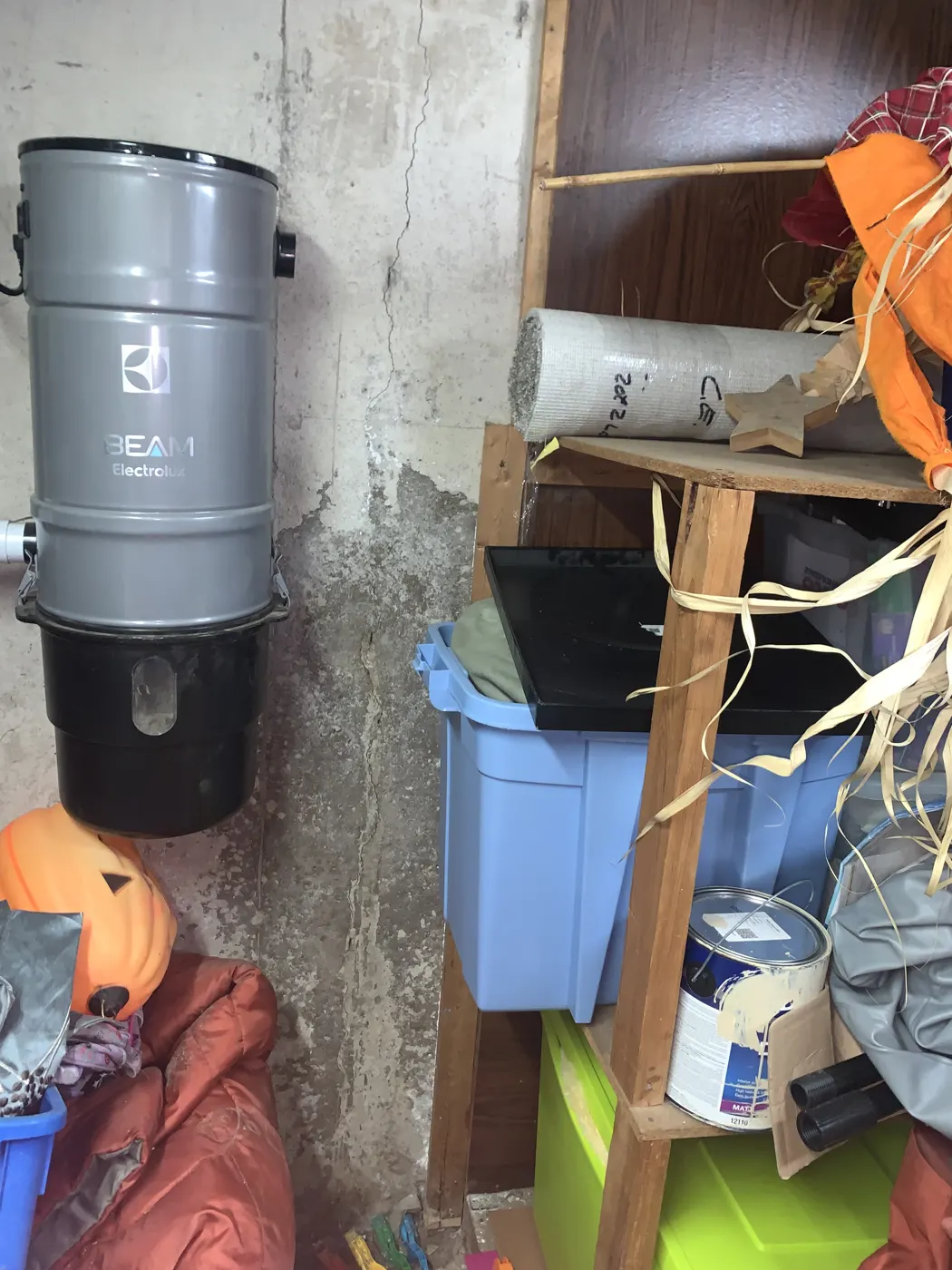 Before — a full-height crack, actively wet. The dark staining spreading either side of the line is the giveaway. This wall was dry to the touch on the day it was quoted.
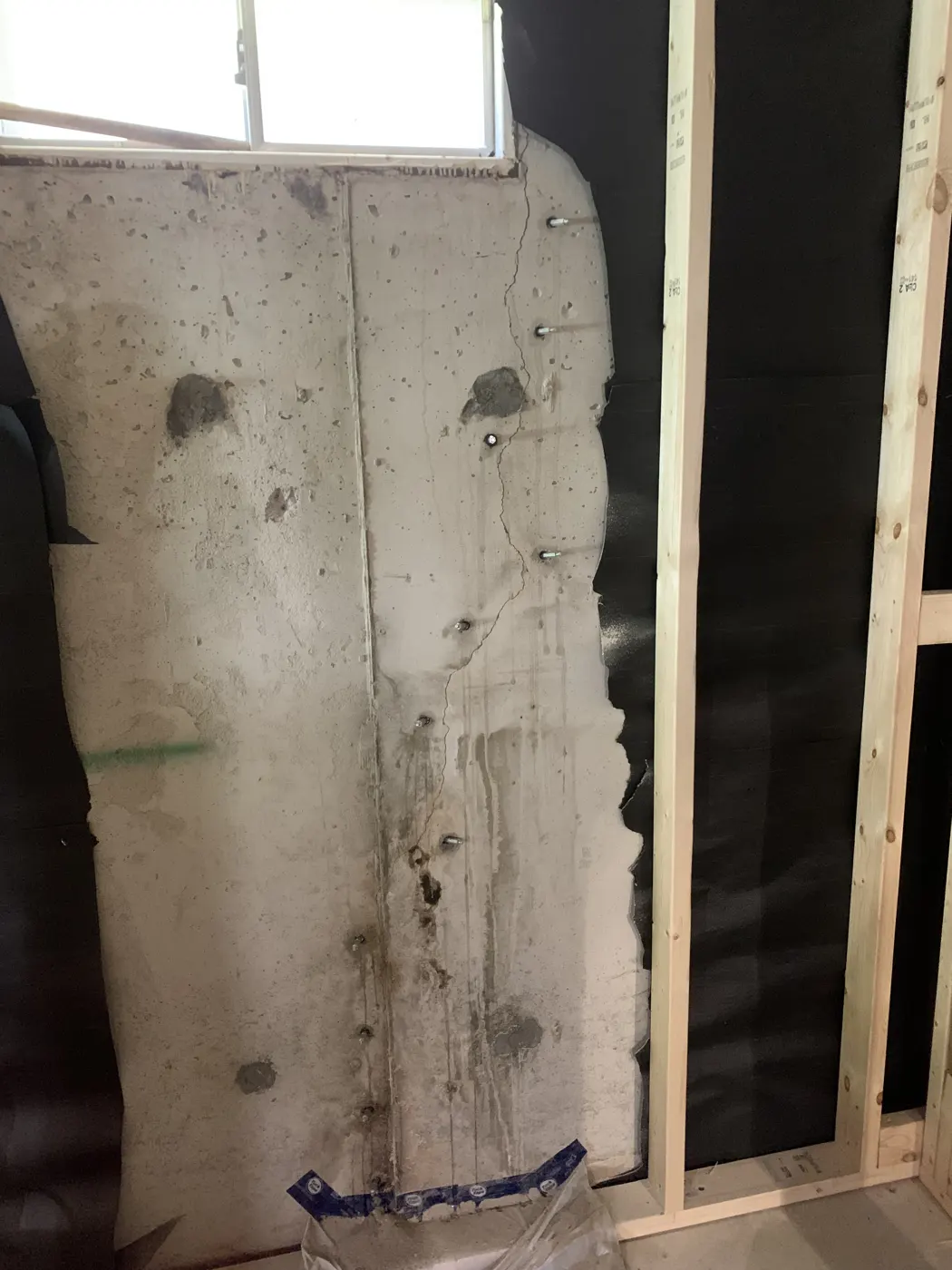 Ports set and spaced. Drilled on alternating sides and angled to meet the crack at depth. Spacing follows the thickness of the wall, not a fixed rule of thumb.
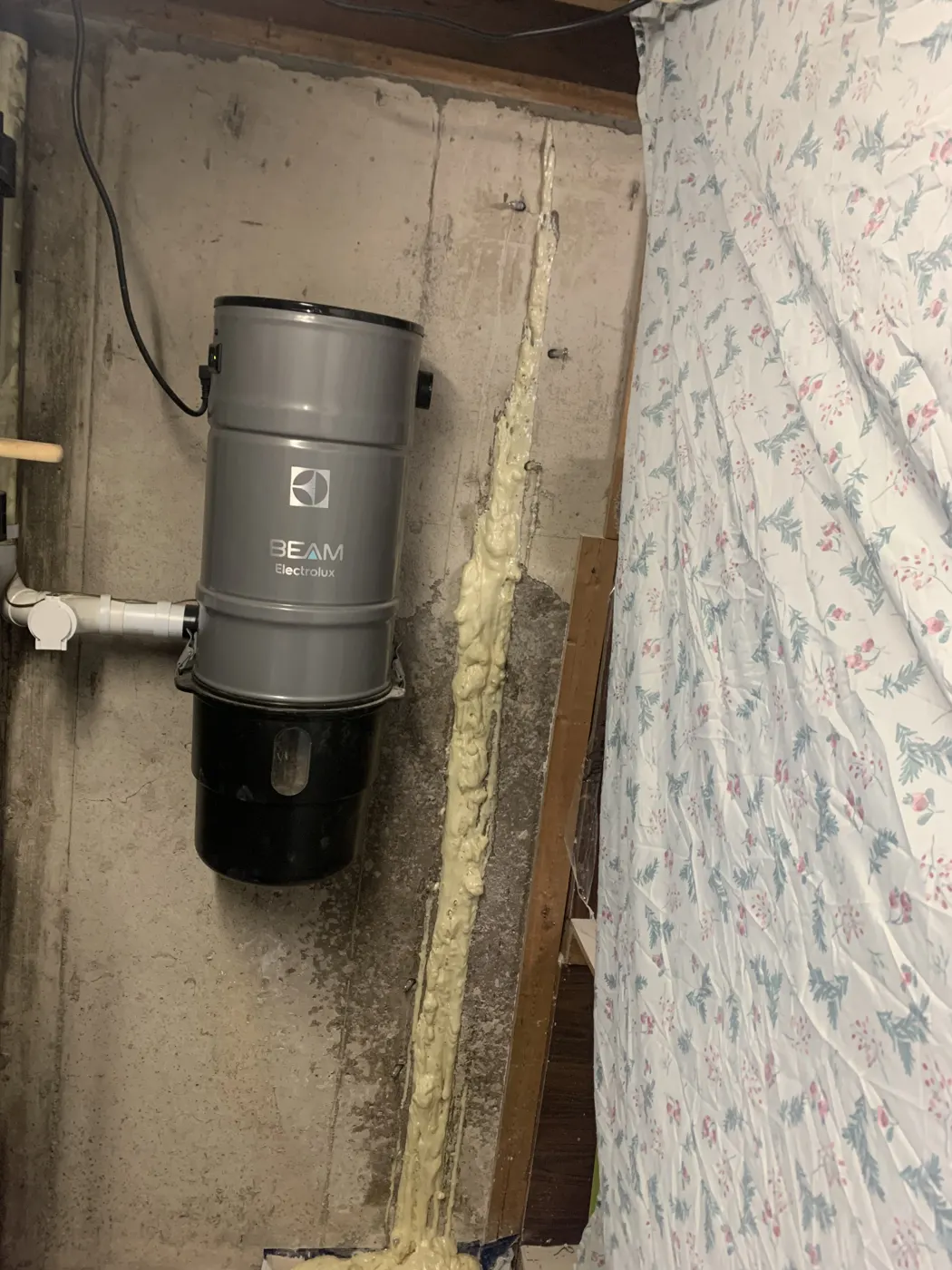 During — resin arriving. Foam appearing at the surface means that section is full. It reacts with the water already in the crack, which is why a damp crack injects better than a bone-dry one.
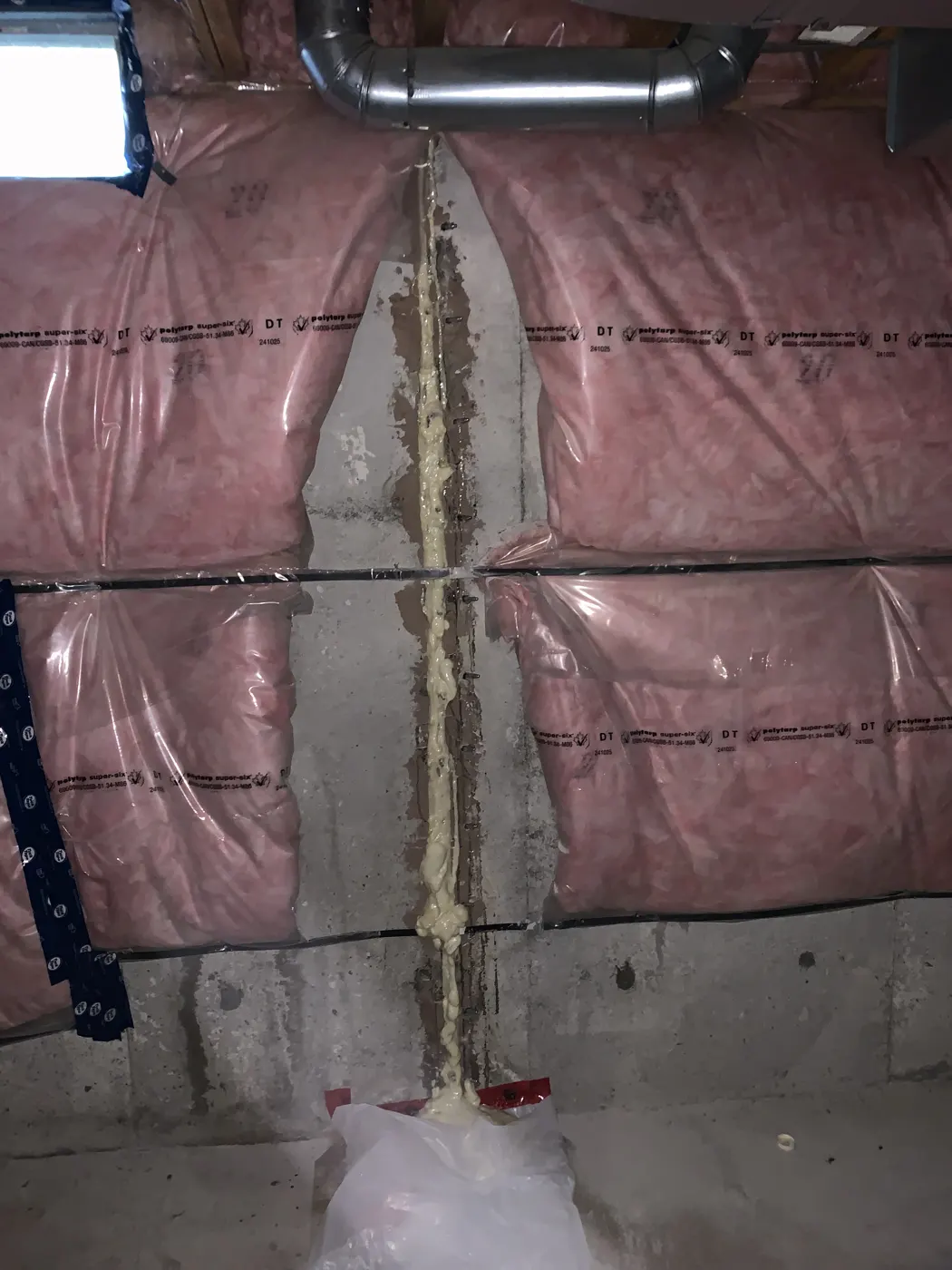 After — sealed front to back. Not a skim over the visible line: a flexible seal through the wall. The wall can be insulated and boarded over the same week.
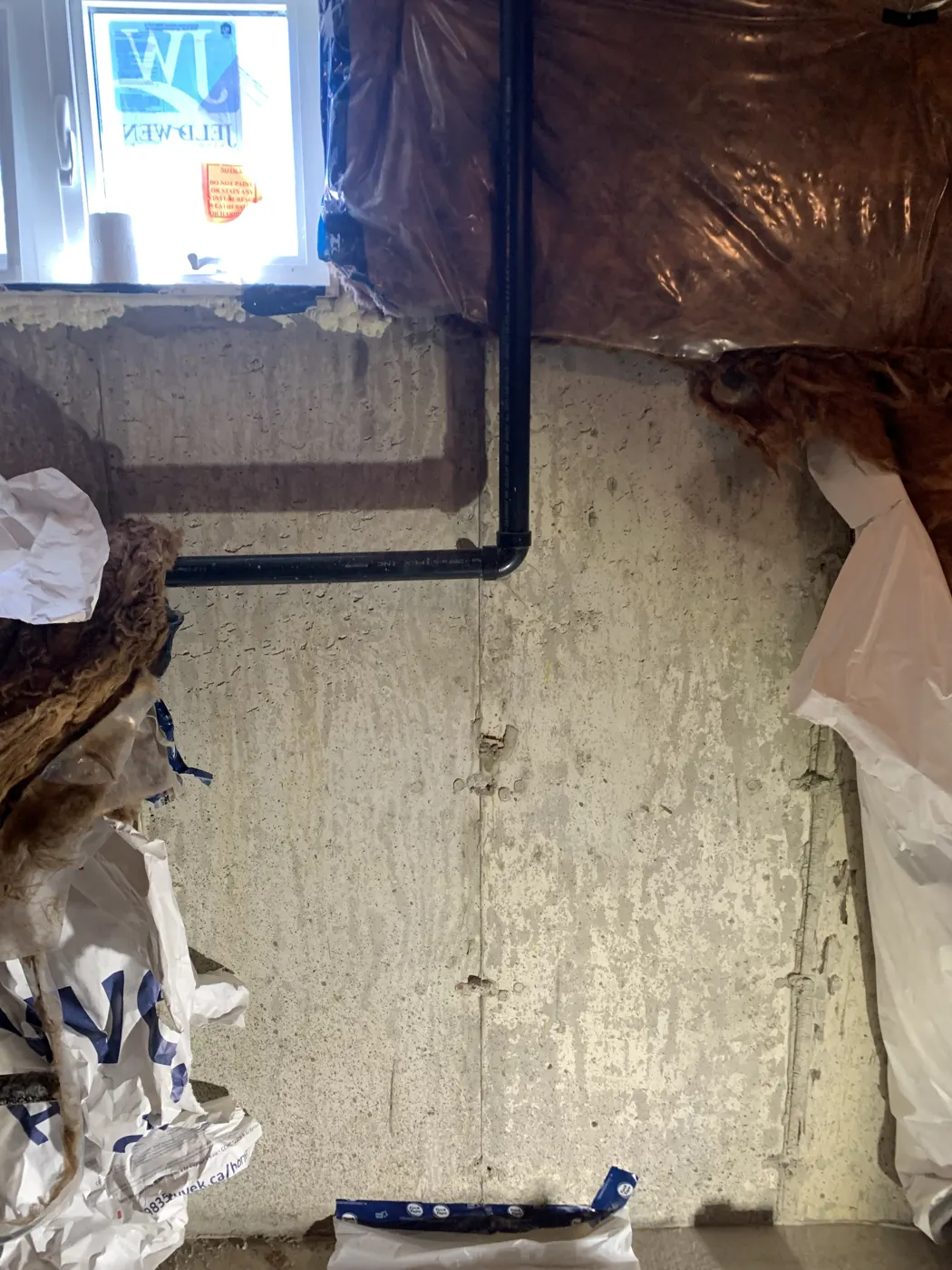 The one to catch before drywall. A cold joint seeping in a basement mid-renovation. Sealed now it costs one visit; found after the unit is finished it costs the finishing twice.
Per crack, quoted in writing before anything starts. No hourly billing and no travel surcharge for Waterloo.
| Factor | Effect | Why |
|---|---|---|
| Number of cracks | Largest single factor | Each crack is its own set-up: ports, seal, resin, cure. |
| Height of the crack | Moderate | A full-height crack takes more ports and more resin than a metre near the floor. |
| Wall thickness | Moderate | Thicker walls need deeper ports and more material to fill front to back. |
| Finished vs bare wall | Can be significant | Insulation and board have to come off to reach concrete, and go back after. |
| Access | Minor to moderate | A wall behind storage, a furnace or a stairwell takes longer to work on. |
| Travel to Waterloo | None | Waterloo is quoted from the same published ranges as our Toronto work. |
Current ranges are published openly on our crack injection cost page rather than hidden behind a phone call. If you have several cracks, book them in one visit — the second and third crack on the same trip cost meaningfully less than the first, because the set-up is already there.
All of Waterloo, and the housing stock varies more than people expect.
We also work throughout the wider region — Kitchener is our nearest covered city, and we travel to Cambridge, Guelph and the townships regularly. If you are just outside the boundary, call and ask; the answer is usually yes.
Yes, regularly. We work out of North York and Waterloo is about an hour and a quarter each way on the 401. There is no travel surcharge — Waterloo jobs are quoted from the same published per-crack ranges as our Toronto work. The only practical advice is to have everything you want looked at ready for one visit rather than calling us back for a second crack a month later.
That delay is characteristic of moraine ground. Sand and gravel let rain infiltrate quickly, the water travels down until it meets a denser layer, then moves sideways along it until it reaches an obstruction. If your foundation is that obstruction, water arrives at the wall well after the rain has stopped. It is one of the more reliable signs that you are dealing with a foundation crack rather than a plumbing fault or condensation.
We could not find one. Toronto, Peel and Halton run basement flooding subsidy programs; we found no equivalent City of Waterloo or Region of Waterloo grant. Two things worth knowing even if one appears: those programs almost always fund plumbing work — backwater valves, sump pumps, weeping tile disconnection — and crack injection typically would not qualify anyway. Budget the full amount, and check waterloo.ca yourself before taking our word for it.
No. A Waterloo long-term rental licence requires an electrical inspection, a gas or oil appliance inspection or a declaration that there are none, an insurance declaration, floor and parking plans, and for owner-occupied Class B applications a criminal record check. Nothing in that list asks whether the foundation leaks. That does not put you in the clear: under the Residential Tenancies Act you must keep the unit in a good state of repair and fit for habitation, and a chronically damp wall or visible mould is squarely inside that obligation regardless of your licence status.
Yes, but we need to reach bare concrete along the crack, which means opening a section of the finished wall. We will tell you before we start roughly how much has to come off — usually a strip either side of the crack, not the whole wall. If you are mid-renovation, do it now while the wall is open. Doing it after the unit is finished means paying for the drywall and insulation twice.
It changes how often the crack is under load, not whether it can be repaired. Waterloo has one provincially designated Special Policy Area, approved in 1990, covering part of the Laurel and Clair Creek corridor along University Avenue. Homes in and near that corridor sit closer to a seasonally high water table, so the same crack gets pressed harder and more often. The repair is identical; the argument for not deferring it another year is stronger. Keep the documentation — it comes up when you sell.
For a leaking crack, polyurethane, almost always. It reacts with the water already in the crack, foams to fill irregular voids, and cures flexible so it tolerates the seasonal movement every Ontario foundation goes through. Epoxy is rigid and much stronger in tension, which makes it the right choice when the job is to structurally rebond a crack — usually under engineering direction. Epoxy in a wet crack often will not bond properly in the first place. If someone offers you epoxy for a leak without explaining why, ask the question.
Most single-crack jobs are a few hours, start to finish, in one visit. The resin cures quickly and there is no waiting period before you can use the space. Multiple cracks or a wall that has to be opened first will stretch it, but it is still normally the same day.
The repair carries a transferable lifetime warranty, which is the honest answer to that question. Polyurethane stays flexible, so ordinary seasonal movement does not break the seal. What we cannot warrant is a new crack somewhere else on the wall, or water arriving by a route the injection was never meant to block — through the slab, over the wall, or up a floor drain.
Usually not, and we will tell you that for free. A hairline vertical crack that has never been wet and is not widening is doing no harm. Mark each end with a pencil and the date, photograph it, and look again after a wet spring. If it has moved or wept, call. If it has not, leave it. We would rather do that than sell you a repair you did not need.
Not on its own, and treat anyone who says otherwise with suspicion. A horizontal crack usually means lateral pressure — soil or ice pushing the wall inward. That is a structural question and sometimes an engineering one. Sealing it without dealing with the load hides the symptom while the cause carries on. We will look, tell you what we think, and refer you on if that is what the wall needs.
Injection is a poured-concrete repair. Block walls have hollow cores and mortar joints for resin to escape through, and stone or rubble walls have no continuous mass to travel through at all. In the older parts of Uptown and Mary Allen this genuinely comes up. If that is what you have, the honest options are exterior excavation and membrane, or an interior drainage system — and we will say so rather than inject something that will fail.
For an ordinary vertical or diagonal crack, no. You need one when the wall is moving, bowing, or cracked horizontally, when a crack is widening measurably over months, or when a lender, insurer or buyer asks for a professional opinion in writing. In Ontario that report comes from a professional engineer, and we will tell you when we think you have crossed that line rather than guess at it ourselves.
Talk to your lawyer or agent about disclosure obligations — that is their field, not ours. What we can say is the practical part: a documented, warrantied repair is a far easier conversation at closing than an undocumented one, because you can hand over a written scope showing exactly what was found and what was done. Our warranty transfers with the house, which is the detail that matters to a buyer.
Live Google reviews for Concrete Crack Repair Pros, straight from our own Google Business Profile.
The documents this page relies on, so you can check us rather than trust us.
Free written assessment. An exact per-crack price before anything starts, and an honest answer if injection is not the right repair.