
Parking Structures & Commercial Concrete
Injection seals the water path through a crack. It does not stop corrosion that has already started. Knowing which problem you have is the difference between a repair that holds and one that comes back on the next reserve fund cycle.
Can cracks in a parking garage be repaired by injection? Sometimes — and the honest answer depends entirely on what is causing them. Chemical grout injection is effective at sealing a discrete crack that is passing water, and ASTM D8109-25 is the published guide for that work. It is the wrong repair for delamination, spalling, active corrosion, expansion joints, or a slab whose cracking is a symptom of structural distress. In a chloride-loaded Ontario parking structure those conditions are common, which is why the first thing worth establishing is not the price of injection but whether injection is the right repair at all.
This is not widely known, and as far as we can tell no other Canadian contractor page mentions it. Two CSA standards bracket the subject, and between them they leave a gap that matters enormously if your garage was built between roughly 1960 and 1995.
CSA S413:21, Parking structures, covers new construction. Clause 1.2 applies it to structures of structural steel, reinforced concrete including prestressed concrete, or a combination. But clause 1.3 states plainly: “This Standard does not cover the repair of existing parking structures, and the provisions of this Standard are not necessarily appropriate for the repair and protection of existing structures.”
CSA S448.1:10 (R2025), Repair of reinforced concrete in buildings and parking structures, covers repair. Clause 1.1 states it “specifies requirements for the repair of reinforced structural concrete components of buildings and parking structures.” Clause 1.2 states it “does not cover repairs to (a) pre-stressed, including post-tensioned, components and structures; or (b) non-structural slabs-on-grade.”
| Structure type | New construction | Repair of existing |
|---|---|---|
| Conventionally reinforced concrete | CSA S413:21 | CSA S448.1:10 (R2025) |
| Post-tensioned concrete | CSA S413:21 — prestressed is included | No CSA standard. S448.1 clause 1.2 excludes it. |
Read the two clauses together and the conclusion is unavoidable: there is no CSA standard governing the repair of a post-tensioned parking structure in Canada. That does not mean such repairs cannot be done. It means they fall outside the national standard and require project-specific engineering judgement rather than a checklist.
Which is exactly why we will not tell you we “repair to CSA S448.1” on a post-tensioned deck. The standard itself says we could not. Any contractor who claims otherwise has not read clause 1.2.
If you take one thing from this page, take this. It is the sentence most likely to save a condominium corporation money, and it is the one no competitor page in Canada is willing to write.
Chloride from road salt arrives in solution, soaks into the concrete, and reaches the reinforcing steel. Cracks accelerate this enormously, because a crack is a direct route past the concrete cover rather than a slow diffusion through it. Once chloride concentration at the steel passes a threshold, the alkaline environment that was protecting the bar breaks down and corrosion begins. Corroding steel occupies more volume than sound steel, so it pushes outward — and that internal pressure is what produces the delamination and spalling you can hear underfoot and see falling off the underside of a deck.
Now the important part. Injecting the crack closes the route. It does not:
Injection is a water-management and prevention measure. It has real value before chloride has accumulated at the steel, and real value as one component of a larger restoration alongside concrete removal, chloride testing, membranes, sealers or cathodic protection. It has very little value as a standalone repair on a deck that is already delaminating — there you are sealing one path while the damage proceeds through another.
Anyone who tells a condo board that crack injection will “protect the rebar” or “stop the corrosion” in an already-deteriorated garage is describing something injection does not do. We would rather lose that job than sell it.
On thresholds: the National Ready Mixed Concrete Association notes that threshold chloride concentration values vary, but are typically in the range of 0.05 to 0.1% by weight of concrete, or roughly 0.4 to 0.8% by weight of cement. The word doing the work in that sentence is “vary” — the single 0.4% figure circulates as though it were fixed, and it is not. Chloride testing on your structure tells you where you actually stand; a number off a website does not.
A cross-section through a chloride-exposed parking deck, and the precise point where crack injection helps — and where it stops helping.
Chloride attack in a parking deck: the path, the corrosion, and what injection reaches
Why this matters on a quote. A contractor pricing linear metres of injection on a deck that is already delaminating is selling you the green box while the red box carries on. Sounding the surrounding concrete before quoting is what separates the two, and it is why our assessment starts there rather than with a price.
Every Canadian page we reviewed on this subject positions injection as a solution. Not one of them says where it stops working. Here is where it stops working.
| Condition | Why injection is wrong | What the right direction looks like |
|---|---|---|
| Delamination | Injection bonds a plane. Delamination is a horizontal separation at reinforcement depth spread over an area — there is no discrete crack to inject. | Sounding survey, remove to sound concrete, patch repair |
| Spalling | The material is already gone, and the cause is the corroding steel behind it. | Concrete removal and replacement, steel cleaning or replacement |
| Active corrosion | Injection removes no chloride, passivates no steel and stops no corrosion cell. | Chloride testing, half-cell potential survey, removal, membrane or cathodic protection |
| Structural deficiency or overload | The crack is the symptom. Injection restores tensile bond across it, not the capacity of the member. | Engineering assessment and a strengthening design |
| An active, moving crack | ACI 224.1R puts it bluntly: “Unless the cause of the cracking has been corrected, however, new cracks will probably form near the original crack.” Rigid epoxy in a crack that is still moving simply cracks again beside itself. | A flexible material, or routing and sealing with a bond breaker as ACI 224.1R §3.3 describes |
| Expansion or isolation joints | These are designed to move, and bonded reinforcement is deliberately interrupted through them. Filling one with a rigid resin fights the design. | Joint sealant or joint system replacement |
| Contraction joints | A deliberately weakened plane, intended to open. It is doing its job. | A joint filler matched to the expected movement |
| Widespread map or pattern cracking | Distributed cracking from alkali-silica reaction, freeze-thaw or plastic shrinkage is not a discrete path and cannot be injected. | Materials investigation including petrography; surface treatment or replacement |
| A failed waterproofing membrane | Water is arriving across an area, not through a line. Sealing cracks underneath it treats the wrong thing. | Membrane replacement |
| A leaking crack with epoxy specified | ACI 224.1R states epoxy injection “is not applicable if the cracks are actively leaking and cannot be dried out.” | Polyurethane chemical grout, per ASTM D8109-25 |
| A post-tensioned slab of unknown condition | Outside CSA S448.1 by clause 1.2, and drilling carries real risk until tendon locations are known. | A PT-experienced engineer, PTI DC80.3, and tendon location before anything is drilled |
ACI 224.1R-07 is a US advisory guide, not a code, and is not adopted into Ontario law. It is cited here as best-practice guidance because it is the most widely used reference on the causes and repair of cracks in concrete. ACI lists twelve repair methods for cracked concrete; injection is one of them.
The same sequence we run on site, written down so you can run it yourself before anyone quotes you.
Decision path for a crack in a parking structure
Read the red boxes first. Four of the six outcomes here are “not injection”. That ratio is roughly what we find in practice on chloride-exposed decks, and it is the reason we assess before we price.
A large share of Ontario parking structures built between the 1960s and the 1990s use unbonded post-tensioned slabs. Here is the honest position, separated carefully into what is citable and what is our own practice.
CSA S448.1 clause 1.2 expressly excludes post-tensioned components from the scope of Canada’s concrete repair standard. Professional Engineers Ontario, in its 2016 guideline on structural condition assessments of existing buildings, points engineers to PTI DC80.3, the Post-Tensioning Institute’s guide for evaluation and repair of unbonded post-tensioned concrete structures. Those two facts together are why a PT garage needs an engineer engaged, not just a contractor quoting linear feet.
You will find contractor and scanning-company pages asserting that “industry standards require scanning before drilling into post-tensioned slabs.” We went looking for that requirement in ACI, PTI, CSA and Ontario occupational health and safety material and could not find it. We are not going to repeat a rule we cannot source. Several of those same pages also quote a tendon stress figure that appears to confuse force with stress by roughly a factor of six; we are not repeating that either.
We scan before we drill anchors or injection ports in any slab we cannot positively identify as conventionally reinforced. Not because a standard compels it — it does not — but because severing a tendon is a hazard to the person holding the drill at the moment it happens and a loss of flexural capacity in the slab afterwards. That is our practice, stated as our practice.
If your structure is post-tensioned and you do not have current engineering on it, the useful first step is not a crack injection quote. It is a structural condition assessment by an engineer with post-tensioning experience. We are glad to work after that assessment exists, and we will tell you when it needs to exist first.
We reviewed six Canadian contractor pages on parking garage crack repair before writing this one. Not a single one cited a CSA, ACI or ASTM document. Here are the six that matter, and what each one really says.
| Document | What it states | Why it matters to your structure |
|---|---|---|
| CSA S448.1:10 (R2025) Repair of reinforced concrete in buildings and parking structures |
Clause 1.1: specifies requirements for the repair of reinforced structural concrete components of buildings and parking structures. Clause 1.2: does not cover repairs to pre-stressed, including post-tensioned, components and structures, or to non-structural slabs-on-grade. | Canada’s repair standard. Note the edition: a 2010 standard reaffirmed in 2025, not a 2025 standard. Anyone writing “CSA S448.1-2025” has not looked it up. |
| CSA S413:21 Parking structures |
Clause 1.3: does not cover the repair of existing parking structures, and its provisions are not necessarily appropriate for the repair and protection of existing structures. | A new-construction durability standard. Useful for understanding why your deck was built the way it was; not a repair specification. |
| ACI 224.1R-07 Causes, Evaluation, and Repair of Cracks in Concrete Structures |
§2.1: “The cause of the cracking should be established before repairs are specified.” §3.2: “Unless the cause of the cracking has been corrected, however, new cracks will probably form near the original crack,” and epoxy injection “requires a high degree of skill for satisfactory execution.” | The diagnostic discipline the whole industry skips. A repair specified without a cause is a repair with a return date. |
| ASTM D8109-25 Standard Guide for Waterproofing Repair of Concrete by Chemical Grout Crack Injection |
§4.8: “This guide does not address the use of particulate grouts or epoxy as an injection material.” §4.4 directs that overall conditions be assessed before injection to determine whether a non-structural repair is even appropriate. §4.3 frames the guide around below-grade walls and slabs and cautions that above-grade elements see daily and seasonal temperature movement. | Two things matter here. Epoxy is outside the scope of waterproofing injection. And the guide is written for below-grade work — a suspended parking deck is an above-grade element that moves daily, which changes the material choice. |
| PEO guideline (November 2016) Structural Condition Assessments of Existing Buildings and Designated Structures |
§8.8: “Parking structures and other structures exposed to vehicular traffic present a particular concern due to their exposure to the elements, de-icing salts and dynamic loads of vehicles.” Appendix 1 lists PTI DC80.3 among its references. | Ontario’s own engineering regulator, naming parking structures as a particular concern and pointing engineers at the post-tensioning guide. |
| PTI DC80.3 Guide for Evaluation and Repair of Unbonded Post-Tensioned Concrete Structures |
Covers evaluation and repair of structures post-tensioned with unbonded single-strand tendons. | The document that fills the gap CSA S448.1 leaves open. If your garage is post-tensioned, this is what your engineer should be working from. |
ACI and ASTM documents are US voluntary consensus standards. They are not law in Ontario and become binding only when written into a contract or specification. CSA standards are Canadian and are referenced by Ontario regulation in some contexts but not universally. We cite all of them as the professional benchmark for the work, not as legal obligations.
The sequence matters more than the resin. Most failed injections we are called back to were technically competent repairs applied to a misdiagnosed problem.
Before anything is quoted we want to know why the concrete cracked. Thermal movement, deflection, shrinkage, settlement and corrosion all produce cracks and all demand different responses. ACI is explicit that the cause should be established before repairs are specified, and it is the step most often skipped.
A crack in a chloride-exposed deck rarely travels alone. Sounding the concrete around it tells us whether we are looking at a discrete path or the visible edge of a delaminated area — and those are different jobs with very different budgets.
On any slab we cannot positively identify as conventionally reinforced, tendon and reinforcement locating comes before ports are set. This is our own practice rather than a code requirement, and we have explained why above.
A dormant crack in a dry element and a leaking crack in a deck that flexes under traffic need different products. Polyurethane chemical grout for water; epoxy only where the element is dry, the crack is dormant and the cause has been corrected.
You receive a written record of the work and of anything we saw that falls outside it — delamination, spalling, membrane failure, drainage. If that record says the injection we just did is a partial measure, it says so.
Underground and above-grade parking structures, condominium and multi-residential buildings across Toronto, the GTA and Southern Ontario — foundation walls, elevator pits, mechanical and locker rooms, ramps and slabs. We carry commercial general liability insurance and can provide a WSIB clearance certificate before site access, which is usually the first thing a property manager asks for.
Photographs from our own jobs. These are residential foundation walls — we are not going to pass them off as parking structures — but the port spacing, the resin behaviour and the finish are identical on a commercial element.
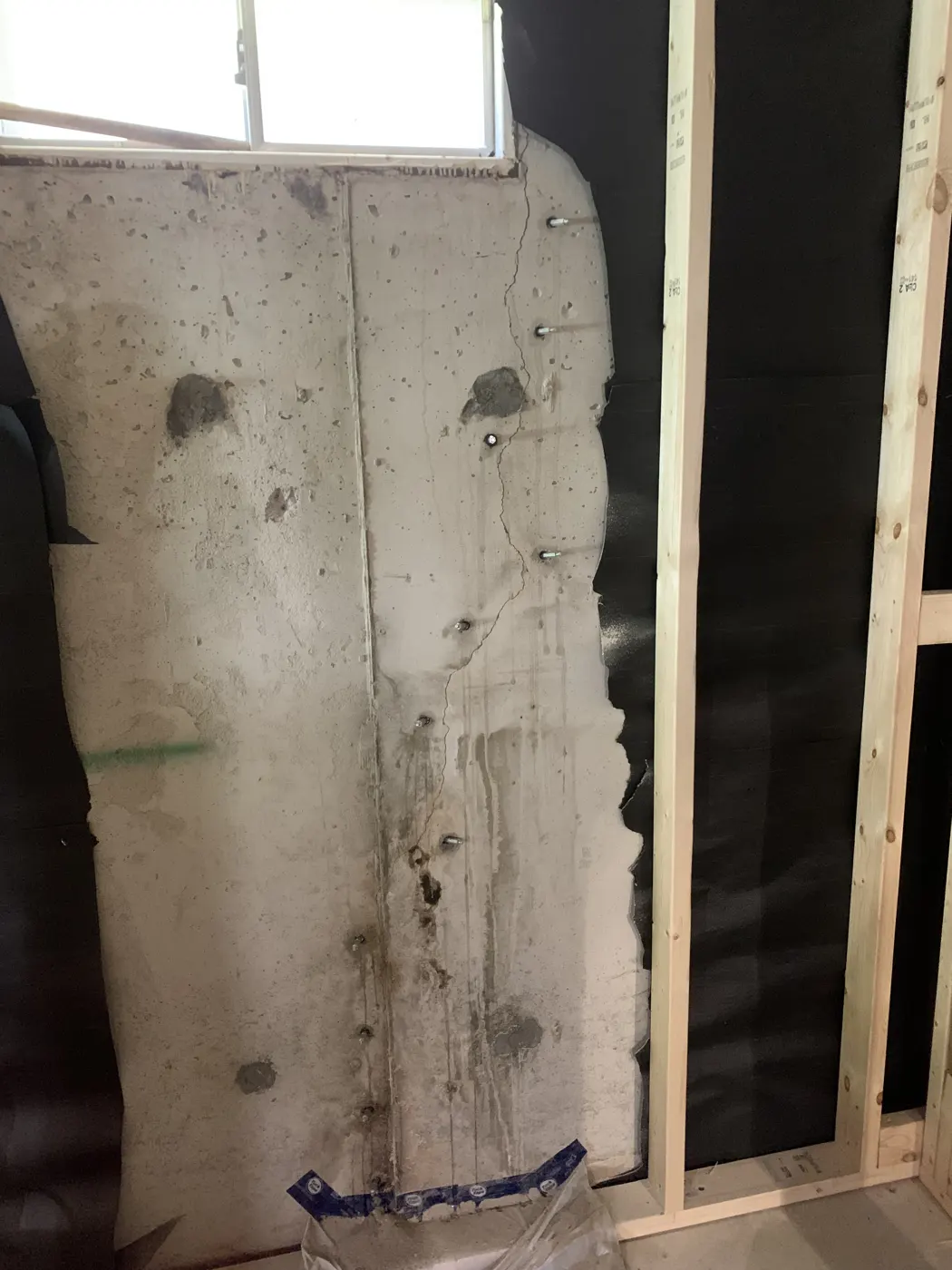
Injection ports set along a crack. Ports are drilled on alternating sides and angled to meet the crack at depth, then spaced to the thickness of the element. Same method on a wall or a suspended slab.
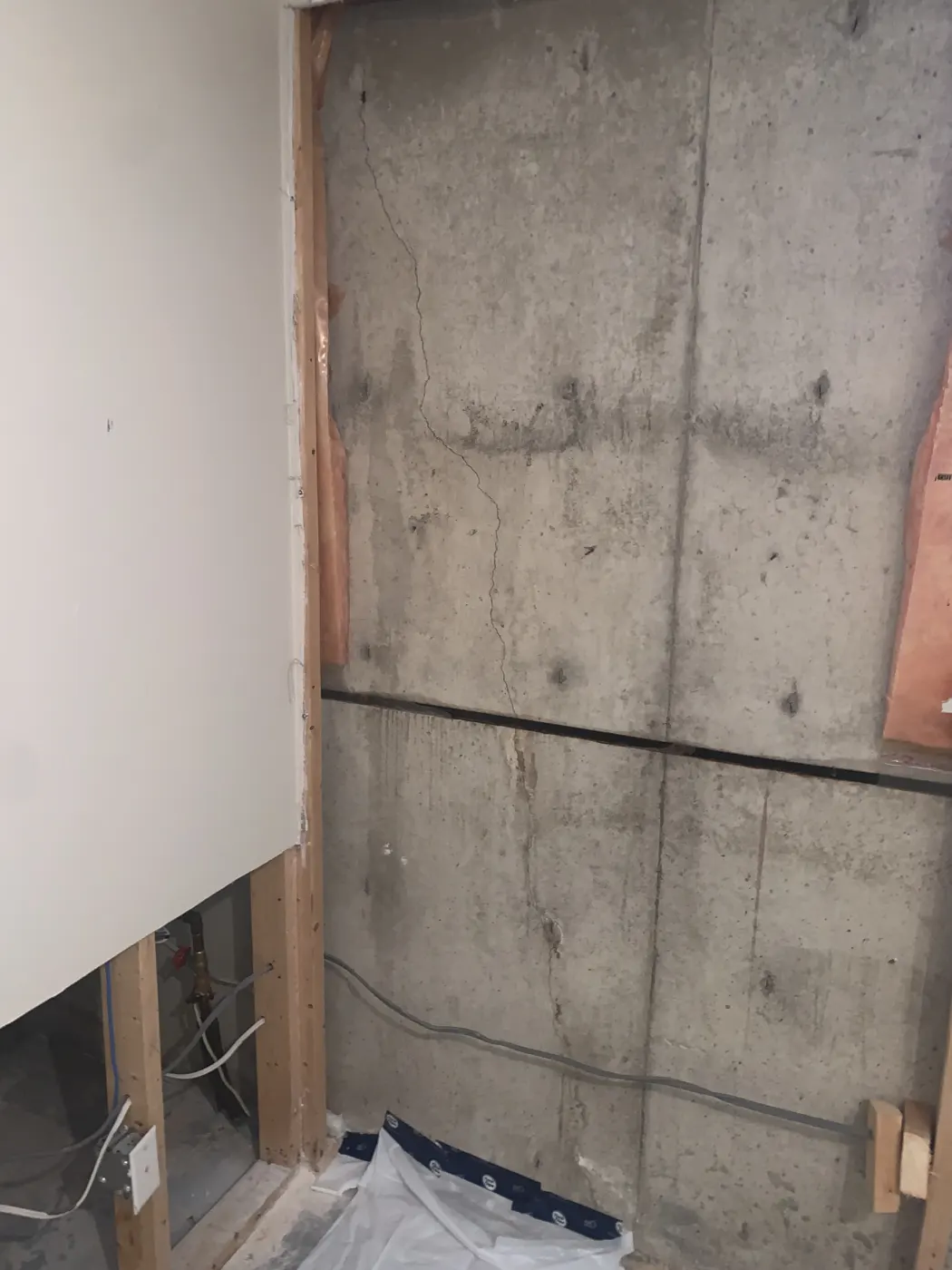
Polyurethane resin travelling. Resin pumped port by port. Return at the next port is the confirmation that it has bridged the gap — which is why the sequence matters more than the pressure.
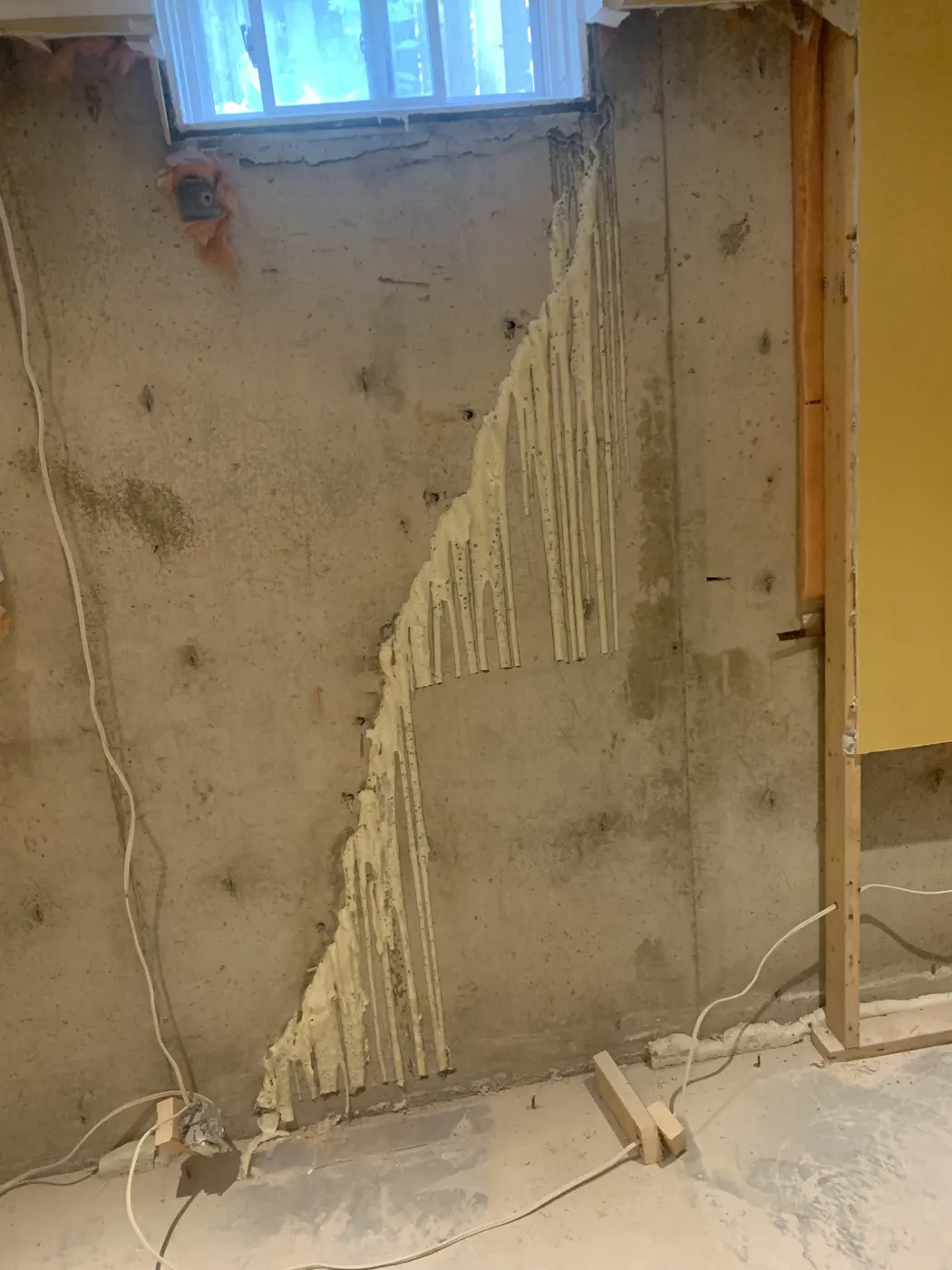
Cured foam, full depth. The resin has reacted with moisture in the crack and expanded through the full thickness. This is what a completed seal looks like from the face.
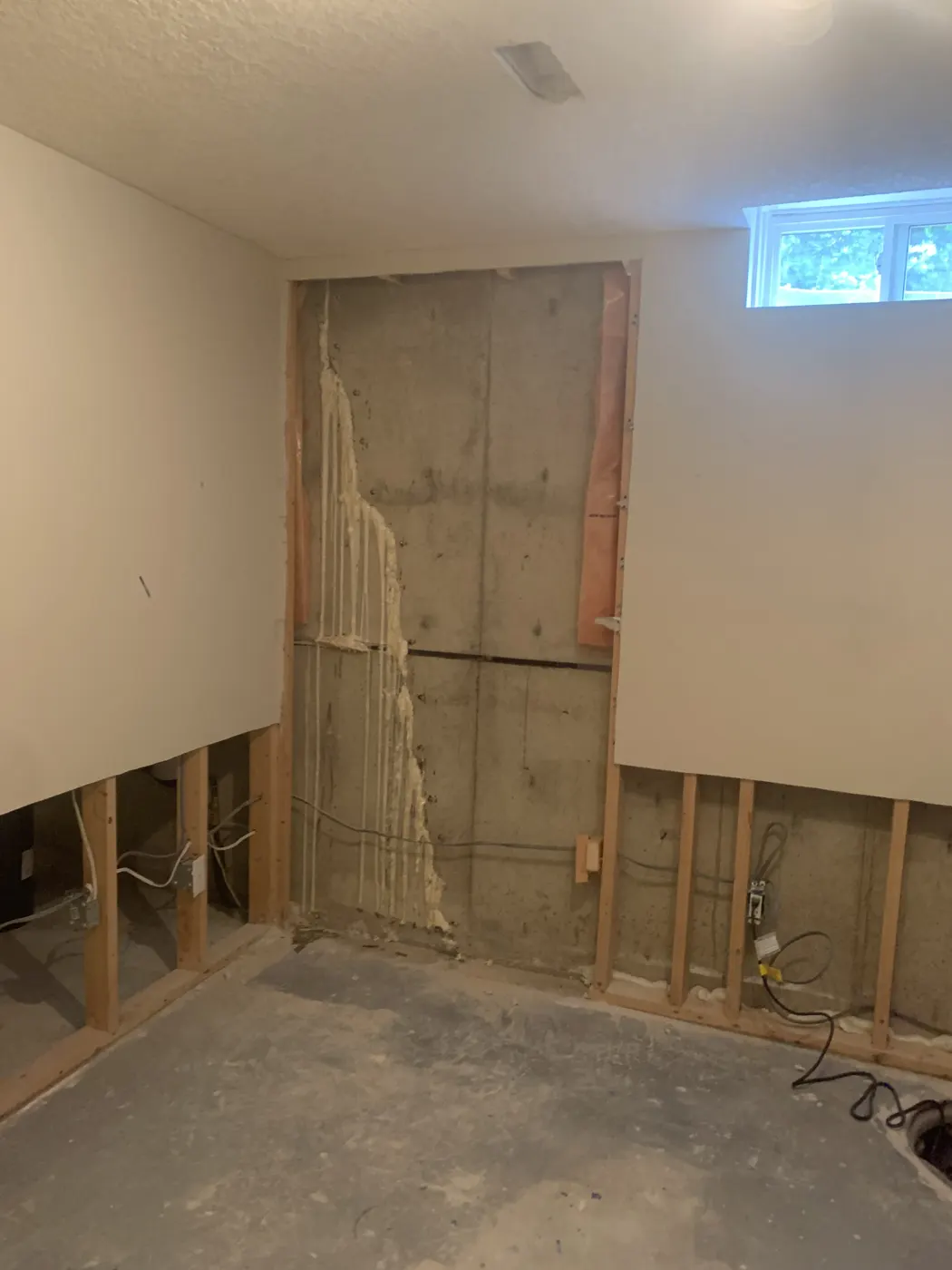
Finished and dressed back. Ports removed and surface seal dressed. We check the repair against the next significant rainfall rather than calling it done on the day.
If you are reading this because a garage line item appeared in a reserve fund study, the useful framing is slightly different.
Ontario condominium corporations are required under the Condominium Act, 1998 and O. Reg. 48/01 to maintain a reserve fund for major repairs and replacement of common elements, and to have reserve fund studies prepared on a recurring cycle by a qualified person. Holders of a certificate of authorization under the Professional Engineers Act are among those qualified to prepare one, and the study must include a physical component inventory alongside a financial projection running at least thirty years.
For a corporation with structured parking, the garage is typically among the largest components in that study. We would like to tell you it is the largest — that claim is repeated constantly in this industry — but we could not find a published Ontario dataset supporting it, so we are not going to state it as fact.
Statutory references are summarised for orientation only. Section numbers and any dollar thresholds under the Condominium Act, 1998 and O. Reg. 48/01 change, and this is not legal advice. Confirm the current text with your corporation’s solicitor or your reserve fund planner before relying on it for a decision.
We looked for a credible Canadian dataset on parking garage repair pricing so we could give you a range with a source behind it. There isn’t one. What exists online is contractor marketing quoting self-reported numbers with no methodology, and reproducing those would just add another layer to the pile.
So instead, here is what actually determines the number on a commercial quote:
On service life: you will see competitor pages promising ten to twenty years from an injection. We could find no basis for that figure and will not repeat it. What governs how long a repair lasts is whether the cause was corrected — which is the same thing ACI says, in more careful language, in §3.2.
We quote after a site visit, in writing, with the scope and the findings both stated. If the honest recommendation is a condition assessment before any repair, that is what the document will say.
The questions property managers, boards and engineers actually ask us, answered with the sources where sources exist and without them where they do not.
Yes, where the crack is a discrete path passing water and the cause of the cracking has been established and corrected. ASTM D8109-25 is the published guide for sealing leaks at cracks in concrete walls and slabs using chemical grout. Injection is the wrong repair where the real problem is delamination, spalling, active corrosion, an expansion joint, or cracking that is a symptom of structural distress. All of those are common in chloride-loaded Ontario parking structures, which is why the diagnosis matters more than the price.
No, and this is the most important misconception about the work. Injection seals the water and chloride path through the crack. It does not remove chloride already present in the concrete, does not passivate steel that has begun to corrode, does not repair delamination or spalling, and does not stop an active corrosion cell. Injection has genuine value as prevention before chloride reaches the steel, and as one element within a larger restoration. As a standalone repair on a deck that is already delaminating, it treats a symptom.
Yes. CSA S448.1:10 (R2025), Repair of reinforced concrete in buildings and parking structures. Note the edition carefully: it is a 2010 standard reaffirmed in 2025, not a 2025 standard, and anyone citing it as CSA S448.1-2025 has not checked. Clause 1.1 states it specifies requirements for the repair of reinforced structural concrete components of buildings and parking structures. Its companion for new construction, CSA S413:21, states at clause 1.3 that it does not cover the repair of existing parking structures.
No. Clause 1.2 states the standard does not cover repairs to pre-stressed, including post-tensioned, components and structures, or to non-structural slabs-on-grade. Because CSA S413:21 separately excludes repair of existing structures, the result is that no CSA standard governs the repair of a post-tensioned parking structure in Canada. That work falls to project-specific engineering. Professional Engineers Ontario, in its guideline on structural condition assessments of existing buildings, references PTI DC80.3 for the evaluation and repair of unbonded post-tensioned structures.
There is no blanket Ontario rule that every garage repair requires an engineer, and we are not going to claim there is. Three things are true, though. The design of structural repair falls within the practice of professional engineering under the Professional Engineers Act. A reserve fund study must be prepared by a qualified person, and a holder of a certificate of authorization under that Act is one of them. And a post-tensioned structure sits outside CSA S448.1 altogether. In practice those three points mean most condominium garage repair programmes involve an engineer, and should.
De-icing salt, principally. Vehicles carry chloride-laden slush into the structure through an entire Southern Ontario winter, where it soaks into the concrete and reaches the reinforcement, and cracks provide a direct route past the concrete cover. Professional Engineers Ontario states it plainly: parking structures and other structures exposed to vehicular traffic present a particular concern due to their exposure to the elements, de-icing salts and dynamic loads of vehicles. Freeze-thaw cycling compounds it, and Southern Ontario has a great many cycles per year.
It can be, but it is a different problem from a below-grade wall and should be treated as one. ASTM D8109 is framed around below-grade walls and slabs, and it cautions that above-grade elements experience temperature-driven movement on a daily and seasonal basis. A suspended parking deck also deflects under live load. Both point the same way: a rigid bond is usually the wrong answer on a suspended deck, and the material needs to tolerate movement rather than resist it.
A crack is an unplanned separation. An expansion joint, in ACI terminology, is a separation provided between adjacent sections to allow movement due to dimensional increases and reductions of the adjacent sections, and through which some or all of the bonded reinforcement is interrupted. The distinction is not cosmetic. A joint is designed to move, so filling it with rigid injection resin works against the structure rather than with it. Joints need joint sealant systems. Cracks may need injection. Treating one as the other is a common and expensive error.
After it, or as a planned part of it, and rarely before. Injecting cracks ahead of concrete removal, membrane replacement or chloride management is frequently work that ends up being done twice. If a larger restoration falls within your reserve fund horizon, the injection scope is better planned inside that project than spent separately a year or two earlier. Where an active leak is causing damage in the meantime, an interim measure can make sense, but it should be understood and budgeted as interim.
That is a question for your reserve fund planner and your corporation’s solicitor rather than for a contractor. Broadly, an Ontario condominium corporation maintains a reserve fund for major repair and replacement of common elements, and for a corporation with structured parking the garage is typically among the largest components in a reserve fund study. Whether a particular injection scope is a reserve fund item or an operating expense depends on how it is characterised in your study and on your corporation’s own practice.
Yes. We carry commercial general liability insurance and can provide a WSIB clearance certificate before site access. Property managers generally ask for both before a crew is allowed on site, so we would rather have them in your hands at quoting stage than on the morning of the work.
We scan and locate before drilling in any slab we cannot positively identify as conventionally reinforced. We want to be straight about the status of that practice: it is ours, not a code requirement. We went looking for a standard, code or regulation mandating tendon location before drilling into post-tensioned concrete and could not find one, and we are not going to cite a rule that does not exist. We do it regardless because severing a tendon is a hazard at the moment of the cut and a loss of flexural capacity in the slab afterwards.
Live Google reviews for Concrete Crack Repair Pros, pulled straight from our own Google Business Profile.
The chemical grout used for water. What it does in the void, and why it is the material ASTM D8109 is written around.
Where a rigid structural bond is the right answer — a dry element, a dormant crack, a corrected cause — and where it is not.
The unbonded interface between two concrete placements. Common in below-grade walls and in the footing-to-wall joint.
The same theme in a residential setting: a technically sound repair applied to a misdiagnosed cause has a return date.
How the process works, what it can and cannot do, and how the two resin families differ.
Written findings and scope for commercial and multi-residential structures across the GTA.
ACI, ASTM and PTI documents are US voluntary consensus publications and are not law in Ontario. CSA standards are Canadian. Nothing on this page is engineering advice or legal advice, and none of it substitutes for a structural condition assessment by a professional engineer where one is warranted.
Site assessment and written findings for parking structures, condominium and multi-residential buildings across Toronto, the GTA and Southern Ontario — including an honest answer when the right next step is an engineer rather than a contractor.