Wondering about the bigger picture? Here’s how much foundation crack repair costs.
Home › Service Areas › East Gwillimbury
The fastest-growing municipality in Canada between 2016 and 2021, built mostly on Schomberg clay plain with wet subsoils under Holland Landing. If your home is newer than seven years, read the Tarion section before you pay anyone. If it is not: flat pricing from $750, one visit, and a lifetime transferable warranty.
East Gwillimbury has more new foundations per capita than almost anywhere in Ontario, and that changes the first question we ask you.
Foundation crack repair in East Gwillimbury costs a flat $750–$1,000 per crack for polyurethane injection and $850–$1,500 for structural epoxy, with every additional crack 5% off. Before you book anything, check the age of your home: Ontario’s Tarion warranty covers water penetration through the basement foundation for two years and major structural defects for seven, and East Gwillimbury’s dwelling count grew 41.7% between 2016 and 2021 — so a great many Queensville, Sharon and Holland Landing homes are still inside that window. On permits, the Town lists “Damp-proofing repairs to foundation walls where plumbing, shoring, and underpinning are not required to complete the work” among its building permit exemptions. There is no Town or York Region subsidy for this work.
From the Town’s own planning studies and the geotechnical reports filed with its development applications.
The Town’s Agricultural Impact Assessment for the East Gwillimbury Secondary Plan places the lands in two physiographic regions: the Schomberg Clay Plains and the Simcoe Lowlands. It describes the Schomberg Clay Plain as “a topographic basin which contains deep deposits of stratified clay and silt,” underlain by a drumlinized till plain, in an area once flooded by glacial Lake Algonquin. Crucially for foundations, the same study records that near Holland Landing the soils are sandy with wet subsoils, while near Queensville they are silty and highly calcareous. Those are two different problems in one town.
The mapped soil series bear that out. Across the secondary-plan lands the dominant series are Bondhead sandy loam at 26.43% and Bondhead loam at 24.64%, followed by Schomberg clay loam at 14.20%, Brighton sandy loam at 9.89%, Schomberg silt loam at 6.97% and Simcoe silt loam at 5.50%, with bottom land at 4.56%, Percy fine sandy loam at 4.14% and muck at 1.03%. Stratified clay and silt expand and contract with moisture; the sandy loams drain quickly but deliver water to whatever opening they find. A wall sitting at the boundary between the two gets loaded unevenly, and uneven loading is what turns a shrinkage crack into a moving one.
A 2024 geotechnical assessment for a Holland Landing site at Highway 11 and Crimson King Way, filed with the Town, gives the clearest measured picture we could verify. Across eight boreholes the sequence was 0.25 to 0.46 metres of topsoil, then silt or fine sand, then silty clay ranging from firm to very stiff or hard, with silty clay till containing cobbles and boulders encountered between 3.0 and 4.0 metres in one hole. Groundwater on completion of drilling ranged from 2.1 to 4.3 metres below ground surface, with one borehole dry. The report sets allowable bearing at 75 kPa under service conditions and 120 kPa factored, with settlement held within 25 mm total and 20 mm differential, and specifies that foundations exposed to weathering or in unheated areas require at least 1.6 metres of earth cover against frost action. That 1.6 m figure is from that one site investigation, not a Town-wide standard — we quote it because it is a real measured requirement nearby, not because it applies to your lot automatically.
At the eastern end of the town, a 2025 stormwater and hydrogeology report for 1402–1410 Mount Albert Road places that site in the Schomberg Clay Plains as well, with surficial deposits of fine-textured glaciolacustrine silt and clay over Newmarket Till sandy silt to silty sand, and states plainly that the site is not within the Oak Ridges Moraine Conservation Plan. Its monitoring wells read 1.36 metres below grade in one location and 6.34 metres in another, with four nearby domestic wells showing static water levels of 3.7 to 7.0 metres in a blue clay to sandy clay unit. So Mount Albert is not the free-draining moraine sand people often assume it is.
On bedrock we will say what the record says: none of the boreholes we could verify reached it. The Holland Landing investigation terminated at roughly 5 metres without encountering rock, and we found no published report giving a depth to bedrock or a formation name anywhere in East Gwillimbury. We have left that figure off this page rather than borrow one from a neighbouring town. Municipal water here comes from six groundwater wells — two in Holland Landing and four in Queensville — drawing on the Yonge Street Aquifer, which tells you the groundwater system beneath the town is productive and shallow enough to pump.
Two materials, two jobs. On a house this new, the diagnosis matters more than the price.
We inject from the inside, so nothing is excavated and your new landscaping stays where it is. A live, leaking, non-structural crack gets polyurethane injection — a flexible foam that fills the full depth of the crack and keeps sealing as the wall moves with the clay. A crack that has displaced the wall, or that is visibly wider at one end, gets structural epoxy, which welds the concrete back into one piece. On houses built in the last decade the most common thing we see is not structural at all: it is a cold joint that never bonded, or a vertical shrinkage crack from the concrete curing, often appearing in the first two or three winters. We also seal tie rod holes at $75–$150 each, treat honeycombing, and repair basement floor, slab and garage floor cracks. Older block walls in the Holland Landing, Mount Albert and Queensville village cores take a different port pattern than poured walls. And if what you have is a drainage failure rather than a cracked wall, we will say so — patching and injection are not interchangeable.
One visit, inside the basement, no excavation and no landscaping touched.
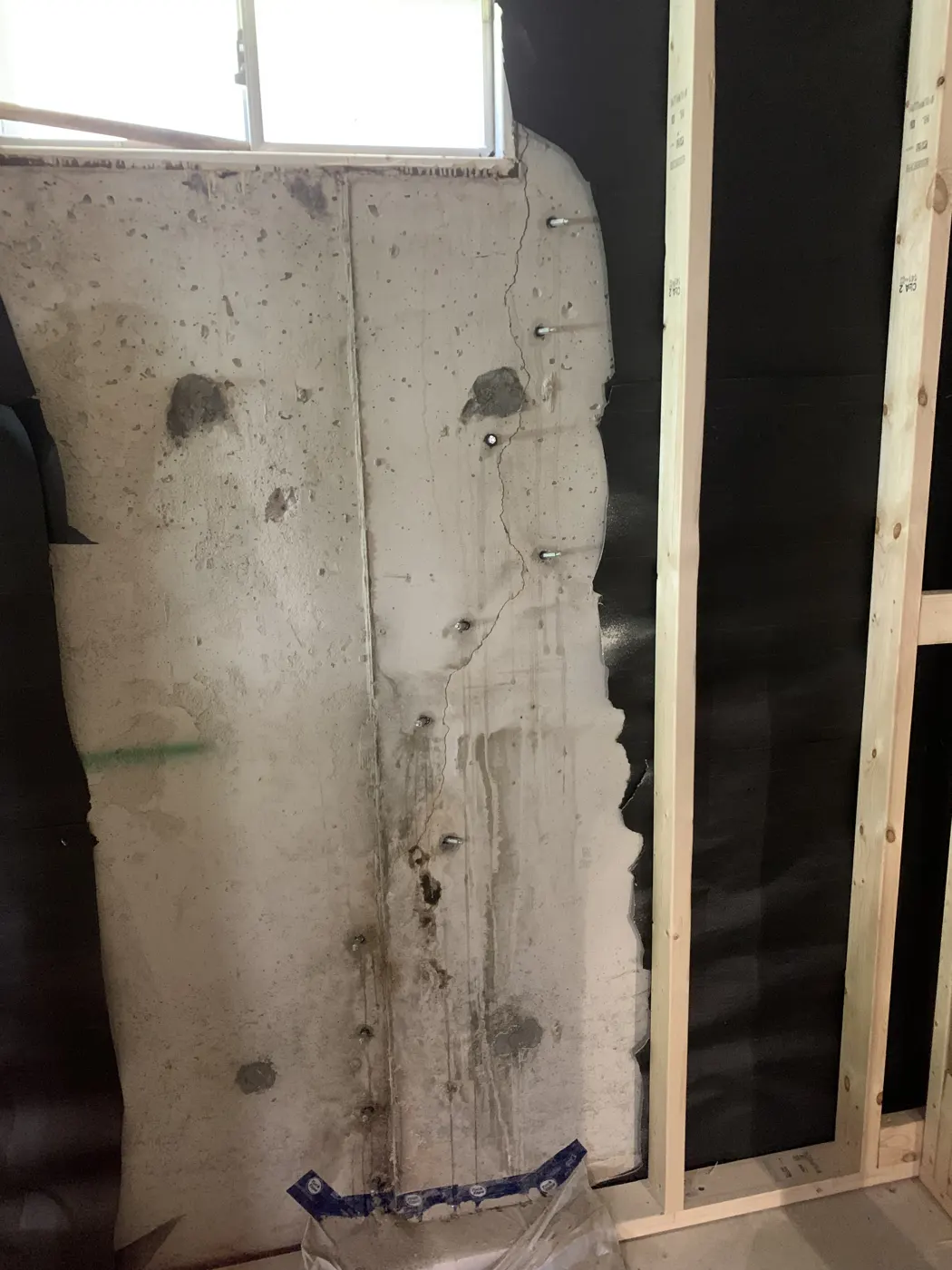 A row of metal injection ports set along the crack
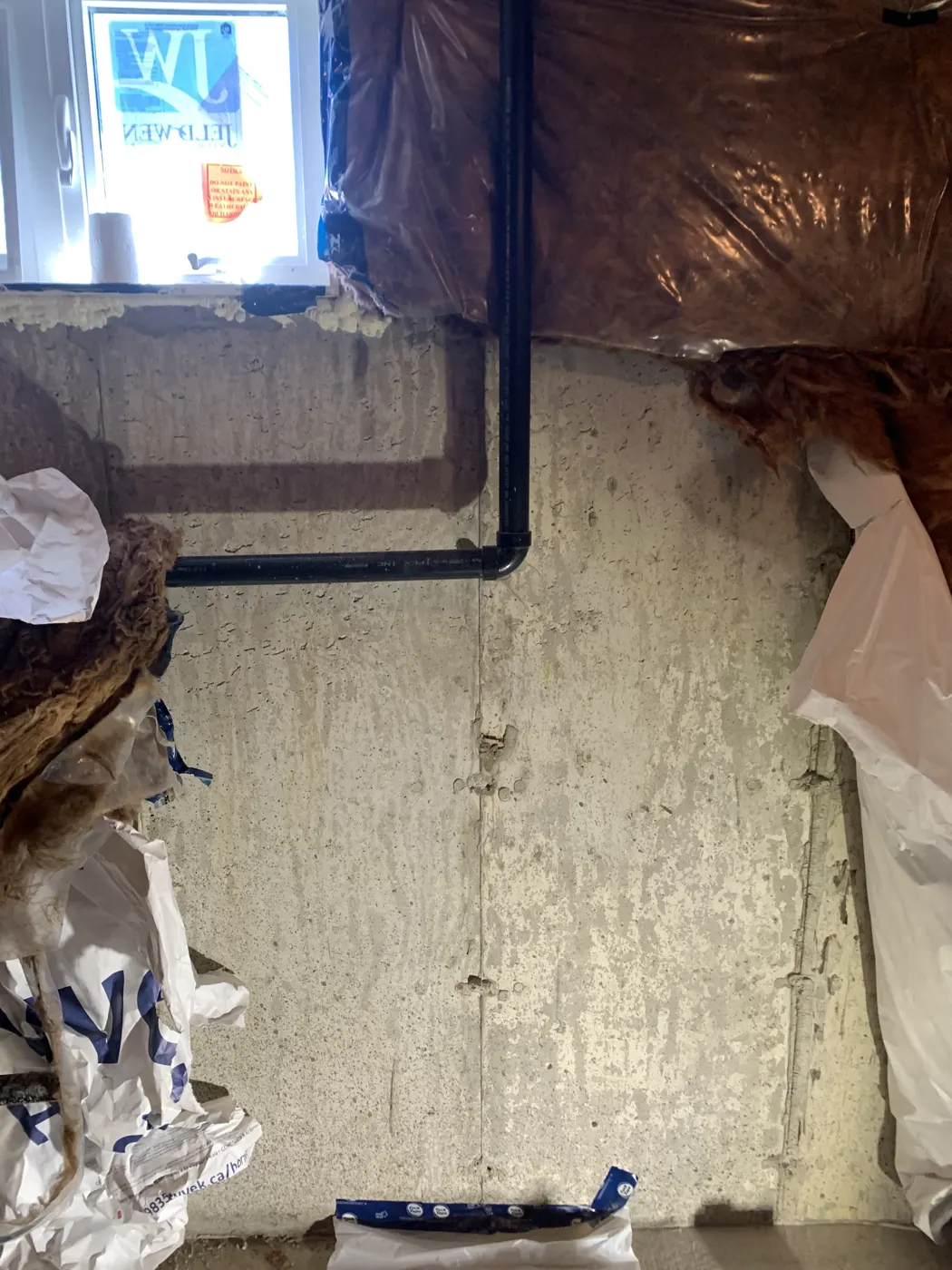 Moisture staining along a cold joint before injection
The sequence does not change. We clean the crack face, set ports along its length at measured spacing, and cap the surface between them so the resin can only go into the wall. Injection starts at the lowest port and works upward, displacing water and air ahead of it rather than trapping them, and we wait for resin to appear at the next port up before moving on — that is how we know the crack is full rather than merely covered. On a wet clay-plain wall the polyurethane is water-activated, so it expands against exactly the moisture that is causing your problem. Caps come off once cured, ports are trimmed, and most single-crack jobs are finished in a couple of hours with the basement usable the same day. On a finished basement we will need the wall opened at the crack, and we quote that at assessment.
The useful news is in the next section instead — Tarion, not a rebate.
| Programme | Who runs it | Does it cover crack repair? |
|---|---|---|
| Homeowner basement-flooding, backwater-valve or waterproofing subsidy | Town of East Gwillimbury | No such programme exists. The Town’s rebate and incentive page lists only tax deferrals for seniors and low-income residents, Municipal Act tax cancellations and reductions, and farm, forest, conservation-land and charity rebates. |
| Backwater valve subsidy | York Region | Not offered in East Gwillimbury. The only backwater valve subsidy named on York Region’s inflow-and-infiltration page is the City of Richmond Hill’s. |
| Water incentive programmes | York Region | Industrial, commercial and institutional customers only. Backwater valves and basement waterproofing are not eligible items. |
| Sewage System Maintenance Inspection Program | Town of East Gwillimbury Building Branch | Not a subsidy — an obligation. The Province requires septic inspections every five years for properties near Lake Simcoe, nearby watercourses in its watershed, or a York Region drinking water well. The cost is the owner’s. |
| Tarion new-home warranty | Tarion Warranty Corporation | Often yes — water penetration through the basement foundation is covered for two years and major structural defects for seven. This is the one route to someone else paying, and it is the one most East Gwillimbury homeowners have. |
| Bottom line | There is no municipal or regional money for crack injection here. Check Tarion before you check your wallet — and if you are outside the warranty, our written quote is the number you pay. | |
York Region does publish free advice rather than funding, and it is sound: disconnect and redirect downspouts so water flows to your yard at least 2 metres away from your home, and — in the Region’s own words — “Fix cracks in your foundation and plumbing to prevent water from seeping in.” That is the entire extent of York Region’s involvement in your basement. Toronto, Peel and Halton run genuine basement-flooding subsidy programmes and we are an eligible contractor under them, but they fund plumbing and drainage measures, not the crack, and none of them reach East Gwillimbury.
East Gwillimbury’s dwelling stock grew 41.7% between 2016 and 2021, the highest rate in York Region. On this page, that is the most valuable paragraph.
If your Queensville, Sharon or Holland Landing home was built in the last seven years, a leaking or cracked foundation is a warranty question before it is a repair bill. Ontario’s new-home warranty, administered by Tarion, specifically names water penetration through the basement foundation in the two-year warranty, and covers major structural defects for up to seven years. Submit the claim to your builder and Tarion first. Paying a contractor to fix it yourself can complicate the claim, which is why we would rather tell you this before quoting than after invoicing.
| Warranty period | What it covers | Relevance to a foundation crack |
|---|---|---|
| Year 1 | Defects in workmanship or materials throughout the home, including violations of the Ontario Building Code and unauthorised substitutions | A crack caused by a poor pour, bad consolidation or a missed cold joint sits here |
| Year 2 | Major systems — plumbing, heating, air and electrical — plus Code violations affecting health and safety, cladding defects, and water penetration through the basement foundation | The clause that matters most. A leaking basement crack is named coverage, not an argument |
| Year 7 | Major structural defects: something that seriously threatens the structural integrity of the home, or affects the use of a significant portion of it | Displaced, widening or stair-stepped cracks belong here |
| What to do | Claim with the builder and Tarion first. We will give you a free written assessment describing exactly what we see in the wall, which you are welcome to hand to the builder — and if the claim is refused or the home is out of warranty, the injection quote stands. | |
Four questions, instant range — polyurethane or epoxy, multi-crack discount included, no obligation.
This is one of the clearer municipalities in York Region on permits, and the wording is worth reading.
Under the heading “Projects with Building Permit Exemptions,” the Town of East Gwillimbury lists “Damp-proofing repairs to foundation walls where plumbing, shoring, and underpinning are not required to complete the work.” That is the Town’s wording, quoted exactly. Interior crack injection is normally damp-proofing repair work needing no plumbing, no shoring and no underpinning — but the Town does not use the words “crack injection,” so describe your specific job to the Building Branch on 905-478-4282 and have them confirm it rather than relying on our reading of their list. The Town also notes, in its own words, that “Although a building permit may not be required, you must still comply with the requirements of the Zoning By-law and any other Applicable Laws.”
What definitely does need a permit, from the Town’s own lists: “Excavating to construct a basement, crawl space, or footing under an existing building,” “Basement walkouts or finished basements,” “Creation of a second dwelling unit in a house,” “Renovations or repairs having structural components such as removing or building walls,” new or repaired septic systems, and additions of any size. So if the crack repair is step one of finishing the basement, you are in permit territory for the finishing work regardless. The Town does not publish its own review timeline, stating instead that you will receive a response within the timeframe stipulated by the Province — Ontario’s guidance sets a 10-day timeframe for a house. Once a permit is issued, work must commence within six months, and the Town attends inspections within 48 hours excluding weekends and holidays.
Our part is simple. Call (800) 371-5302 or request a free assessment, we attend, we diagnose the wall, and you get an exact per-crack price in writing before anything starts. The Civic Centre is at 19000 Leslie Street in Sharon if you want to ask in person; they are open weekdays 8:30 a.m. to 4:30 p.m.
The honest list of what makes one wall cost more than another.
Crack length and wall thickness set the baseline, because both decide how much resin the wall takes. Material is next: polyurethane at $750–$1,000 per crack for a live leak, structural epoxy at $850–$1,500 where the wall has actually moved. Count works in your favour — every additional crack is 5% off. Access is the big local variable, and it cuts a particular way here: East Gwillimbury’s newer homes often have finished or partly finished basements already, and drywall across the crack has to be opened, which is quoted at assessment rather than guessed at. Older village stock in Holland Landing, Mount Albert and Queensville is more likely to be block rather than poured, which takes a different port pattern and prices differently. Tie rod holes are $75–$150 each. HST is extra. Nothing is hourly — the written quote is the price. And if you are inside the Tarion window, the most expensive mistake is paying us at all before you have made the claim.
Five communities and three hamlets, from the Holland River to Brown Hill.
The Town’s Official Plan names its communities as Holland Landing, River Drive Park, Sharon, Queensville and Mount Albert, and we work in all five. Holland Landing, Sharon, Queensville and Green Lane West together make up what the Town calls its Central Growth Area — the serviced part of the municipality, and where most of the new foundations are. Mount Albert is a Greenbelt settlement area served locally rather than by the Central Growth Area trunk infrastructure.
Beyond those, York Region’s Official Plan recognises the hamlets of Ravenshoe, Holt and Brown Hill, where development depends on private on-site water and waste systems. The Town is explicit that the rural areas will not be provided with municipal services and will remain on private systems, so if you are outside the Central Growth Area or Mount Albert, assume well and septic — which matters for the five-year septic inspection obligation, though not for the injection itself.
The Town puts its area at 238 square kilometres. Neighbouring municipalities we also cover include Newmarket, Aurora and King.
Holland Landing, Sharon, Queensville, Mount Albert, River Drive Park and the rural hamlets.
East Gwillimbury runs from the Holland River and the edge of the Holland Marsh in the west across to Mount Albert and Brown Hill in the east. We travel all of it rather than asking you to come to us, and assessments are free wherever you are in the Town.
Six reasons, all of them checkable.
A quarter-century of GTA and Southern Ontario basements kept dry.
Injection repairs warrantied for life — and the warranty moves with the house when you sell.
Full commercial coverage on every job, every crew, every home.
If your home is inside the warranty window we will tell you to claim before you hire us. We would rather lose the job than take money you should not be spending.
Inspection, honest diagnosis, and an exact per-crack quote — free, no pressure, and usable as evidence for a builder claim.
Your price is confirmed in writing before any work starts — no hourly surprises.
Every review below is a real, verifiable Google review of Concrete Crack Repair Pros. Nothing is paraphrased, and nothing is borrowed from a sister company.
Are these reviews genuine? Every review shown above is pulled live from the Concrete Crack Repair Pros Google Business Profile at 64 Millwick Dr, North York — not from a parent or sister brand’s listing. The rating and the count update automatically as new reviews arrive, so what you see here is what is on Google right now.
The same name, address and phone number we publish everywhere, so you can check us before you call.
The Town lists “Damp-proofing repairs to foundation walls where plumbing, shoring, and underpinning are not required to complete the work” under its Projects with Building Permit Exemptions. Interior crack injection normally fits that description, but the Town does not use the phrase “crack injection,” so call the Building Branch on 905-478-4282 and describe your job to have it confirmed. A permit is definitely required for excavating to construct a basement, crawl space or footing under an existing building, for basement walkouts or finished basements, for a second dwelling unit, and for structural renovations.
The builder, and Tarion, first. Ontario’s new-home warranty covers water penetration through the basement foundation for two years and major structural defects for seven. At three years you are outside the water-penetration window but inside the structural one, so the answer depends on what the crack is doing. Book our free written assessment, use it to describe the defect to your builder, and if the claim is refused we will inject it.
No. The Town’s rebate and incentive page lists only tax deferrals and reductions — nothing for flooding, basements or foundations. York Region’s inflow-and-infiltration page names a backwater valve subsidy only for the City of Richmond Hill, and York Region’s water incentive programmes are for industrial, commercial and institutional customers and exclude basement waterproofing. Toronto, Peel and Halton run real programmes, but none of them apply here.
Most often because the concrete shrank as it cured, or because a pour was interrupted and the cold joint between lifts never fully bonded. Neither means the house is failing, and both are injectable. The local ground does not help: the Town’s own planning study places Queensville on silty, highly calcareous soils within the Schomberg Clay Plains, and stratified clay and silt load a wall unevenly as moisture changes. New-build cracks typically show up in the first two or three winters, which is exactly when Tarion coverage still applies.
Not harder, but it changes the material choice. The Town’s planning study records sandy soils with wet subsoils near Holland Landing, and the 2024 geotechnical report filed for a Holland Landing site measured groundwater at 2.1 to 4.3 metres below grade in firm to very stiff silty clay. Water sitting that close to a wall favours polyurethane, which is water-activated and expands against the moisture rather than being defeated by it. A dry structural crack in the same soil would still get epoxy.
A flat $750 to $1,000 per crack for polyurethane injection on a live, leaking, non-structural crack, and $850 to $1,500 per crack for structural epoxy where the wall has moved. Every additional crack is 5% off. Tie rod holes are $75 to $150 each. HST is extra, and opening a finished basement wall to reach the crack is quoted at assessment. For comparison, exterior excavation and membrane work runs $5,000 to $20,000 or more on a typical home.
Four pages worth reading before you spend money on a wall.
Free written assessment, an exact per-crack price before anything starts, and a lifetime transferable warranty on the repair. Holland Landing, Sharon, Queensville, Mount Albert and River Drive Park — and if you are still under Tarion, we will tell you that first.