
Wondering about the bigger picture? Here’s how much foundation crack repair costs.
Home › Service Areas › Georgina
A water table the Town itself describes as within a metre and a half of the surface, a lake that runs above its average high-water mark some springs, and a lot of walls poured before 1980. When the crack shows up: flat pricing from $750, one visit, and a lifetime transferable warranty — plus the straight answer on York Region subsidies, which is that there aren’t any.
Georgina is a shoreline town with a shallow water table, and that combination decides what happens to a cracked foundation wall here.
Foundation crack repair in Georgina costs a flat $750–$1,000 per crack for polyurethane injection and $850–$1,500 for structural epoxy, with every additional crack 5% off. Unlike Toronto, Peel or Halton, neither the Town of Georgina nor York Region runs a homeowner basement-flooding, backwater-valve or waterproofing subsidy — there is no rebate to claim here. Note also that Georgina’s published permit list names damp-proofing foundation walls and weeping tile as permit work, so confirm your job with the Building Division before anyone starts. The wall itself is our job: injected from the inside in one visit and warrantied for life.
The Town’s own studies and the geotechnical work filed with it, rather than generic Ontario soil talk.
Georgina sits in the Simcoe lowlands on the south shore of Lake Simcoe, and the Town is explicit that the Oak Ridges Moraine does not extend inside its boundaries — so the sandy, free-draining moraine conditions that help basements in King or Aurora are not what you have here. The Town’s Pefferlaw Secondary Plan background report describes glaciation leaving overburden materials “of a depth of 9 – 15 metres consisting of gravel and sand lenses as well as clay and clay tills,” resting on limestone of the Trenton–Black River Group. The same report puts the water table as “generally being located within 1.5 metres of the ground surface,” with shallow groundwater following the surface topography in a general northward flow toward Lake Simcoe.
Measured numbers back that up. A 2022 subsurface investigation at 219 Pefferlaw Road, filed with the Town, logged topsoil over fill, then brown moist sand, buried topsoil horizons and a grey silty sand to clayey silt, with grey shale bedrock encountered at 3.96, 4.57 and 6.01 metres below grade. Groundwater in those boreholes ranged from 1.67 to 4.51 metres below ground surface on 6 April 2022. Out on Georgina Island, the Lake Simcoe Region Conservation Authority’s subwatershed plan records overburden varying from 1 m to 25 m over flat-lying Ordovician limestone, dolostone, shale, arkose and sandstone.
The soils mapped across the town are a mixed bag rather than one uniform clay: Simcoe clay loam, a poorly drained lacustrine clay, alongside Otonabee sandy loam and Emily loam formed on limestone till, Brighton, Ioga, Tecumseth, Rubicon and Granby sandy loams on sandy outwash, and muck in the organic pockets. For a foundation wall that distinction matters. Poorly drained Simcoe clay holds water against the wall and loads it; the sandy loams drain freely but transmit water fast to any opening they meet. Either way a shrinkage crack or a cold joint that stays dry in August will run in April, because the water table is close enough to the slab that seasonal rise does most of the work.
We should be straight about the limits of the published record. Every measured figure above is from Pefferlaw or the Lake Simcoe islands — there is no publicly filed borehole log or geotechnical report for Keswick or Sutton that we could verify, so we have not extrapolated those numbers to the two largest communities in town. If your wall is in Keswick or Sutton, the assessment is done on your wall, not on a map.
One more Georgina-specific pressure: lake level. On 8 April 2025 the Town published an LSRCA shoreline hazard warning recording Lake Simcoe at 219.26 m, approximately 11 centimetres higher than the average annual high-water level, with a significant risk of flooding in low-lying areas adjacent to the lake and a high risk of dike failures in the Keswick, Kolbar and Bradford polders. The Town’s own flooding guidance is worth repeating in full, because it is unusually blunt: “Do not place sandbags directly against structures with weak or aging foundations.”
Two materials, two jobs. Which one your wall gets is a diagnosis, not a sales choice.
We inject from the inside, so nothing is excavated and nothing in your yard is disturbed. A live, leaking, non-structural crack — the common case on a Georgina poured wall with a high water table behind it — gets polyurethane injection, a flexible foam that expands into the full depth of the crack and keeps sealing as the wall moves seasonally. A crack that has actually changed the wall, where the two faces have displaced or the crack is wider at one end, gets structural epoxy, which welds the concrete back into one piece and is stronger than the surrounding slab once cured. We also seal tie rod holes at $75–$150 each and cold joints, treat honeycombing, and handle basement floor, slab and garage floor cracks. Block foundations, common in Georgina’s older village and lakeshore stock, are handled too, with a different port pattern than poured walls. If what you actually have is a failed drainage system rather than a cracked wall, we will tell you that instead of injecting it — patching and injection are not interchangeable, and neither is a substitute for weeping tile that has collapsed.
One visit, inside the basement, no excavation and no landscaping touched.
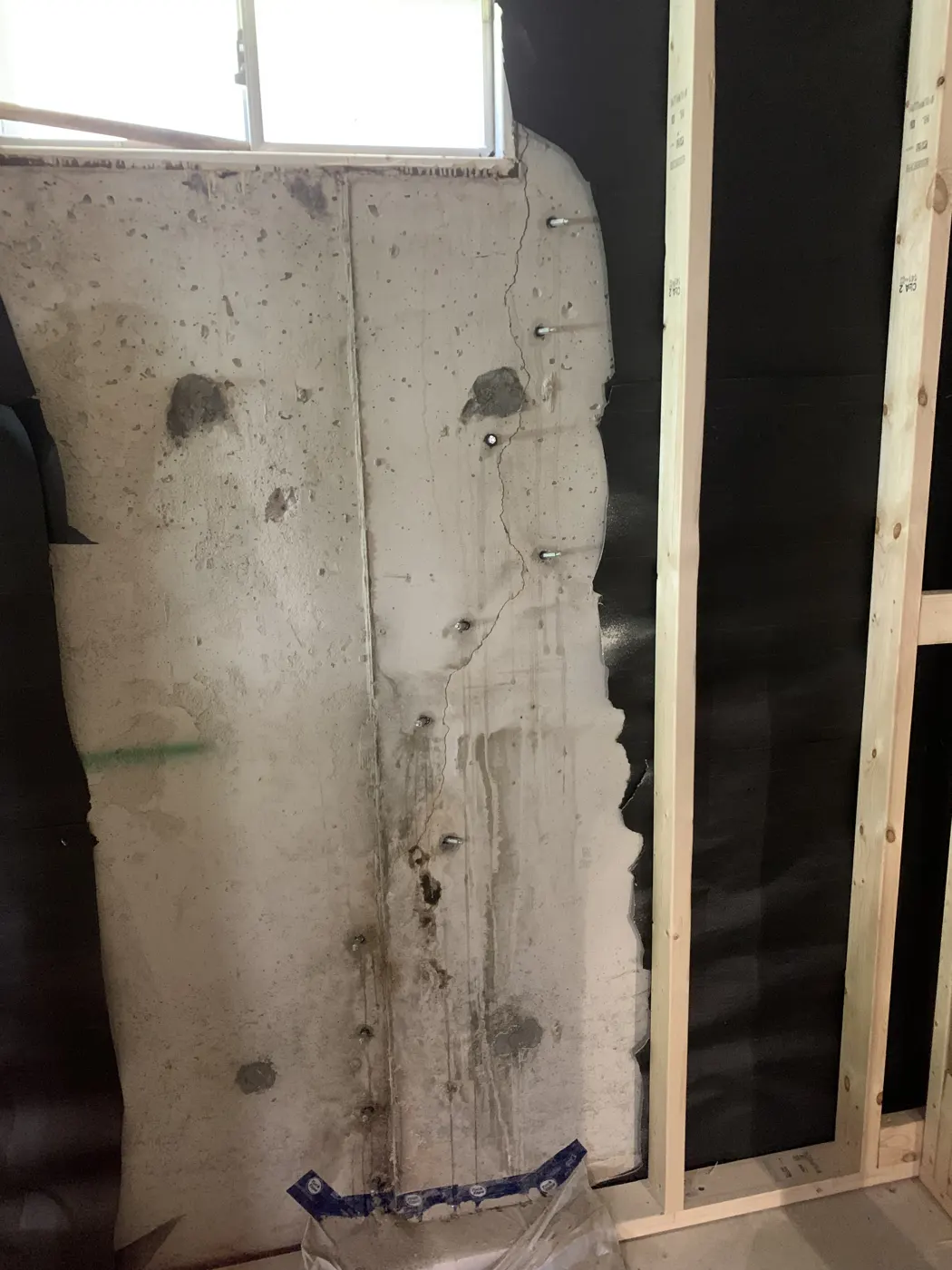 A row of metal injection ports set along the crack
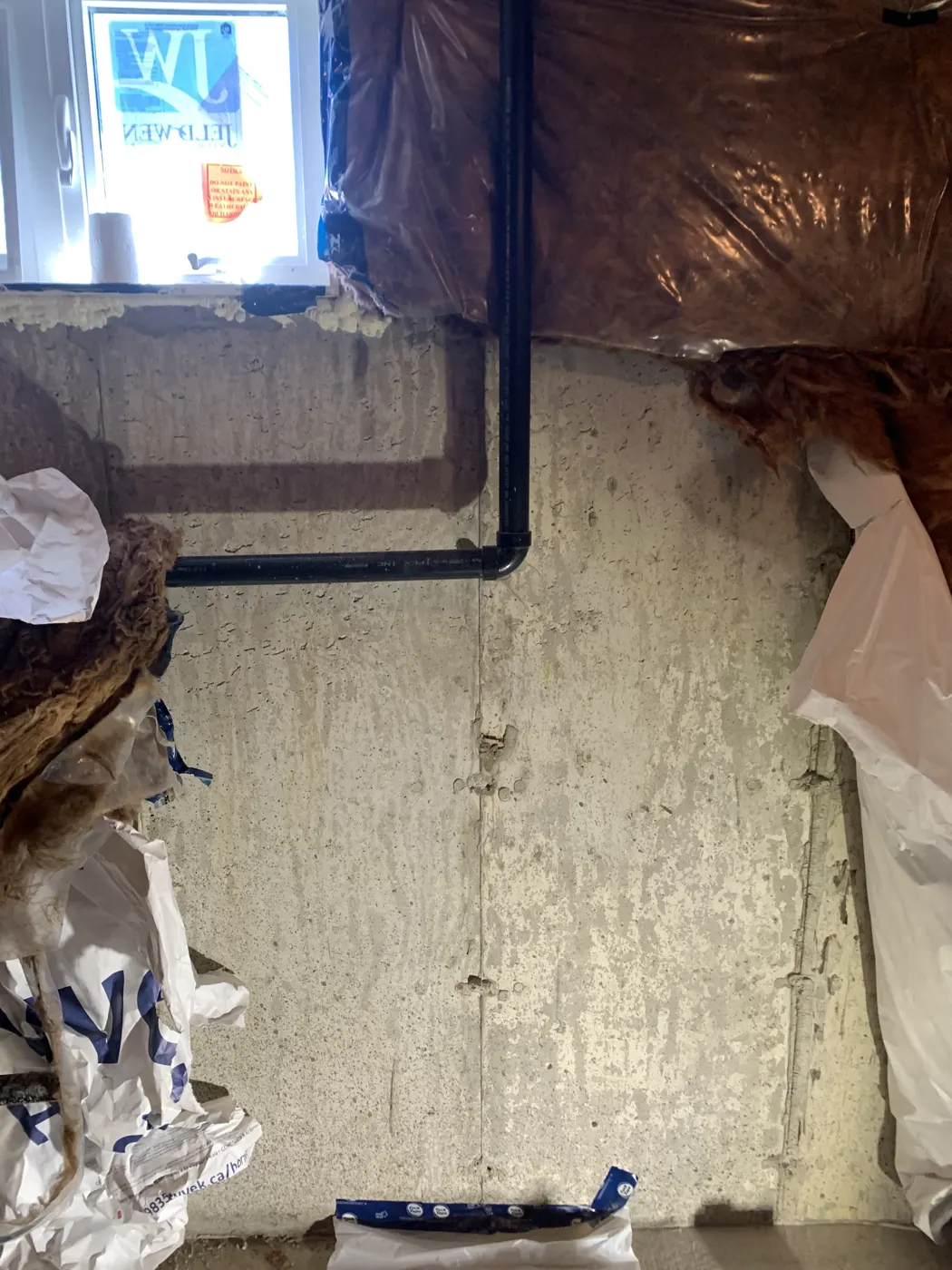 Moisture staining along a cold joint before injection
The sequence is the same on every wall. We clean the crack face, set ports along its length at measured spacing, and cap the surface between them so the resin has nowhere to go but into the wall. Injection starts at the lowest port and works upward, so the resin displaces water and air ahead of it instead of trapping them. We watch for resin at the next port up before moving, which is how we know the crack is full rather than merely capped. On a wet Georgina wall with groundwater standing close behind it, polyurethane is actually easier to place than on a dry wall — the foam is water-activated and expands against the moisture it meets. Once cured, the surface caps come off and the ports are trimmed. Most single-crack jobs are done inside a couple of hours, and the basement is usable the same day.
We would rather say this plainly than let you find out after the invoice.
| Programme | Who runs it | Does it cover crack repair? |
|---|---|---|
| Homeowner basement-flooding, backwater-valve or waterproofing subsidy | Town of Georgina | No such programme exists. The Town’s grants page lists only a non-profit grant, development-fee rebates, downtown CIP grants, the Explore Georgina tourism grant and a community initiatives fund. |
| Backwater valve subsidy | York Region | Not offered in Georgina. The only backwater valve subsidy named on York Region’s inflow-and-infiltration page is the City of Richmond Hill’s. |
| Water incentive programmes | York Region | Industrial, commercial and institutional customers only. Backwater valves, foundation drains and basement waterproofing are not eligible items. |
| Stormwater rate | Town of Georgina | This is a charge, not a rebate — the residential rate is 0.036097%. Nothing flows back to homeowners for repairs. |
| Sewer lateral repair between the property line and the house | Property owner | Owner’s cost in full. The Town states the property owner is responsible for clearing all blockages that occur within the sewer lateral. |
| Bottom line | There is no Town of Georgina or York Region money for foundation crack repair, crack injection or basement waterproofing. If a contractor tells you a rebate will cover part of your quote in Georgina, ask them to name the programme. | |
This is worth contrasting with the regions immediately south. Toronto, Peel and Halton all run genuine basement-flooding subsidy programmes, and we are an eligible contractor under them — but they fund plumbing and drainage measures such as backwater valves, sump pumps and weeping tile disconnection, not the crack itself, and none of them apply in York Region. For a Georgina homeowner the practical consequence is simple: the number on our written quote is the number you pay, because there is nothing to claim back against it.
There is also a Georgina-specific obligation that is not a subsidy but does cost money. Properties in the Town’s mandatory septic inspection areas must have their on-site sewage system inspected every five years from the date of construction or the most recent maintenance inspection, under the Ontario Building Code’s mandatory programs provisions. That is the owner’s expense, and since municipal sewers reach only Keswick and Sutton, it applies to a great many Georgina properties.
Census data show 1,065 Georgina dwellings were built between 2016 and 2021. If yours is one of them, the repair may not be yours to pay for.
Ontario’s new-home warranty, administered by Tarion, covers water penetration through the basement foundation under the two-year warranty, and major structural defects for up to seven years. If your home is still inside those windows, a leaking foundation crack is a warranty claim first and a repair bill second. Make the claim before you hire anyone — paying for the work yourself can complicate it.
| Warranty period | What it covers | Relevance to a foundation crack |
|---|---|---|
| Year 1 | Defects in workmanship or materials throughout the home, including Ontario Building Code violations | A crack from a bad pour, poor consolidation or a missed cold joint falls here |
| Year 2 | Major systems, Code violations affecting health and safety, cladding defects, and water penetration through the basement foundation | This is the clause that matters most — a leaking basement crack is named coverage |
| Year 7 | Major structural defects that seriously threaten structural integrity or affect use of a significant portion of the home | Displaced, widening or stair-stepped cracks belong here |
| What to do | Submit the claim to your builder and Tarion first. We are happy to give you a free written assessment describing what we see in the wall, which you can hand to the builder — and if the claim is refused or your home is out of warranty, the injection quote stands. | |
Four questions, instant range — polyurethane or epoxy, multi-crack discount included, no obligation.
We will not tell you a permit is unnecessary, because Georgina’s published lists do not say that.
Most municipalities we work in publish a plain exemption for interior foundation repair. Georgina does not, and we would rather flag that than guess on your behalf. The Town’s building permit page lists work that does require a permit, and that list explicitly includes “Damp-proofing foundation walls and installing weeping tiles,” “Excavating a basement/underpinning of foundation walls,” “Constructing a foundation,” and “Finish a basement or convert a basement room to a bedroom.” The Town’s separate list of work you do not need a permit for covers small sheds, low decks, like-for-like window and door replacement, re-siding, re-shingling, replacing fixtures and cupboards without altering plumbing, and “Painting and decorations and minor maintenance.”
Interior crack injection appears by name on neither list. So the honest position is this: it is not named as exempt, and the nearest exempt category is “minor maintenance.” Before we book you, call the Building Division on 905-476-4301 ext. 3007 or email building@georgina.ca and describe the job. It takes one phone call, the Town asks for up to five business days to respond to enquiries, and it means nobody is relying on an assumption. If a permit is required for your particular situation, the Town’s published Building Code review timeframes are 10 business days for a house, 15 for small buildings, 20 for large and 30 for complex. If you are also finishing the basement or adding a second unit, a permit is required regardless, and an additional residential unit is not permitted within 100 m of the Lake Simcoe shoreline or a permanent stream unless it can be accommodated within the existing dwelling’s septic system.
Our part is straightforward. Call (800) 371-5302 or request a free assessment, we attend, we diagnose the wall, and you get an exact per-crack price in writing before anything starts. We cover Georgina from our North York shop and we are on the road up Highway 404 to Keswick and Sutton regularly.
The honest list of what makes one wall cost more than another.
Crack length and wall thickness come first, because both decide how much resin the wall will take. Material is next: polyurethane at $750–$1,000 per crack for a live leak, structural epoxy at $850–$1,500 where the wall has actually moved. Count matters in your favour — every additional crack is 5% off, and most of the walls we see in the older Keswick and Sutton stock have two or three rather than one. Access is the main variable that is genuinely local: a finished basement with framing and drywall across the crack has to be opened and that is quoted at assessment, and a lakeshore cottage conversion with a low crawlspace headroom takes longer per port than a standard full-height basement. Block walls take a different port pattern than poured walls and price differently. Tie rod holes are $75–$150 each. HST is extra. Nothing here is hourly — the written quote is the price.
Three larger communities, a string of lakeshore settlements and six rural hamlets.
The Town’s own community profile describes Georgina as a number of lakefront communities, small rural hamlets and three larger communities — Keswick, Sutton and Jackson’s Point, and Pefferlaw — with Keswick the largest, holding more than half of the Town’s population. We work in all three, and in the hamlets of Belhaven, Ravenshoe, Baldwin, Brownhill, Virginia and Udora.
Along the Lake Simcoe shore we cover Willow Beach, Roches Point, Orchard Beach, Duclos Point, Island Grove, Sunset Beach, Crescent Beach, Paradise Beach, Franklin Beach, Eastbourne, Mossington Point, Moore’s Point and McRae Beach. These are the addresses where the shallow water table and former-cottage construction most often meet in the same basement, and they are also where the Town’s own servicing schedules distinguish between serviced, partially serviced and unserviced lakeshore areas.
Georgina Island, Fox Island and Snake Island are the territory of the Chippewas of Georgina Island First Nation and are not part of our Town service area. Neighbouring towns we also cover include Newmarket, Aurora and King.
Keswick, Sutton, Jackson’s Point, Pefferlaw and the lakeshore, from the Holland River east to Udora.
Georgina covers 287.69 square kilometres on the south shore of Lake Simcoe, which is a lot of ground for one town. We travel it rather than asking you to come to us, and assessments are free whether you are two minutes off Woodbine Avenue in Keswick or out past Baldwin.
Six reasons, all of them checkable.
A quarter-century of GTA and Southern Ontario basements kept dry.
Injection repairs warrantied for life — and the warranty moves with the house when you sell, which matters on a Georgina lakeshore resale.
Full commercial coverage on every job, every crew, every home.
We are an eligible contractor under the Toronto, Peel and Halton basement-flooding programmes — and we will tell you plainly that York Region and Georgina have none.
Inspection, honest diagnosis, and an exact per-crack quote — free, no pressure.
Your price is confirmed in writing before any work starts — no hourly surprises.
Every review below is a real, verifiable Google review of Concrete Crack Repair Pros. Nothing is paraphrased, and nothing is borrowed from a sister company.
Are these reviews genuine? Every review shown above is pulled live from the Concrete Crack Repair Pros Google Business Profile at 64 Millwick Dr, North York — not from a parent or sister brand’s listing. The rating and the count update automatically as new reviews arrive, so what you see here is what is on Google right now.
The same name, address and phone number we publish everywhere, so you can check us before you call.
Georgina does not publish a clear answer, so we will not pretend it does. Interior crack injection is not named on the Town’s permit-required list, but that list does include “Damp-proofing foundation walls and installing weeping tiles” and “Excavating a basement/underpinning of foundation walls.” It is also not named on the Town’s list of work needing no permit, where the closest category is “Painting and decorations and minor maintenance.” Call the Building Division on 905-476-4301 ext. 3007 or email building@georgina.ca and describe your job before work starts. Finishing the basement or adding a second unit requires a permit regardless.
No. The Town of Georgina’s grants page lists no homeowner flood, basement or foundation programme, and York Region’s inflow-and-infiltration page names a backwater valve subsidy only for the City of Richmond Hill. York Region’s water incentive programmes are for industrial, commercial and institutional customers and exclude backwater valves and basement waterproofing. Toronto, Peel and Halton do run programmes, but none of them apply in Georgina.
Because the water table rises to meet the crack. The Town’s Pefferlaw background report describes a water table generally within 1.5 metres of the ground surface, and a 2022 investigation on Pefferlaw Road measured groundwater at 1.67 to 4.51 metres below grade in early April. Add Lake Simcoe running above its average annual high-water mark — 219.26 m on 8 April 2025, about 11 centimetres above average, per the LSRCA warning the Town published — and a crack that was dry all summer has standing water behind it by April. The crack has not changed; the water has.
Yes. The Town’s own Pefferlaw study notes the continuing conversion of cottages into permanent residential dwellings, and those are some of the most common walls we see on the Georgina lakeshore. Low headroom does not stop injection, but it slows the port work, so access is one of the things we price at assessment rather than guess at over the phone. Block walls, which are common in that older stock, take a different port pattern than poured walls.
Not the injection itself. We work on the inside face of the wall and never touch the septic bed or the lateral. It does affect two other things: municipal sewers reach only Keswick and Sutton, so a sewer-linked subsidy would not apply to you even if York Region offered one, and properties in the Town’s mandatory inspection areas must have the on-site sewage system inspected every five years from construction or the last maintenance inspection.
A flat $750 to $1,000 per crack for polyurethane injection on a live, leaking, non-structural crack, and $850 to $1,500 per crack for structural epoxy where the wall has actually moved. Every additional crack is 5% off. Tie rod holes are $75 to $150 each. HST is extra, finished-basement access is quoted at assessment, and the written quote is confirmed before any work begins. For comparison, exterior excavation and membrane work on a typical home runs $5,000 to $20,000 or more.
Four pages worth reading before you spend money on a wall.
Free written assessment, an exact per-crack price before anything starts, and a lifetime transferable warranty on the repair. Keswick, Sutton, Jackson’s Point, Pefferlaw and the lakeshore.