
Home › Guides & Resources › Lifespan
The question every homeowner should ask before paying for a repair — answered honestly, including the ways an injection can be ruined and how a lifetime warranty is even possible.
Written by the Concrete Crack Repair Pros field team · Reviewed by our senior injection technicians · Published and last reviewed: August 4, 2026
How long does crack injection last? Done correctly, it is a permanent repair: the resin fills the crack through the full thickness of the wall, and neither polyurethane nor epoxy degrades inside buried, UV-free concrete. That permanence is why we can back every injection with a transferable lifetime warranty. When an injected crack does leak again, the cause is almost always workmanship — a surface-only patch, the wrong resin for a moving crack — or a brand-new crack nearby, not the chemistry wearing out.
Nothing inside a foundation wall attacks a cured injection resin.
The two resins used in professional injection age differently from almost anything else in your house, because their environment is unusually kind. Cured resin inside a crack sees no sunlight — UV exposure, the main enemy of polymers, is zero inside a buried wall. It sees no abrasion, no foot traffic, and only the slow temperature swings that reach through two-plus metres of soil and concrete.
Hydrophobic polyurethane is engineered to react with water: it expands into every branch of a wet crack, cures into a flexible gasket, and keeps flexing as the wall breathes through seasons of freeze-thaw. Flexibility is the point — a hairline that moves a fraction of a millimetre each winter cannot shear a material that bends with it. Structural epoxy takes the opposite approach: it cures into a bond stronger than the surrounding concrete, effectively welding the two halves of the wall back into one piece. Pull-off testing in the industry routinely breaks the concrete before the epoxy joint.
Neither material has a service-life clock ticking inside a wall. What has a clock is everything around the repair — which is why the honest lifespan conversation is about workmanship and crack behaviour, not chemistry.
All four are set on installation day — which is why quotes should be interrogated, not just compared.
| Factor | Done right | Done wrong — how it fails |
|---|---|---|
| Fill depth | Resin pushed through the wall’s full thickness, bottom port to top | Surface-sealed only: water sits behind a cosmetic skin and reopens it within a few seasons |
| Resin match | Flexible polyurethane on leaking or breathing cracks; rigid epoxy on structural ones | Rigid material on a moving crack re-cracks along the bond line; flexible foam where strength was needed fixes nothing |
| Port technique | Ports spaced to the crack’s width and path, pressure held until refusal | Skipped sections and unfilled branches leave capillary paths that find the surface months later |
| Diagnosis | Movement checked before resin is chosen; structural causes referred out honestly | Injecting a symptom of active settlement — the wall keeps moving and opens a new crack beside the repair |
Notice what is not on the list: the age of the house, the brand of kit, the season of the repair. A 90-year-old wall holds an injection exactly as well as a 9-year-old one — the four factors above are the whole game, and every one of them is a choice the installer makes.
One diagram explains most “my crack repair failed” phone calls we receive.
Kits are not scams — they are surface patches, and surface patches have a lifespan.
| Approach | Year 1 | Year 5 | Year 10 | What you own at year 10 |
|---|---|---|---|---|
| DIY kit, re-done when it reopens | ~$100 | ~$300 | ~$500 | A crack that is still open behind the latest patch — plus whatever the water touched between failures |
| Professional polyurethane injection | $750–$1,000 | $750–$1,000 | $750–$1,000 | A filled crack under a transferable lifetime warranty |
Assumptions: kit cost uses the ~$100 benchmark from our DIY-vs-professional comparison, re-applied every two to three years — the reopening pattern we most commonly find on service calls to previously patched cracks. Professional price is our published polyurethane range, once. The raw dollars are closer than most contractors admit; the real gap is the state of the wall — every patch cycle leaves the crack open and wet inside, and if the basement gets finished in those ten years, cycle three lands behind drywall.
Three explanations cover nearly every callback in this trade.
It was never injected full-depth. The most common story behind “injection failed after two years” is that no true injection happened — the crack was veed out and sealed at the face. Depth is invisible in a finished photo, which is why it hides behind cheap quotes.
The wrong resin met a moving crack. Rigid material in a crack that still breathes will shear along the bond line, reopening as a fine crack that tracks the original. The fix is re-injection with flexible polyurethane — and asking why movement was not assessed the first time.
It is a new crack. Concrete that cracked once has told you something about its stresses; a neighbouring crack years later is common and is not the repair failing. This is the one honest limit of any warranty: it covers the crack that was injected, not the wall’s future. We tell homeowners this before the work, not after. The full failure taxonomy — five modes, with the questions that expose each one on a quote — is in Why Crack Injections Fail.
A warranty is a lifespan claim with consequences — read it that way.
Because a full-depth injection has no natural expiry, we warranty each injected crack against leaking for the life of the structure, and the warranty transfers to the next owner — it follows the house, not the invoice. Read any contractor’s warranty as their real lifespan estimate: a two-year warranty on an “permanent” repair is the installer telling you how long they trust their own depth and resin choices. Ours is in writing, arrives with the invoice, and has one honest boundary: it covers the injected crack, not new cracks elsewhere in the wall. When buyers’ agents call to confirm a transfer during a sale, that phone call usually takes two minutes and saves the deal a conditional clause.
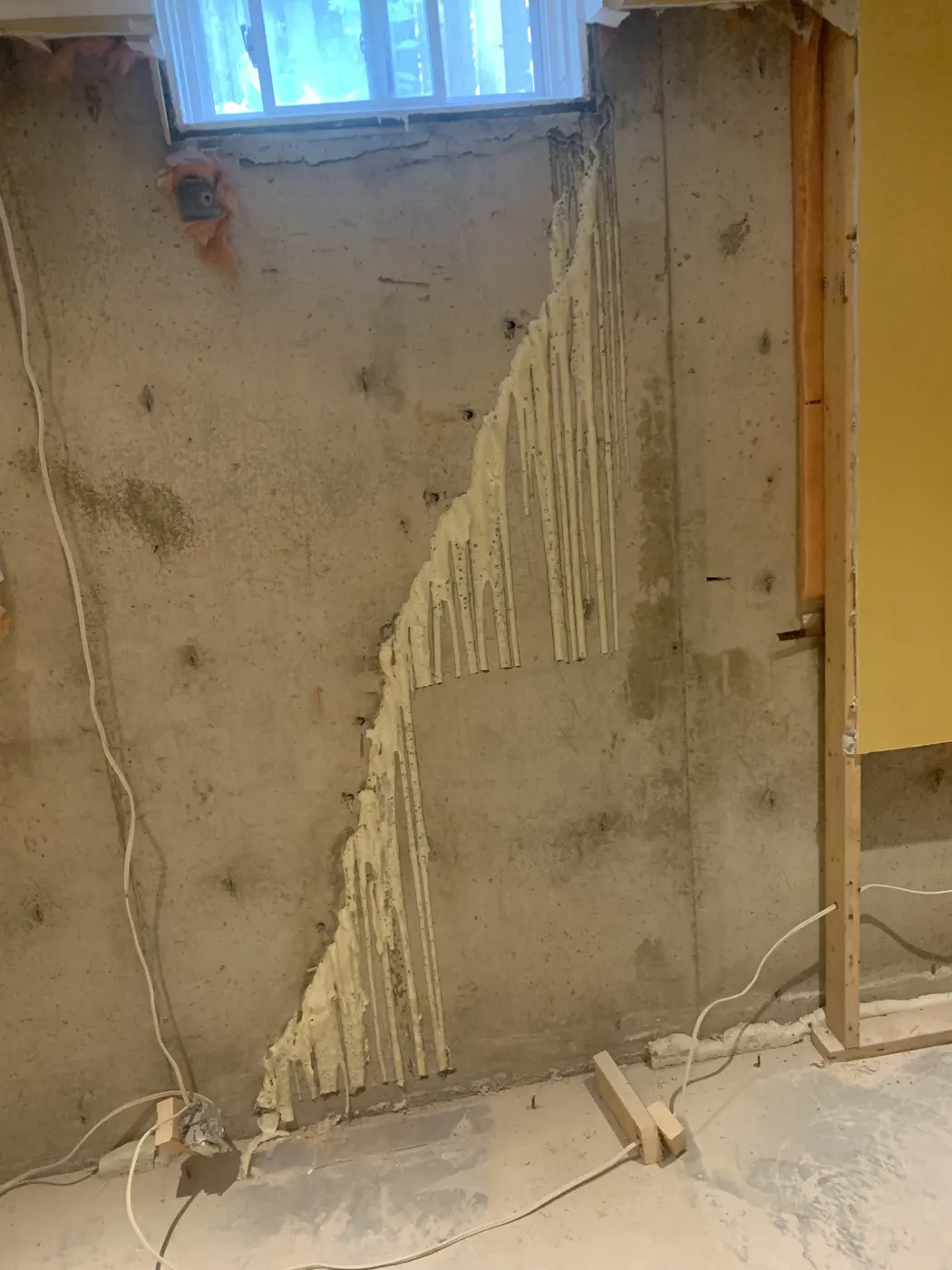
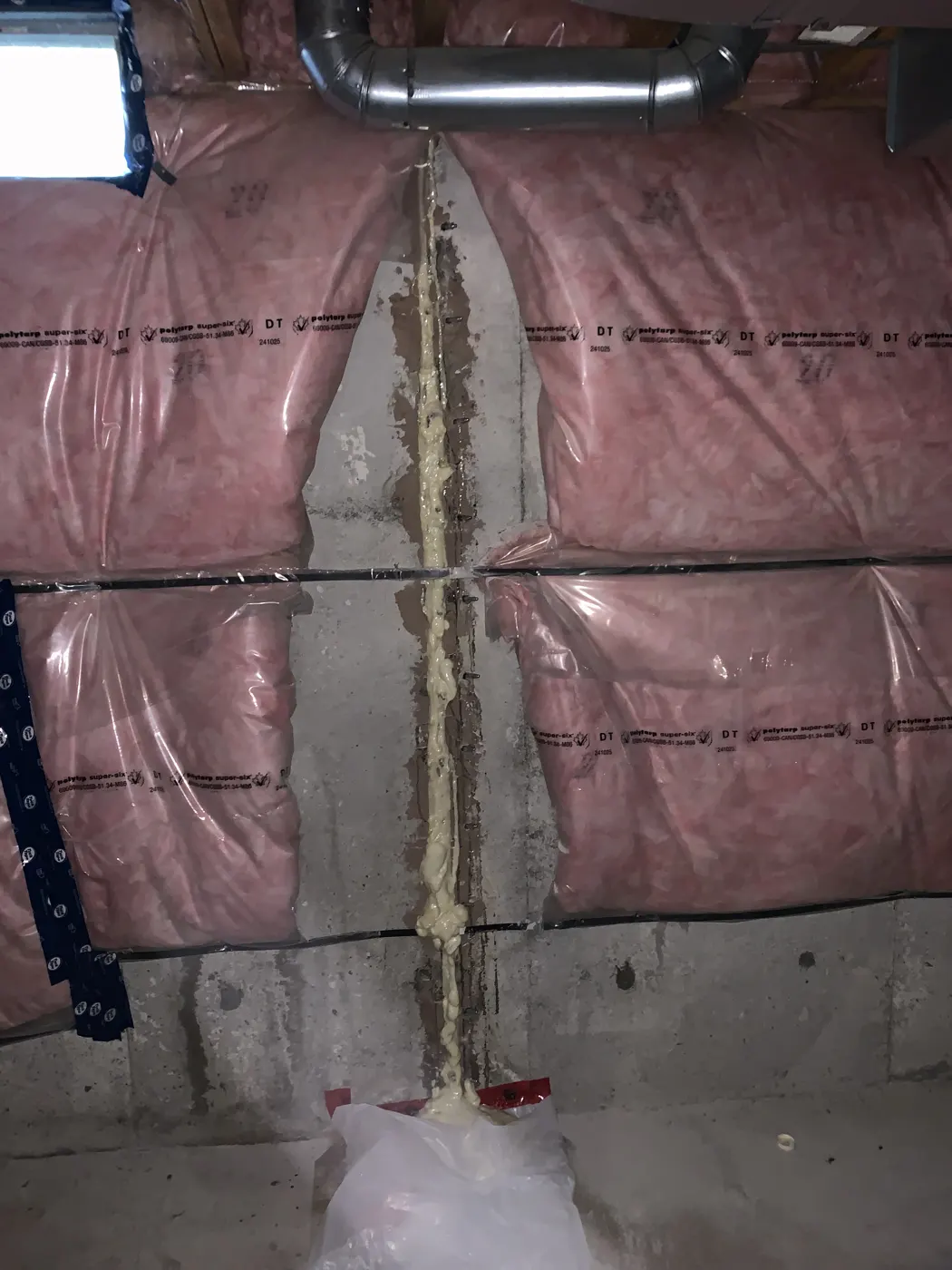
Two frames from recent jobs — the standard the warranty stands on.
Not inside a wall. Cured hydrophobic polyurethane is a stable, flexible polymer, and the conditions that age plastics — UV light, abrasion, oxygen cycling — are absent inside buried concrete. It keeps flexing with seasonal wall movement instead of fighting it, which is exactly why it is the resin of choice for leaking cracks. If a polyurethane repair leaks, suspect fill depth or a new crack before you suspect the material.
Properly mixed structural epoxy bonds stronger than the concrete around it — industry pull-off tests typically break the wall before the joint. It does not shrink meaningfully after cure. The realistic epoxy failure is choosing it for a crack that is still moving: rigid resin in a breathing crack can re-crack along the bond line. That is a diagnosis error on day one, not ageing.
No — a full-depth injection is a once-per-crack repair, and our transferable lifetime warranty exists because callbacks on properly injected cracks are rare. The every-few-years cycle belongs to surface patches and DIY kits, which seal the face of the crack and leave the void behind. If a contractor proposes scheduled re-injection, they are describing patching, whatever the invoice calls it.
Yes — freeze-thaw is the design condition, not an exception. Southern Ontario walls move slightly as soil freezes, thaws and swells with meltwater, and flexible polyurethane accommodates that movement season after season. Winter is also a fine time to do the work: injection happens from the basement side with no excavation, so February repairs are routine for our crews.
Yes. The warranty attaches to the injected crack in that foundation, not to you as the customer, so it transfers to the buyer — a selling point worth putting in the listing paperwork. Agents confirm transfers with one phone call. Keep the invoice with your home records; that plus the address is all a future owner needs.
Injection is engineered for poured concrete, where a single crack plane runs through solid material. Block walls leak differently — through hollow cores and mortar joints — and honest contractors say so rather than injecting anyway. If your wall is block, the assessment will point you to the right approach for that structure; the free visit costs nothing either way.
Installer shortcuts, in order of frequency: sealing the surface without filling the depth, choosing rigid resin for a moving crack, spacing ports too widely and missing branches, and skipping the movement diagnosis entirely. Every one is invisible in a finished photo and none is cheap to discover later — which is why the useful questions to ask a contractor are about depth, resin choice and warranty length, not price alone.
Where these claims come from, and where to go deeper.
Pricing and discount figures on this page are our own published rates, current at the review date above. The DIY benchmark comes from our kit-vs-professional comparison. Resin behaviour reflects manufacturer technical practice for hydrophobic polyurethane and structural injection epoxy as applied by our crews; failure patterns are first-party field observations from repairs across Toronto, the GTA and Southern Ontario.
Free assessment, honest resin choice, full-depth injection — and a lifetime transferable warranty that says so in writing.