
Crack injection for Whitchurch-Stouffville homeowners — Stouffville, Ballantrae, Musselman’s Lake, Gormley, Vandorf and the Oak Ridges Moraine hamlets. Priced per crack, in writing, warrantied for the life of the home.
Home › Service Areas › Whitchurch-Stouffville
Poured and block walls, basement floors, garage slabs, tie rod holes and cold joints — injected from inside the basement in a single visit, with no excavation and nothing dug up outside.
Short answer: a leaking crack in a Stouffville basement is normally injected from the inside in one visit, and the Town does not require a building permit for it — “repairs to leaking foundations” sits on Whitchurch-Stouffville’s own list of work that does not need a permit.
Most of Whitchurch-Stouffville sits on the Oak Ridges Moraine, on knobby hills between roughly 290 and 373 m above sea level. That sounds like good drainage, and at the surface it often is — but the moraine is a water machine. Under the surficial clayey silt till lies the moraine’s sand and gravel, and a confined artesian aquifer sits only 10 to 20 m below grade. Town-commissioned work off Ninth Line measured the seasonal high water table at 1.50 m below grade in April 2023, dropping to 2.76 m by that August. A basement wall here gets loaded and unloaded with the seasons, every year.
Good drainage on top, a pressurised aquifer underneath.
Whitchurch-Stouffville is moraine country. The Town sits across the Oak Ridges Moraine on knob-and-kettle hills between about 290 and 373 m above sea level, and a height of land runs through it: streams on the north side head for Lake Simcoe, while the southern headwaters feed the Rouge River and Duffins Creek on their way to Lake Ontario. The kettle lakes — Musselman’s Lake, Preston Lake and Van Nostrand Lake — are the visible evidence that the water table here is close to the surface in places. The Town draws about 5,500 cubic metres a day from five municipal wells, which is another way of saying the ground beneath these houses holds a great deal of water.
A hydrogeological assessment for the Town at Elm Road and Ninth Line (Shaver and MacGillivray, 25 June 2025) logged the sequence a Stouffville basement actually sits in: 150 mm of topsoil, then loose silty sand fill to 0.8 m, then clayey silt till — sandy, with trace gravel, brown, moist and very stiff — from 0.8 to 2.3 m, then saturated compact sand from 2.3 to 4.6 m. Standard penetration values across the profile ran from 1 to 90 blows, reaching 78 to 90 in the saturated sand below 4.6 m. A second Town-commissioned investigation at 5061 Stouffville Road (4 April 2025) found topsoil from 125 to 3,800 mm and clayey silt to silty clay till extending to between 9.0 and 37.1 m, over sandy silt to silty sand till in a compact to very dense state, with cohesionless water-bearing soils at various depths and sub-artesian conditions in them.
That is the mechanism. Your footings bear on very stiff till; immediately below it is saturated sand, and below that the moraine’s confined sand and gravel aquifer at 10 to 20 m, under pressure. The water table swings more than a metre between April and August. Concrete that shrinks as it cures, backfill that settles, and a wall that gets pushed and released seasonally will eventually open a crack — and then the water has a path. Bedrock plays no part in it: the Whitby Formation shale is roughly 100 m below the Site, and the Stouffville Road boreholes never reached rock at all. The crack is the problem, which is why sealing the crack is the fix.
What goes into the crack depends on whether it is moving or just leaking.
Most of what we see here is a wet, non-structural crack in a poured wall, and that is a polyurethane injection — a flexible resin that expands into a wet crack and keeps sealing as the wall moves with the seasonal swing in the water table. Where the crack has to carry load again, or where a horizontal crack suggests the wall has been pushed, we use epoxy, which bonds the two faces back into one slab. The types of foundation cracks page walks through telling them apart, and crack injection covers the method. We also seal tie rod holes and leaking cold joints, plus basement floor, slab and garage floor cracks. For condo and industrial work across York Region, see parking garages and commercial.
Two frames from our crews’ recent work.
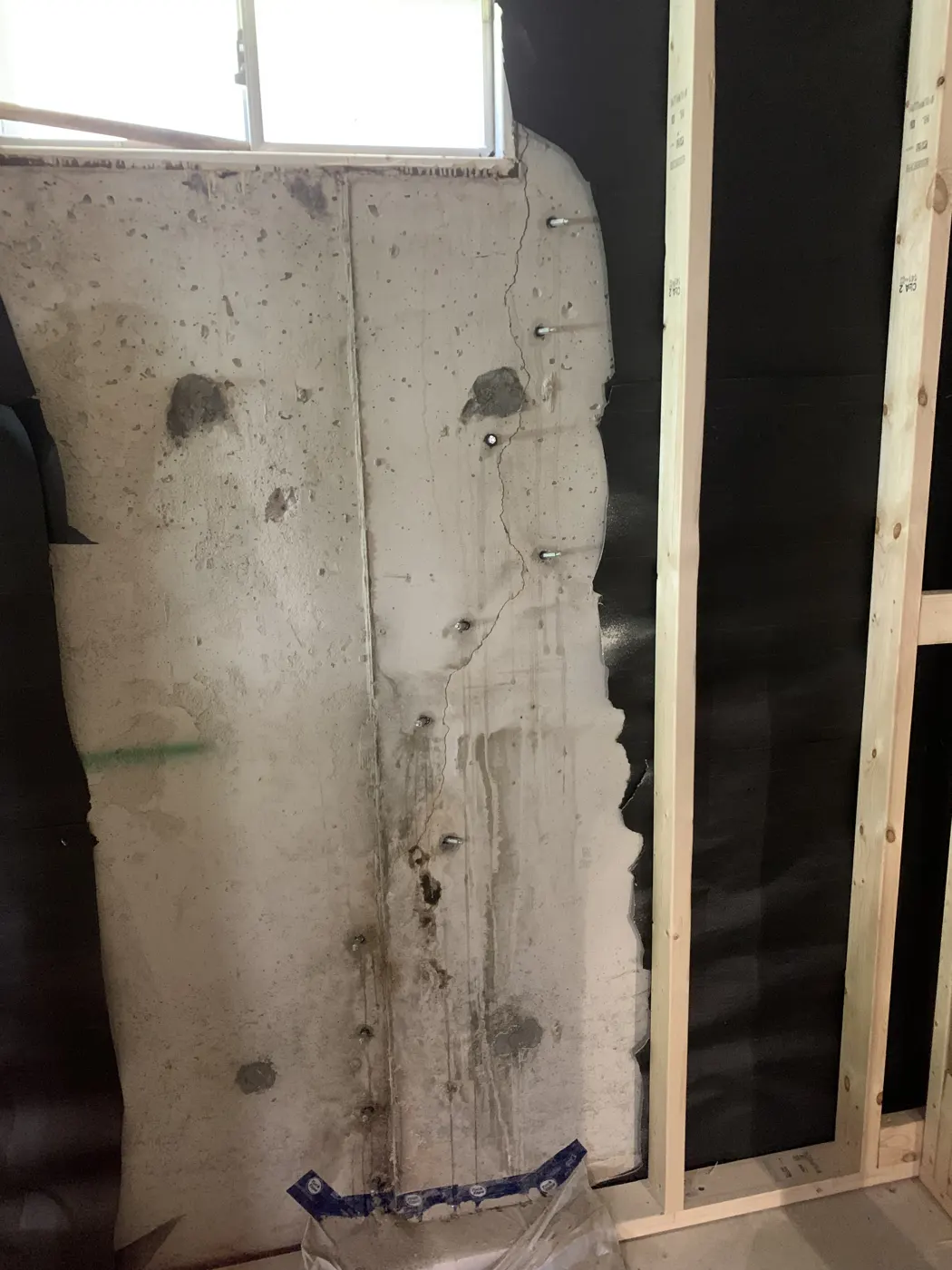
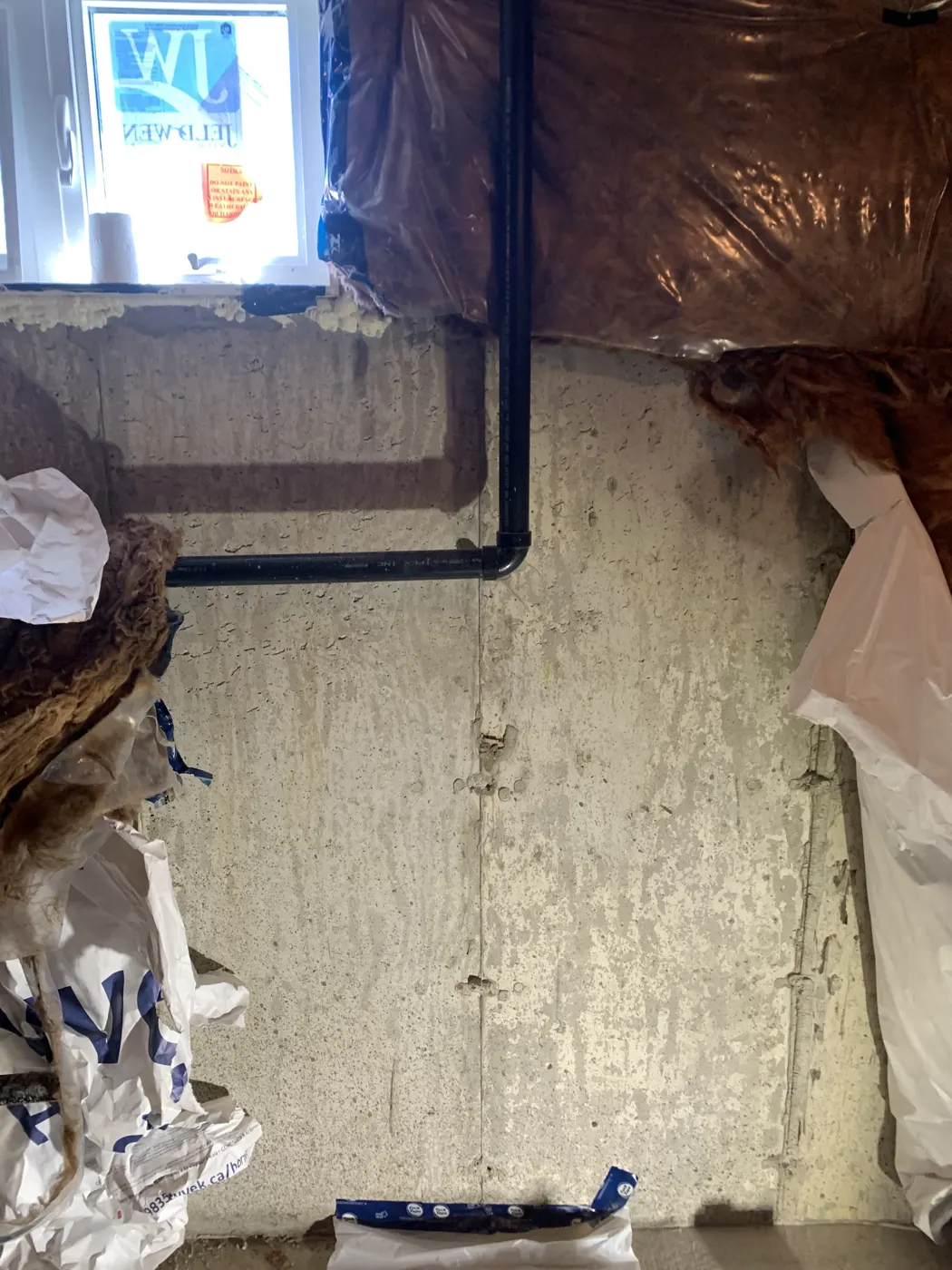
There is no Town subsidy for this, and we are not going to pretend otherwise.
| What homeowners ask | What the Town publishes | Pays for crack injection? |
|---|---|---|
| Is there a Town rebate for basement water? | No subsidy or rebate programme is published for repairs on private property | No |
| Who pays for private-side repairs? | “If there is sewage damage or a blockage on private property, the homeowner is responsible for the repairs” | No |
| Will the Town attend a private-side backup? | Yes, for a service fee of $487.00 during business hours or $685.00 after hours | No |
| Do permit fees apply to the repair? | No — repairs to leaking foundations do not require a building permit | No |
Elsewhere in the GTA there are municipal and regional programmes that help with basement flooding, and homeowners quite reasonably ask whether one applies here. Two things are worth knowing. First, we could find no Town of Whitchurch-Stouffville programme that contributes to foundation crack repair or waterproofing; the Town’s own position is that private-property repairs belong to the owner. Second, and more importantly, the regional programmes that do exist across the GTA — Peel’s backwater valve rebate, Durham’s basement flooding loan, the City of Toronto’s subsidy — all cover backwater valves and sump pumps. None of them covers foundation crack injection, because a valve and a pump address sewage backing up through your drains, not groundwater arriving through a crack in the wall under pressure. If you hear otherwise from a contractor, ask them to show you the programme in writing. The Town’s Customer Service line is 905-640-1900.
Ontario-wide warranty coverage that a lot of homeowners pay out of pocket to duplicate.
If your Whitchurch-Stouffville home is less than seven years old, water penetration through the basement wall may be the builder’s problem rather than yours. Tarion’s new home warranty covers it province-wide, and it applies in the newer subdivisions around Stouffville and Lincolnville exactly as it does anywhere else in Ontario. That matters here more than most places: Stouffville’s urban area has grown fast, and newer poured walls are where shrinkage cracks show up most, because the concrete is still curing and the backfill is still settling. The warranty window and the cracking window overlap heavily.
We would rather tell you that at a free assessment than quote you for something you already paid for in the price of the house. Bring your enrolment date; if you are inside the window we will say so.
Four questions, instant range — polyurethane or epoxy, multi-crack discount included, no obligation.
What the Town does and does not want permitted, and who to call to check.
Whitchurch-Stouffville publishes a clear list of work that does not require a building permit, and “repairs to leaking foundations” is on it — alongside window and door replacement at the same size, re-roofing with lightweight material, adding insulation and replacing plumbing fixtures that are not relocated. So the injection itself does not need a permit.
What does need one: basement entrances, second suites, decks and porches, residential renovations, garages and carports, demolition and septic systems. If you are injecting cracks before finishing the basement or adding a walkout, the finishing and the walkout are the permitted parts, not the injection. The Town’s Building Division is at 111 Sandiford Drive, Stouffville, 905-640-1900 ext. 2249, buildingpermits@townofws.ca, and they will confirm all of this for free. General Customer Service is 905-640-1900.
Priced per crack rather than per hour, and confirmed in writing first.
Four things move the number. Wall thickness and height set how much resin a crack takes, and the deep basements in the newer Stouffville subdivisions take more than the older, shallower ones in the village core and out at Ringwood. Whether the crack is dry, damp or actively running changes the resin and sometimes the port spacing — and on the moraine that can depend on the month you call, because the water table swings over a metre between spring and late summer. Access matters: a crack behind a finished wall, a furnace or a cold room means careful removal and reinstatement, and we say so before we start. And the count matters — most jobs here are one to three cracks, and the second and third cost less than the first because the crew and the pump are already on site. Rural properties at Ballantrae, Vivian, Bethesda or Musselman’s Lake are priced the same way; the drive does not change the per-crack rate. See crack injection cost for the real ranges.
All 206 square kilometres, village core to moraine hamlet.
Whitchurch-Stouffville covers 206.42 km² and about 49,864 people at the 2021 census, across roughly 16,707 occupied private dwellings — a density of 241.6 per km², with the great majority of that population, about 36,753, in Stouffville itself. Around 91 per cent of the housing stock is single-family, which is why nearly every call we take here is a residential basement. We cover Stouffville and the hamlets and lakeside communities across the Town: Ballantrae, Bethesda, Bloomington, Cedar Valley, Gormley, Lemonville, Lincolnville, Musselman’s Lake, Pine Orchard, Pleasantville, Preston Lake, Ringwood, Vandorf, Vivian and Wesley Corners. Properties on private wells and septic out on the moraine are no different to us — the repair is inside the basement either way. Nearby coverage: Markham, Richmond Hill and Newmarket.
The numbers behind the warranty.
A quarter-century of GTA basements kept dry.
Injection repairs warrantied for life — and the warranty moves with the house when you sell.
Full commercial coverage on every job, every crew, every home.
Eligible contractor for City of Toronto, Peel & Halton basement-flooding subsidy programs.
Inspection, honest diagnosis, and an exact per-crack quote — free, no pressure.
Your price is confirmed in writing before any work starts — no hourly surprises.
Every review below is a real, verifiable Google review of Concrete Crack Repair Pros. Nothing is paraphrased, and nothing is borrowed from a sister company.
Are these reviews genuine? Every review shown above is pulled live from the Concrete Crack Repair Pros Google Business Profile at 64 Millwick Dr, North York — not from a parent or sister brand’s listing. The rating and the count update automatically as new reviews arrive, so what you see here is what is on Google right now.
The same name, address and phone number we publish everywhere, so you can check us before you call.
No. The Town lists “repairs to leaking foundations” among the work that does not require a building permit, alongside window and door replacement at the same size, re-roofing with lightweight material and replacing plumbing fixtures that are not relocated. Basement entrances, second suites, decks and residential renovations do require permits — so if you are finishing the basement afterwards, that is the part that gets permitted, not the injection.
Because the moraine drains downward into a pressurised system rather than away. Under the surficial clayey silt till lies the moraine’s sand and gravel, with a confined artesian aquifer only 10 to 20 m below grade. Town-commissioned work at Elm Road and Ninth Line measured saturated sand from 2.3 m and a seasonal high water table of 1.50 m below grade in April 2023. Good surface drainage does not stop water pressing on a wall from below and behind.
We could find no Whitchurch-Stouffville programme that contributes to crack repair or waterproofing, and the Town states plainly that repairs on private property are the homeowner’s responsibility. The regional basement-flooding programmes that exist elsewhere in the GTA cover backwater valves and sump pumps rather than crack injection, because those devices address sewage backing up through drains, not groundwater entering through a crack.
The Town is split at the height of land. The Lake Simcoe Region Conservation Authority covers the northern part, within the Lake Simcoe watershed, and the Toronto and Region Conservation Authority covers the south, within the Humber and Rouge River watersheds. Neither has any role in an interior crack injection — their permits concern work near watercourses, wetlands, valleylands and floodplains, not sealing a crack from inside your basement.
Possibly the builder. Tarion’s new home warranty runs province-wide and covers water penetration through the basement wall for seven years, applying in the newer Stouffville and Lincolnville subdivisions as it does anywhere else in Ontario. Newer poured walls are also where shrinkage cracks appear most, because the concrete is still curing and the backfill still settling. Check your enrolment date before you pay anyone, us included.
Not for the injection itself, which happens entirely inside the basement and touches neither the well nor the septic bed. What it does change is the rebate question: programmes built around sanitary backwater valves assume a municipal sanitary lateral, so they are irrelevant to a property on septic. The per-crack price is the same out on the moraine as it is in the village; the drive does not change the rate.
The sources behind every number on this page.
A free written assessment, an exact per-crack price before we start, and a transferable lifetime warranty on the injection. Stouffville, Ballantrae, Gormley, Vandorf, Musselman’s Lake and every moraine hamlet in between.